
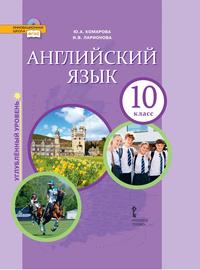
Английский язык: учебник для 10 класса общеобразовательных организаций. Углублённый уровень
Покупка
Новинка
Тематика:
Гуманитарные дисциплины. Школа
Издательство:
ООО "Русское слово-учебник"
Год издания: 2021
Кол-во страниц: 193
Дополнительно
Вид издания:
Учебник
Уровень образования:
Среднее общее образование
ISBN: 978-5-533-01739-8
Артикул: 803220.03.99
Доступ онлайн
365 ₽
В корзину
Учебник «Английский язык» углублённого уровня для учащихся 10 класса общеобразовательных организаций соответствует Федеральному государственному образовательному стандарту среднего общего образования, Примерной основной образовательной программе среднего общего образования, входит в систему учебников «Инновационная школа».
Аудиоприложение к учебнику размещено на сайте издательства «Русское слово» русское-слово.рф.
Тематика:
ББК:
УДК:
- 373: Дошкольное воспитание и образование. Общее школьное образование. Общеобразовательная школа
- 811111: Английский язык
ОКСО:
- Профессиональная подготовка по профессиям рабочих и по должностям служащих
- 00.01.02: Иностранный язык
- Среднее профессиональное образование
- 00.02.02: Иностранный язык
ГРНТИ:
Скопировать запись
Английский язык: учебник для 10 класса общеобразовательных организаций. Углублённый уровень, 2020, 803220.02.99
Английский язык: учебник для 10 класса общеобразовательных организаций. Углублённый уровень, 2019, 803220.01.99
Фрагмент текстового слоя документа размещен для индексирующих роботов
ФГОС
ИННОВАЦИОННАЯ ШКОЛА
Ю.А. Комарова
И.В. Ларионова
АНГЛИЙСКИЙ ЯЗЫК
Учебник для 10 класса
общеобразовательных организаций
Углублённый уровень
3-е издание
Допущено Министерством просвещения
Российской Федерации
Соответствует
Федеральному государственному
образовательному стандарту
Москва
«Русское слово»
УДК 373.167.1:811.111*10(075.3)
ББК 81.2Англ-10
          К63


 © Ю.А. Комарова, 2019, 2021


 © И.В. Ларионова, 2019, 2021
ISBN 978-5-533-01739-8

 © ООО «Русское слово — учебник», 2019, 2021
Комарова Ю.А.
К63
Английский язык: учебник для 10 класса общеобразовательных организаций. Углублённый уровень / Ю.А. Комарова, И.В. Ларионова. — 3-е изд. — М.: ООО «Русское слово — учебник», 2021. —
192 с.: ил. — (ФГОС. Инновационная школа).


ISBN 978-5-533-01739-8
Учебник «Английский язык» углублённого уровня для учащихся 10 класса общеобразовательных организаций соответствует Федеральному государственному образовательному стандарту среднего общего образования, Примерной основной образовательной программе среднего общего образования,
входит в систему учебников «Инновационная школа».
Аудиоприложение к учебнику размещено на сайте издательства «Русское слово» русскоеслово.рф.
УДК 373.167.1:811.111*10(075.3)
ББК 81.2Англ-10
Авторы:
Юлия Александровна Комарова, доктор педагогических наук, профессор, член-корреспондент РАО,
проректор по международному сотрудничеству Российского государственного педагогического университета им. А.И. Герцена;
Ирина Владимировна Ларионова, старший преподаватель кафедры иностранных языков СанктПетербургской академии постдипломного педагогического образования, почётный работник общего образования.
В создании учебника принимали участие Патриша Рейлли, преподаватель английского языка как иностранного, специалист в области повышения квалификации преподавателей английского языка, автор
учебных пособий по английскому языку, и Рой Норрис, преподаватель английского языка как иностранного,
автор учебных пособий по английскому языку и подготовке к международным экзаменам по английскому
языку.
Учебник включён в Федеральный перечень учебников в соответствии
с приказом Министерства просвещения Российской Федерации от 20 мая 2020 года № 254.
Student’s Book contents
1 FREE TIME


         page 6
2 STORIES


        page 18
3 SPORT FOR ALL


        page 30
4 MUSIC


        page 42
5 THE ENVIRONMENT


        page 54
6 SCIENCE FICTION?


        page 66
7 ART


        page 78
8 RELATIONSHIPS


        page 90
9 GENDER


        page 102


Progress check


        page 112


Grammar reference


        page 121


Writing reference


        page 133


Pronunciation


        page 142


Essential tips for the Unifi ed State Exam in English

        page 143


Unifi ed State Exam in English: Practice Tests


        page 148


Irregular verbs


        page 172


Dictionary


        page 174
P

G

W

P

E

U

I

D
Unit
Vocabulary
Reading
FREE TIME
page 6
  Present simple and present
continuous
  State verbs
  Present perfect simple (for,
since, just, already, yet)
  Now say it – exchanging
information
  Free time
  Adjectives of emotion
  Common collocations
  Comparatives and
superlatives
  Adverbs of frequency
  Happiness isn’t just
about money ...
  Strategy –
predicting
STORIES
page 18
  Past simple, past continuous and
past perfect simple
  Past simple and present perfect
simple (contrast)
  used to / would
  Now say it – talking about books
 Adjectives
  Phrasal verbs
  Adverbs of manner
  The never-ending
story ...
  Strategy –
skimming
SPORT FOR ALL
page 30
  Present continuous, be going to
and will
  Time clauses
  Future continuous and future
perfect
  Now say it – arranging to meet
 Sport
  Common collocations
  Negative adjective prefixes
  Gerunds
  Disabled or superabled?
  Strategy – topic
sentences
MUSIC
page 42
  Modal verbs: obligation, advice,
prohibition, possibility and
certainty
  can / be able to
  Modal perfects
  Now say it – giving advice
  Music
  Adjectives to describe
music
  -ed and -ing adjectives
  Compound adjectives
  The rhythm of
peace
  Strategy –
guessing the
meaning of
unknown words
THE
ENVIRONMENT
page 54
  Defining and non-defining relative
clauses
  Omission of relative pronouns
  Now say it – giving directions
  Environment
  Adjective suffixes
  Phrasal verbs
  Gerunds and infinitives
  be used to / get used to
  The concrete
jungle
  Strategy – difficult
words
SCIENCE
FICTION?
page 66
  First, second and third
conditionals
  Now say it – talking about
relationships
 Science
  Phrasal verbs
  Compound nouns
  ‘Science fiction’
today, ‘science
fact’ tomorrow?
  Strategy – key
words
ART
page 78
  The passive
  Transforming sentences from
active to passive
  have/get something done
  Now say it – talking about
appearance
  Art
  do and make
  Collocations
  The causative with make
  Art on the streets
  Strategy –
scanning for
specific information
RELATIONSHIPS
page 90
  Reported speech: statements,
questions, commands, requests
and suggestions
  Now say it – passing on
a message
 Relationships
  Phrasal verbs
  -ive, -y and -able adjectives
  Reporting verbs
  Have you heard ...?
  Strategy –
understanding
reference
GENDER
page 102
  Grammar review
  Now say it – complaining
  Nouns and gender
  Compound nouns and
adjectives review
  Gerunds and infinitives
review
  Gender balance
  Strategy – review
F
p
1
S
p
2
S
p
3
M
p
4
T
E
5
S
F
6
A
p
7
R
p
8
G
p
Contents
Listening
Speaking
Writing
  Solidarity
programmes
  Strategy –
recognising key
words
  Expressing preferences
  Strategy – justifying your
preferences
  An informal email
  Punctuation
  Connectors – and,
but, so, because

Maths
and

S
o
c
i
e
t
y

&

C
u
l
t
u
r
e
  Youth of today
  Graphic novels
  Strategy – using
questions to predict
content
  Talking about past
experiences
  Strategy – making sure
you have something to
say
  Retelling a narrative
  Participle clauses
  Connectors – time
expressions

Literature
and

S
o
c
i
e
t
y

&

C
u
l
t
u
r
e
  Nobel Prize
winners
 The X Games
  Strategy – using
available information
to predict content
 Giving an opinion
  Strategy – giving reasons
to support your opinion
  An opinion essay
  Connectors – cause
and effect

PE
and

S
o
c
i
e
t
y

&

C
u
l
t
u
r
e
  Virtual fitness
  Music as a form of
torture
  Strategy – listening
for specific
information
 Describing people
  Strategy – using
modifiers to sound polite
  A description of
a person
  Connectors – addition
and contrast (1)

Biology
and

S
o
c
i
e
t
y

&

C
u
l
t
u
r
e
  The orchestra of
peace
  Green architecture
  Strategy – listening
for the main idea
 Describing a place
  Strategy – adding
a personal evaluation
  A description of
a place
  Definite, indefinite and
no article

Ecology
and

S
o
c
i
e
t
y

&

C
u
l
t
u
r
e
  Eco-campaigns
  Ahead of their time
  Strategy – activating
prior knowledge of a
subject
  Agreeing and disagreeing
  Strategy – checking your
understanding of another
person’s point of view
  A for and against
essay (1)
  Connectors – addition
and contrast (2)

Physics
and

S
o
c
i
e
t
y

&

C
u
l
t
u
r
e
  Authors who
predict inventions
  3-D pavement art
  Strategy –
answering multiple
choice questions
  Describing a photograph
  Strategy – expressing
similarities and differences
  A biography
  Time expressions and
sequencing words and
phrases

Art
and

S
o
c
i
e
t
y

&

C
u
l
t
u
r
e
  Tourist art
  Cyber bullying
  Strategy – activating
passive vocabulary
  Giving and receiving news
  Strategy – expressing
surprise or disbelief
  A family story
  Inversion
  Using specific
language to describe
people and events

Psychology
and

S
o
c
i
e
t
y

&

C
u
l
t
u
r
e
  Social networking
sites
  Gender in business
culture
  Strategy – review
 Review
  Strategy – avoiding
repetition
  A for and against
essay (2)
  Common errors

Linguistics
and

S
o
c
i
e
t
y

&

C
u
l
t
u
r
  Gender in
schools in Britain
FREE TIME
1 Read the words. Which hobbies and free
time activities do you do?

read a book   surf the Net   hang out
go shopping   listen to music
play computer games   watch sport on TV
2 How many hours per week do you
spend doing each free time activity?
Compare your answers with a partner.

a – 0;  b – less than 2;  c – between 3 to 5;
d – more than 5
DID YOU KNOW?
The origin of the word hobby comes
from …
a a medieval toy horse.
b another word for occupation.
Reading
1 These key words appear in the text.
Read them and translate.
Use a dictionary to check the meaning
and pronunciation.

 • happiness   • experts   • health care
• citizens   • enjoyment   • psychologists
READING STRATEGY
PREDICTING
Use the title, pictures and key words to try and
get a general idea of what the text is about.
This means that when you read, you read to
check your guesses.
2a  Look at the title, pictures, and key words
in 1. Which ideas do you think the text
will discuss?
1 The things people do in their free time.
2 The things that make people happy.
3 The happiness of people in poor countries.
4  The happiness of people who win the
lottery.
 b  Read the text quickly and check your
guesses.
3 Choose the best answer according to the
text.
1 What does the text say about Denmark?
 a It is a surprising country.
 b It is a good place to go to learn things.
 c Positive Psychologists like it.
 d Its population lives very well.
2  What does the text say about money and
happiness?
 a People are happier when they are poor.
 b  Countries like Japan are happy because
they are rich.
 c  Governments give money to make people
happier.
 d  It is not clear whether money influences
happiness.
3 What does the text say about hobbies?
 a You need money to do them.
 b They are better than late night parties.
 c They can contribute to happiness.
 d  The Danish do them because the
government gives them money.
4 Answer the questions in your own words.
1  According to the survey, why is Denmark
a happy country?
2  According to the experts, what makes people
happy?
3  Why is ‘being busy’ not enough to be happy?
5 Find words in the text that mean …
1 infrequently. (paragraph A )
2 free time. (paragraph B)
3 a work of detailed study. (paragraph D)
4  helps someone to remember. (paragraph E)
isn’t just about
money …
C
The fi rst thing is that, although the least happy
countries in the world tend to be poor, money
isn’t everything. In fact, Japan, one of the world’s
richest countries, is number 90 on the list! This
is frustrating news for governments because
getting richer doesn’t mean we feel happier. In
Britain, for example, levels of happiness have
fallen over the last fi fty years even though it is
three times richer now than in the 1950s.
D
The second thing is that we feel happier when
we’ve got things to do; the Danish government
gives money to groups of citizens to take part in
hobbies. However, being busy is like spending
money, it doesn’t add up to happiness on its own.
This is because real happiness does not come
from moments of enjoyment, but from generally
feeling good with the other people in our lives.
Positive Psychologists think this explains some
of the surprising results from the recent research.
For example, teenagers in the USA prefer good
relationships with their friends and parents to the
buzz of late-night parties.
E
So, what does all this mean for the rest of us?
How happy are places like Britain? Positive
psychology reminds us that ‘enjoying the
moment’ is not as important as ‘being happy’.
So, go on, have a guess: who do you think are
generally happier, the British or ... ?
READ ALOUD
03 Find these words in the text. How do you pronounce them?
(1) [ˈreəli]  (2) [ˈɔːd(ə)n(ə)ri]  (3) [ˈhelθ ˌkeə]  (4) [njuːz]
(5) [bʌz]  (6) [ˈdʒen(ə)rəli]
25
30
35
40
45
50
A
What is happiness? It’s a question that we
often ask, but can rarely answer. We usually
think money makes us happy. We often think
about friends and family too. We sometimes
consider the way we spend our free time. But,
what about nationality? A British expert has
recently produced a map of the world showing
which countries know how to have a good
time … and which don’t.
B
According to this world map of happiness,
Denmark is the happiest place on the planet.
While many ordinary Danes were surprised by
this news, experts – including a group called
Positive Psychologists – weren’t. The things
that make Denmark a relaxing place to live,
they say, are a good balance between work
and free time, regular social contact, quality
health care, and interesting things for people
to do in their time off . No one is suggesting
that we all move to Denmark, but Positive
Psychologists think we can learn a thing or two
about how to have fun from the Danish.
5
10
15
20
DISCUSSION POINT
Buzz
(informal) a strong feeling of pleasure or excitement
Write three things that give you a buzz. Do they contribute to
your happiness?
I’m learning my lines for the school play at
the moment.
6  My friends and I are rarely buying CDs. We
are usually downloading music from the
Internet.
4a Read the verbs in the box. Which ones are
state verbs?
  practise   go   see   spend   belong   know
need   learn   think   work
STATE VERBS
!
Some verbs are used to describe states
(rather than activities). These include
sentiments (eg, love), opinions/beliefs
(think), possession (have) and senses (smell).
 b Complete the text with the correct form of
the verbs in brackets.

My friend Tony is a talented musician and
he (1) … (spend) a lot of his free time at the
music school, where he (2) … (go) to class
three evenings a week. He (3) … (learn) the
trumpet now but he already (4) … (know)
how to play the piano very well and I (5) …
(think) he can play the flute too. The trumpet
isn’t his – it (6) … (belong) to his sister, who
is also a musician, but she (7) … (work) as an
au pair in France this summer so she  (8) …
(not need) it at the moment. Currently, Tony
(9) … (practise) for a concert, so his other
friend, Andy, and I (10) … (not see) him very
often.
Present simple and present continuous
1 Match the sentences in the Grammar box
to the uses below.

a actions happening at the time of speaking

b routines

c facts and general truths

d temporary situations

e timetables

f  repeated actions that are annoying or
unexpected
2 Complete the sentences using the correct
form of the verb in brackets.
1  Paul’s upstairs in his bedroom. I think he …
(play) video games.
2  Every year we … (go) to France for our
holiday.
3  My sister … (always use) my clothes
without my permission.
4  I … (not do) any sport at the moment. I …
(have) a rest for a couple of months.
5  Children in Britain often … (spend) over
three hours a day watching TV.
6  The bus … (leave) at ten past every hour
except at weekends.
3 Correct any errors in the sentences. Use
the time expressions in bold to help you.
1  I’m really fed up – you’re always copying
my homework.
2  I usually go to basketball practice on
Wednesdays but this week I go on Tuesday.
3  I can’t talk now – I play on my new
computer console.
4 We’re going to be late! The film starts at 9.30.
1  Where’s Ben?
The film starts
at 9.
5 We’ve missed the film now – let’s
go on Thursday – new films come
out every Thursday.
2 He’s always
arriving late.
I’m so fed up!
3 Where are you? We’re
waiting for you.
8 No problem – you’ll be fine. You
always get ‘A’s’ in your exams.
4 I’m doing my
homework.
see page 16
I can’t! I know we
usually 6 go out
on Thursdays but
this month 7 I’m
studying for my
English exam every
Thursday.
NOW SAY IT
EXCHANGING INFORMATION
Present perfect simple
1 Someone has broken a window.
2 A: How long have you been on this course?
 B: I’ve been here for six months.
3 Andy has passed his exams.
4  We haven’t had a regular teacher since last
Christmas.
5 I’ve been to Sakhalin twice.
We use for to talk about a period of time.
We use since to talk about a point in time.
5 Match the sentences in the Grammar box
to the uses below.

a  a situation that started in the past and has
relevance in the present

b news of recent events

c  a past action that is relevant at the time of
speaking (or that has a result in the present)

d to talk about life experiences
6 Complete the sentences using the correct
form of the verb in brackets. Use the
present simple or the present perfect
simple.
1 We … (live) in this house since I was three.
2 David … (know) how to skate, but I don’t.
3 I … (not hear) this song for a long time.
4  How long … (you have) that dress for?
I … (never see) it before.
5 How often … (you, go) to the gym?
6 … (you, go) to Chicago?
JUST, ALREADY AND YET
!
They’ve just left.
She’s already seen the film.
I haven’t finished the book yet.
7 Read the text and complete it with the
correct form of the verb in brackets. Use
the other words to help you.
Researchers (1) … (just / carry out) a study
to discover what makes us happy. ‘We (2) …
(speak) to a wide range of people last week,’
said a research spokesperson. ‘Even though
we (3) … (yet / not collate) all the results,
we (4) … (already / make) some important
findings.’ Perhaps researchers (5) … (find)
the key to happiness after all.
8 Write sentences using the present perfect
simple.
1 James / not / do / his homework / yet.
2 How long / you / know / your best friend / for?
3 Lara / just / sell / her stamp collection.
4 We / not / speak / to Elisa / since / February.
5 I / already / hear / that joke.
6 Why / you / not / clean / your room / yet?
Mike  How (1) … (you, get on) in your new job at
the department store, Claire?
Claire  Not so bad, thanks. I quite (2) … (like) it.
I (3) … (work) in a different department
every week, so I (4) … (not have) two
weeks the same since I started.
Mike  That (5) … (sound) quite good.
Claire  Yes, it’s alright. Anyway, how about you? You
(6) … (study) for your A levels, aren’t you?
Mike  That’s right. It’s OK, but we (7) … (get)
loads of homework every day. My history
teacher (8) … (ask) us to write two essays
tonight.
Claire  Poor you! (9) … (you think) it was a bad
idea to stay on at school, then?
Mike  No, I don’t.  I (10) … (not earn) any money
at the moment, but …
a  Complete the dialogue using the
correct form of the verb in brackets.
b
04  Listen and check your answers.
c  Use the useful language to create your
own dialogue.
1
USEFUL LANGUAGE
!
How are you getting on …?
Not so bad / It’s alright / Really well / Don’t
ask!
It sounds quite good / great / terrible.
How about you? You’re … , aren’t you?
That’s right.
Poor/Lucky you!
Vocabulary
3 Copy the table and complete it with the
phrases below to make collocations.
p
have
take
spend
waste
a bad time
a break
• a bad time • a break • an hour’s rest • a laugh
•  an opportunity • your (free) time • a great time
• your pocket money • your morning • a rest
• fun • energy
see page 17
4 Write sentences about you using the
collocations in 3 and the hobbies and free
time activities on page 6.
I sometimes waste time watching sport on TV.
  b Complete the sentences about the bar chart
using words from 5.
1  According to the findings of a recent … , it’s
people, not activities, which make American
adolescents happy.
2   The … of adolescents say that spending time
with their boyfriend or girlfriend is what makes
them happiest.
3  The … of adolescents who spend time with
friends and parents is very high too.
4 … said celebrities made them happy.
5  The … number of hours that adolescents
spend online is 11.5.
6  There isn’t a significant … between surfing the
net and happiness.
7  Other factors that affect a … of adolescents
are reading magazines and watching TV.
Vocabulary in context > Maths
5 Read the words and phrases in the box.
How do you say them in your language?

majority   minority   correlation   average
less than half   survey   percentage
6a Look at the bar chart about American
adolescents. What makes them happiest?
And least happy?
spend time with their
girlfriend/boyfriend
spend time with
friends
spend time with
parents
talking to
teachers
learning about
celebrities
reading
magazines
watching TV
100
ACTIVITY
PERCENTAGE
Happy in the USA?
80
60
40
20
Interesting facts
•  Young people in the USA
spend approximately 11.5
hours per week online.
•  There is no statistical
relationship between
surfing the Net and
happiness.
84%
79%
74%
72%
49%
38%
33%
1 Complete the definitions below with
a word from the box.

enjoyable   relaxing   dull   exciting
interesting   frustrating
1  Something that makes you feel
annoyed and impatient is … .
2  Something that makes you feel less
tense is … .
3  Something pleasurable and fun, like
chatting to friends is … .
4  When something is … , it makes you
want to know more about it.
5 The opposite of 4 is … .
6  Going on a roller coaster or
something that gives you a sudden,
positive feeling is … .
2 Think of a hobby or free time
activity for each of the adjectives
in 1 then write sentences.
I find reading magazines very enjoyable.
READ ALOUD
a Find these words on the page. Where do you
think the stress falls?
  (1) [ɪndʒɔɪəb(ə)l]   (2) [ɪksaɪtɪŋ]   (3) [frʌstreɪtɪŋ]
(4) [ɪntrəstɪŋ]   (5) [rɪlæksɪŋ]
b
05  Listen, check and repeat.
A
H
Похожие Показать весь список
Доступ онлайн
365 ₽
В корзину