
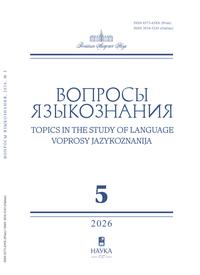
Вопросы языкознания, 2026, № 5
Покупка
Новинка
Тематика:
Общие вопросы. Лингвистика
Издательство:
Наука
Наименование: Вопросы языкознания
Год издания: 2026
Кол-во страниц: 162
Дополнительно
Доступ онлайн
1 276 ₽
В корзину
Тематика:
ББК:
УДК:
ОКСО:
ГРНТИ:
Скопировать запись
Фрагмент текстового слоя документа размещен для индексирующих роботов
            ВОПРОСЫ ЯЗЫКОЗНАНИЯ/
            TOPICS IN THE STUDY OF LANGUAGE


Журнал основан в январе 1952 года Выходит 6 раз в год
ISSN 0373-658Х (Print)
ISSN 3034-5243 (Online)
                Издается под руководством
Отделения историко-филологических наук РАН


        5

СЕНТЯБРЬ — ОКТЯБРЬ


Москва ФГБУ «Издательство «Наука» 2026
Главный редактор:

В. А. Плунгян д. ф. н., проф., академик РАН, Институт русского языка
              им. В.В. Виноградова РАН; Институт языкознания РАН

Зам. главного редактора:

Н.Б. Вахтин      д. ф. н., проф., чл.-корр. РАН, Европейский университет в Санкт-Петербурге;
                 Институт лингвистических исследований РАН
В. И. Подлесская д. ф. н., проф., Институт языкознания РАН

Редколлегия:

В. М. Алпатов       д. ф. н., проф., академик РАН, Институт языкознания РАН
И. М. Богуславский  д. ф. н., проф., Институт проблем передачи информации им. А. А. Харкевича
                    РАН; Мадридский политехнический университет, Испания
М. Д. Воейкова      д. ф. н., Институт лингвистических исследований РАН
В. 3. Демьянков     д. ф. н., проф., Институт языкознания РАН
Д. О. Добровольский д. ф. н., проф., Институт русского языка им. В. В. Виноградова РАН; Институт
                    языкознания РАН
А. Ф. Журавлёв      д. ф. н., Институт славяноведения РАН
П. В. Иосад         Ph.D., проф., Эдинбургский университет, Великобритания
Н.Н. Казанский      д. ф. н., проф., академик РАН, Институт лингвистических исследований РАН
В. И. Киммельман    Ph.D., проф., Бергенский университет, Норвегия
Г.И. Кустова        д. ф. н., проф., Институт русского языка им. В. В. Виноградова РАН
А. М. Молдован      д. ф. н., академик РАН, Институт русского языка им. В. В. Виноградова РАН
М.С. Полинская      Ph.D., проф., Мэрилендский университет, США
Е.В. Рахилина       д. ф. н., проф., Национальный исследовательский университет «Высшая
                    школаэкономики»; Институт русского языка им. В. В. Виноградова РАН
Я. Г. Тестелец      д. ф. н., проф., Российский государственный гуманитарный университет;
                    Институт языкознания РАН

Зав. редакцией: Н. В. Ганнус
Зав. отделами: А. С. Кулева, А. Д. Подгорная
Отдел рецензий: М. И. Сатина

Статьи отбираются редколлегией журнала на основе анонимного независимого рецензирования.
Индексируется в: Российский индекс научного цитирования (РИНЦ); Elsevier BV Scopus; European Reference Index for the Humanities and Social Sciences (ERIH PLUS); Russian Science Citation Index (RSCI); Web of Science Core Collection’s Emerging Sources Citation Index(ESCI).

        Адрес редакции: 119019, Москва, ул. Волхонка, 18/2, Институт русского языка им. В.В. Виноградова РАН, редакция журнала «Вопросы языкознания»
               Телефон: +7 495 637-25-16
                 E-mail: vopjaz@pran.ru, voprosy@mail.ru
                   Сайт: vopjazras.ru, vja.ruslang.ru


© Российская академия наук, 2026
ВОПРОСЫ ЯЗЫКОЗНАНИЯ/
TOPICS IN THE STUDY OF LANGUAGE (VOPROSY JAZYKOZNANIJA) Founded in January 1952 6 issues per year
ISSN 0373-658X (Print) ISSN 3034-5243 (Online)


SEPTEMBER — OCTOBER


Moscow «Nauka» Publishers» 2026
Editor-in-chief:

Vladimir A. PLUNGIAN Vinogradov Russian Language Institute (RAS);
                     Institute ofLinguistics (RAS)

Assistant editors:

Vera I. PODLESSKAYA Institute ofLinguistics (RAS), Moscow, Russia
Nikolai B. VAKHTIN  European University at St. Petersburg; Institute for Linguistic Studies (RAS),
                    St. Petersburg, Russia

Editorial board:

Vladimir M. Alpatov Institute ofLinguistics (RAS), Moscow, Russia
Igor M. Boguslavsky Kharkevich Institute for Information Transmission Problems (RAS), Moscow,
                    Russia; Universidad Politecnica de Madrid, Spain
Valery Z. DEMYANKOV Institute ofLinguistics (RAS), Moscow, Russia

Dmitrij O. DOBROVOL’SKIJ Vinogradov Russian Language Institute (RAS); Institute ofLinguistics (RAS), Moscow, Russia

Pavel IOSAD            University ofEdinburgh / Oilthigh Dhun Eideann, UK
Nikolai N. KAZANSKY    Institute for Linguistic Studies (RAS), St. Petersburg, Russia
Vadim KIMMELMAN        University ofBergen, Norway
Galina I. KUSTOVA      Vinogradov Russian Language Institute (RAS), Moscow, Russia
Aleksandr M. MOLDOVAN  Vinogradov Russian Language Institute (RAS), Moscow, Russia
Maria POLINSKY         University ofMaryland, College Park, USA
Ekaterina V. RAKHILINA HSE University; Vinogradov Russian Language Institute (RAS), Moscow,
                       Russia
Yakov G. Testelets     Russian State University for the Humanities; Institute ofLinguistics (RAS),
                       Moscow, Russia
Maria D. VOEIKOVA      Institute for Linguistic Studies (RAS), St. Petersburg, Russia
Anatoly F. Zhuravlev   Institute of Slavic Studies (RAS), Moscow, Russia

Managing editor: Natalia V. Gannus
Editorial staff: Anna S. Kuleva, Anastasia D. Podgornaia
Review editor: Maria I. Satina

Articles are selected by the editorial board on the basis of anonymous double-blind independent peer review process.
Abstracting/Indexing: Elsevier BV Scopus; European Reference Index for the Humanities and Social Sciences (ERIH PLUS); Rossiiskii indeks nauchnogo tsitirovaniya (RINTs); Russian Science Citation Index (RSCI); Web of Science Core Collection’s Emerging Sources Citation Index (ESCI).

                 Address: “Voprosy Jazykoznanija”, editorial office, Vinogradov Russian Language Institute (RAS), Volkhonka street, 18/2, Moscow, 119019, Russia
               Telephone: +7 495 637-25-16
                   E-mail: vopjaz@pran.ru, voprosy@mail.ru
                 Website: vopjazras.ru, vja.ruslang.ru
    Содержание

Проблемы современной армянской диалектологии

V. A. Plungian, М. G. Stepanyants. Armenian dialects: A typological crossroads (Guest editors’ preface)...........................7
Г. Г. Геворгян, | A.B. Варданян |. История и современные тенденции классификации диалектов армянского языка...................................11
B. Л. Катвалян, A. A. Гарибян. Процесс формирования диалектологического атласа армянского языка: региональные атласы...............................22
A. Ю. Саргсян, Л. Г. Маргарян, Ш. М. Минасян. Карабахский диалект армянского языка: фонетика и морфология....................................40
Y. Makarov, О. Sayeed, В. Vaux. Deconstructing glottalization, ejectivity, and breathy voice in Armenian dialects.....................................59
V. Khurshudyan, V. A. Plungian, М. G. Stepanyants. Mapping the future time reference in Standard Eastern Armenian and across the dialects.............81
S. Avetyan. The distribution and historical development of 3sg aorist endings in Armenian dialects.......................................................99
К. K. Lesniak. Specificational pseudoclefts in Nor-Nakhichevan Armenian.......120
V. A. Kagirova. The category of number and its expression in Hamshen Armenian.140
    Contents

Contemporary issues in Armenian dialectology

Vladimir A. Plungian, Maxim G. Stepanyants. Armenian dialects: A typological crossroads (Guest editors’ preface)...............................7
Gayane Gevorgyan, | Artak Vardanyan], History and recent developments in the classification of Armenian dialects.....................................11
Viktor L. Katvalyan, Alina A. Gharibyan. Compiling the Armenian dialect atlas: Regional atlases...............................................................22
Armen Y. Sargsyan, Lusine G. Margaryan, Shogher M. Minasyan. The Karabakh dialect of Armenian: Phonetics and morphology..................................40
Yury Makarov, Ollie Sayeed, Bert Vaux. Deconstructing glottalization, ejectivity, and breathy voice in Armenian dialects.........................................59
Victoria Khurshudyan, Vladimir A. Plungian, Maxim G. Stepanyants. Mapping the future time reference in Standard Eastern Armenian and across the dialects.81
Sargis Avetyan. The distribution and historical development of 3sg aorist endings in Armenian dialects...........................................................99
Kirill K. Lesniak. Specificational pseudoclefts in Nor-Nakhichevan Armenian....120
Vasilisa A. Kagirova. The category of number and its expression in Hamshen Armenian... 140
С./Рр. 7-10


    Armenian dialects: A typological crossroads (Guest editors’ preface)

© 2026                         Vladimir A. Plungian
Institute ofLinguistics, Russian Academy of Sciences, Moscow, Russia; plungian@iling-ran.ru; ORCID: 0000-0002-2393-1399

Maxim G. Stepanyants
HSE University, Moscow, Russia;
maximstepanyants@gmail.com; ORCID: 0009-0001-7634-0429

Acknowledgements: We are indebted to the anonymous reviewers for their shared expertise, to the authors for careful consideration of all the suggestions made during the preparation of the articles, and to thejournal’s editor for meticulous attention to the texts.
DOI: 10.7868/S3034524326050011


    Армянские диалекты: типологический лабиринт (Предисловие редакторов спецвыпуска)

Владимир Александрович Плунгян
Институт языкознания РАН, Москва, Россия;
plungian@iling-ran.ru; ORCID: 0000-0002-2393-1399

Максим Гургенович Степанянц
Национальный исследовательский университет «Высшая школа экономики», Москва, Россия; maximstepanyants@gmail.com; ORCID: 0009-0001-7634-0429

DOI: 10.7868/S3034524326050011


   The present special issue brings together contributions on Armenian dialectology. By way of background, Armenian is an Indo-European language that constitutes a separate branch of the family. Its oldest attested form, Classical Armenian (or Grabar), is well documented and has received considerable scholarly coverage. This historical record provides the baseline against which the later dialectal diversity can be measured. Historically, Armenian was spoken over a broad territory extending across the Armenian Highland in Transcaucasia and into adjacent areas. Throughout the period for which evidence is available, this mountainous region has been home to speakers of multiple unrelated—though converging [Donabedian, Sitaridou 2020]—languages, organized at various times into different political entities.
   As a result, the Modern Armenian continuum consists of highly divergent idioms. It comprises the Eastern and Western standard literary languages, alongside numerous varieties traditionally referred to as “Armenian dialects”. The natural accumulation and spread of dialectal features have been interrupted repeatedly by large-scale migrations and forced population displacements. Notably, following the events of the First World War, many Western Armenian varieties
have become moribund or extinct. Today a substantial number of Armenian speakers live in the Diaspora.
   Its diversity, contact history, and long written record make Armenian data exceptionally valuable for linguistic typology. Yet, despite this potential, research on Modern Armenian varieties—including their development through the Middle Armenian period—remains largely inaccessible to the international scholarly community, as most contributions are published in languages with limited circulation. Armenian dialects thus remain seriously underdescribed, even for scholars specializing in the Caucasus linguistic area. The literary languages are slightly better covered, but here, too, major lacunae persist: notably, no full-scale grammatical description of Standard Western Armenian has ever been published in English, aside from a handful of practical textbooks.
   Even scarcer are works in international languages of science that are specifically devoted to dialectology. These include the grammar of Iranian Armenian [Dolatian et al. 2023] and the debate on the Armenian consonantal system, which took place largely in the journal Voprosy Jazykoznanija [Zhirmunsky 1962]. Nevertheless, a number of useful concise overviews of Armenian dialectal data do exist [Djaukjan 1972; Weitenberg 2002; Ovsepyan, Gevorkyan 2013; Weitenberg 2017; Martirosyan 2019]. Among the most influential monographs are the pioneering study by Kerope Patkanov [1869]; Hrachia Acharyan’s “Classification...” [Adjarian 1909], then updated and published in Armenian [Acarean 1911]—the latter edition was recently translated into English with a commentary [Dolatian 2024]; and the handbook by John Greppin and Amalya Khachaturian [1986]. No doubt, there is a vast dialectological literature written in Armenian (mostly Eastern), and it is growing (see the recent contributions in the bibliographies of the articles collected in the present issue).
   A detailed overview of the current state of Armenian dialectology has been provided by Bert Vaux [2024]. Since then, some progress has been made, notably within the multivaria-tional corpus project DALiH (https://dalih.fr/), but mostly with regard to standard Armenian varieties. Despite ongoing research, there is still a lack of both comprehensive documentation and dedicated studies. For some dialects, the latest thorough descriptions date back to the Soviet period. Moreover, certain descriptive domains—such as syntax, grammatical semantics, and prosody—have traditionally received far less attention. Overall, Armenian dialectology is a vast field that calls for concerted international effort.
   The present issue is intended as a step in this direction, bringing together authors from academic institutions in Armenia, France, Russia, and the United Kingdom. The assembled contributions address a broad range of topics within Armenian dialectology, combining traditional Armenological methodology with recent advances in linguistic typology.
   The first two articles address broader issues: (i) Gayane Gevorgyan and Artak Vardanyan survey the various approaches to the classification of Armenian dialects; (ii) Victor Katvalyan and Alina Gharibyan describe the development of a dialectological atlas for Armenian.
   Furthermore, three articles are devoted to the typology of specific dialectal features: (iii) Yury Makarov, Ollie Sayeed, and Bert Vaux evaluate the elusive evidence for glottalization and breathy voice; (iv) Sargis Avetyan examines the various 3sg aorist endings across the dialects and traces their historical development; (v) Victoria Khurshudyan, Vladimir Plungian, and Maxim Stepanyants discuss the multiple strategies for expressing future time reference in Standard Eastern Armenian and across the dialects.
   The last three articles focus on specific dialects, though they are also informed by a broader perspective: (vi) Armen Sargsyan, Lusine Margaryan, and Shogher Minasyan offer a concise description of the phonetics and morphology of Karabakh Armenian; (vii) Vasilisa Kagirova examines the plural markers in Hamshen Armenian; and (viii) Kirill Lesniak studies the speci-ficational pseudocleft constructions in Nor-Nakhichevan Armenian.
   Throughout the present issue, the Armenian data are presented in a Latin-based script. Armenian has a unique alphabet, and the practice most widely adopted in linguistic literature for the transliteration of Armenian orthographies is the Hubschmann-Meillet system. It is best
Vladimir A, Plungian, Maxim G. Stepanyants


suited for Classical Armenian and for Standard Eastern Armenian, which preserves an archaic phonological inventory; even in the case of Standard Western Armenian, the transliteration is less transparent. Moreover, Armenian dialects have sounds that are absent from the standard varieties (and thus may lack a straightforward transliteration equivalent). The representation of such sounds requires amendments to the graphic system. Besides, the transliteration of a dialectological transcription based on the Armenian script—which itself can be more or less detailed and closer to the orthography—may introduce some ambiguity and practical difficulties. For example, the symbols ё and о (used for t and о in the dialectological notation) bear a macron, yet represent plain vowels /e I and /о I that do not contrast with any other mid vowels in length, contrary to what the macron might misleadingly suggest. For a detailed discussion of Acharyan’s seminal dialectological notation see Dolatian’s [2024: 31-40] commentary.
   Most contributors to the present issue adopt the Hubschmann-Meillet system. This choice ensures consistency between the transliteration of the literary languages (especially Classical Armenian) and dialectal data within a single text. More specifically, the contributors to articles (i), (ii), (iv), (v), and (vi) apply the Hubschmann-Meillet transliteration, sometimes with some straightforward modifications. The contributors to articles (iii) and (viii), by contrast, have opted to present their data in the International Phonetic Alphabet. The article (vii) uses a more complex strategy, described in the text. In all articles, the references originally in Armenian script are given in the Hubschmann-Meillet transliteration.
   It is hoped that the present issue will prove useful to both specialists in Armenian and ty-pologists with an interest in the linguistic diversity of the Caucasus.


REFERENCES

Acafean 1911 — Acafean H. Hay barbaragitut‘iwn: uruagic ew dasaworut'rwn hay barbarneri (barbara-gitakan k‘artёsov) [Armenian dialectology: A sketch and classification of Armenian dialects (with a dialect map)]. Moscow; Nor-Nakhichevan: Lazarev Institute of Oriental Languages Press, 1911.
Adjarian 1909 — AdjarianH. Classification des dialectes armeniens [Classification of Armenian dialects]. Paris: Honore Champion, 1909.
Djaukjan 1972 — DjaukjanG. B. Mnogopriznakovaya statisticheskaya klassifikatsiya armyanskikh dia-lektov [Multi-feature statistical classification of the Armenian dialects]. Voprosy Jazykoznanija, 1972, 4: 26-38.
Dolatian 2024 — Dolatian H. (ed.). Adjarian Is Armenian dialectology (1911): Translation and commentary . Berlin: Language Science Press, 2024.
Dolatian et al. 2023 — Dolatian H., Sharifzadeh A., Vaux B. A grammar of Iranian Armenian: Parska-hayeren or Iranahayeren. Berlin: Language Science Press, 2023.
Donabedian, Sitaridou 2020 — Donabedian A., Sitaridoul. Anatolia. The Routledge handbook of language contact. Adamou E., Matras Y. (eds.). London: Routledge, 2020, 404-433.
Greppin, Khachaturian 1986 — Greppin J.A. C., Khachaturian A. A. A handbook of Armenian dialectology . Delmar, New York: Caravan Books, 1986.
Martirosyan 2019 — MartirosyanH. The Armenian dialects: Archaisms and innovations; description of individual dialects. Bulletin of Armenian Studies, 2019, 5: 164-258.
Ovsepyan, Gevorkyan 2013 — OvsepyanL. S., GevorkyanG. G. Armyanskie dialekty (obshchii obzor) [Armenian dialects (a general overview)]. Yazyki mira: Reliktovye indoevropeiskie yazyki Perednei i Tsentral’noi Azii. Koryakov Yu. B., KibrikA. A. (eds.). Moscow: Academia, 2013, 320-334.
Patkanov 1869 — PatkanovK. Issledovanie o dialektakh armyanskogo yazyka. Filologicheskii opyt [Study of Armenian dialects. A philological investigation]. St. Petersburg: Imperial Acad. of Sciences Press, 1869.
Vaux 2024 — VauxB. Current state of Armenian dialectology. Adjarian’s Armenian dialectology (1911): Translation and commentary. Dolatian H. (ed.). Berlin: Language Science Press, 2024, 67-130.
Weitenberg 2002 — Weitenberg J. J. S. Aspects of Armenian dialectology. Present-day dialectology: Problems and findings. Berns J., van Marle J. (eds.). Berlin: De Gruyter Mouton, 2002, 141-158.
Weitenberg 2017 — Weitenberg J. J. S. The dialectology of Armenian. Handbook of comparative and historical Indo-European linguistics: An international handbook. Vol. 2. Klein J., Joseph B., Fritz M. (eds.). Berlin: De GruyterMouton, 2017, 1132-1146.
Zhirmunsky 1962 — Zhirmunsky V. M. Nekotorye itogi diskussii ob armyanskom konsonantizme [Some resultsof the discussionon Armenian consonantism]. VoprosyJazykoznanija, 1962, 5: 33-46.

Получено! received 18.05.2026

Принято!accepted 05.06.2026
Доступ онлайн
1 276 ₽
В корзину