
16+
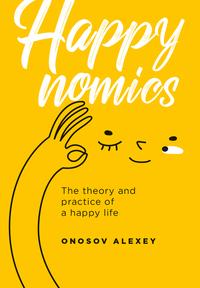
Happynomics: The theory and practice of a happy life
Покупка
Новинка
Основная коллекция
Издательство:
Альпина ПРО
Год издания: 2026
Кол-во страниц: 253
Возрастное ограничение: 16+
Дополнительно
Вид издания:
Практическое пособие
Уровень образования:
Дополнительное образование
ISBN: 978-5-00206-077-1
Артикул: 898118.01.99
Доступ онлайн
269 ₽
В корзину
Are you striving for greater happiness and life satisfaction, but you don't know where to start? Alexey Onosov, having conducted more than 500 interviews with successful entrepreneurs and studied mountains of literature, took out all the most valuable things from them and describes in detail all the steps to achieve sustainable happiness. His book is "Happinomics. Theory and Practice of a happy life" will give you a clear understanding of what happiness is and how to achieve it, as well as offer specific tools for working on yourself. After reading the book, you will be able to understand your true desires and take the first steps towards their realization.
And if you are experiencing difficulties in relationships with yourself or others, then the practices presented in the book will teach you effective communication techniques and help you build a more harmonious relationship. You will be able to apply the practical tips, exercises and proven techniques offered by the author immediately after reading. After all, according to the author, happiness is not an accident, but a skill that can be learned through regular training and practice.
Move from the position of victim to the position of creator of your life, take full responsibility for your happiness and actively work on yourself, regardless of external circumstances and the behavior of other people. The book has everything to ensure that you do not stray from your intended path and become a truly happy person!
Скопировать запись
Фрагмент текстового слоя документа размещен для индексирующих роботов
Happynomics
The theory and practice
of a happy life
© 2026 by Alexey Onosov
ISBN 978-5-00206-077-1
TABLE OF CONTENTS


Introduction ............................................... 5
Chapter 1. On your marks.................................... 9
Chapter 2. Truth .......................................... 13
Chapter 3. Happiness ...................................... 16
Chapter 4. Causes of unhappiness .......................... 24
Chapter 5. Success and/or happiness ....................... 46
Chapter 6. Happynomics .................................... 51
Chapter 7. System of axes.................................. 60
Chapter 8. Essence, personality, and subpersonalities...... 81
Chapter 9. Reason — a good servant, but a bad master ...... 90
Chapter 10. Habits......................................... 94
Chapter 11. Glossary ..................................... 104
Chapter 12. Brake, engine ................................ 140
Chapter 13. The happiness plan............................ 162
Chapter 14. The adversaries .............................. 165
Chapter 15. Techniques for personal happiness ............ 173
Chapter 16. Techniques for happiness in relationships .... 218
Conclusion ............................................... 244
Appendix ................................................. 247
Acknowledgements ......................................... 252
INTRODUCTION
One day, a young man asked a sage, “What is truth?”
The sage said nothing. Instead, he led the young man to a large mirror
covered with a heavy cloth. He pulled the cloth away, revealing the young
man’s reflection.
“What do you see?” the sage asked.
“I see myself,” the young man replied.
The sage covered the mirror again. “And now?”
“Nothing,” said the young man.
The sage nodded. “That’s truth. It’s always right in front of us — but we
often fail to see it. We cover it up with our fears, desires, and assumptions.
To truly see the truth, you must clear the mirror of your mind and be
willing to look into it without distortion.”
The young man stood in silence, thinking.
The sage continued, “Truth isn’t what we want to see. It’s what is. Only
by accepting that can we begin to find real happiness.”
Why does happiness matter so much?
If you’re not happy, chances are the people around you won’t be
either. Our emotional state rubs off — especially on our kids. They
pick up more than we think, and those feelings can echo through
generations, creating a legacy of unhappiness. Is that really what we
want to leave behind?
The idea for this book started taking shape back when I was helping run a business club. Over several years, I invited about a hundred
successful entrepreneurs to speak at our events.
That’s when something strange occurred to me. Not all
wealthy, successful entrepreneurs seemed genuinely happy. It
made me wonder: are success and happiness really the same
thing? And if they’re not, which one truly matters more? How
do you achieve a lasting sense of happiness?
Looking at the sometimes tense or tired faces of our guest speakers, I wasn’t always sure I’d want to trade places with them.
I started asking these questions to every successful entrepreneur
I met. After three years, one thing became obvious: there were way
more questions than answers. It bothered me so much that I launched
my own business club and put a lot of energy into it for about a year.
But eventually, I became frustrated with how little real progress I was
making. The process just didn’t feel effective.
For several years, I was on a mission. I tore through books like
crazy. At my peak, I was reading up to 50 a year, sometimes even
more. But strangely enough, the more I read, the less clarity I had.
What threw me off was that these respected, successful, and supposedly happy authors kept giving completely opposite advice. One
would say “slow down, reflect.” Another would say “push harder,
never stop.” It was all over the place. And honestly, it left me feeling
more confused than inspired.
What bothered me most was that many of these books could be
boiled down to a couple of short social media posts. To get to the
one useful idea, I had to dig through layers of theory, case studies,
and filler. And often, the gold nugget I was hoping for just wasn’t
there at all.
That’s when I started dreaming about writing a book packed with
value — no fluff, just concentrated insights that actually help.
Next, I turned to biographies of great people, thinking I might
find some answers there. At first, it looked promising. But after going through about a dozen, I did the math. If one biography took 10
hours to read, and considering my schedule, I’d barely get through a
few dozen a year. That just wasn’t going to cut it.
So, I started looking for short, high-impact collections of entrepreneur biographies. Something snappy and useful. To my
surprise, I found nothing like that in Russia or abroad.
All I could find were collections of quotes from famous philosophers — some of them translated into more than 30 languages, by
the way. And then there was Tim Ferriss’s Tribe of Mentors (2017),
which came close to what I was looking for, but still wasn’t quite it.
It featured not just entrepreneurs but all kinds of famous and accomplished people.
I spent a long time thinking about what to do next. Then, one
sunny day in Sochi, it hit me: what if I just did it myself? What if I
interviewed 100 or more successful Russian entrepreneurs, sat down
with each of them for an hour or two, and asked the one question that
really mattered — how do you become both happy and successful?
If I couldn’t find a condensed collection of real-life wisdom from
high-level players, maybe I could create one.
At first, things went pretty smoothly. But after just 10 interviews,
I realized the project was way bigger than I’d imagined. Still, I’m not
the kind of person who gives up once I’ve started something. I decided
to push through, no matter what.
Plenty of people told me I’d never be able to get in touch with
these top-tier entrepreneurs. Their time, after all, could be worth millions of rubles an hour. Why would they talk to me about happiness?
But that’s what kept me going. Almost every person I interviewed
was genuinely interested in the idea. They appreciated what I was
trying to do and thanked me for it. That gave me the energy to keep
pushing.
I kept the title simple: 100 Business Heroes. Statistically, only about
5 percent of businesses actually make it. And while that may not
sound heroic in the classic sense, there’s something undeniably heroic
about building something from the ground up and surviving.
A lot happened while I was working on the book — the pandemic,
business crises, family challenges. Life didn’t just knock the wind out
of me. It hit me with combinations — doubles, triples, even quadruples. More than once, I seriously considered quitting. The whole thing
took a huge amount of time, effort, and money.
But after three years of sheer willpower, I finally published the
book. It got great feedback from respected entrepreneurs and experts.
Turns out, I really had managed to pack it with value. In fact, it’s not
the kind of book you can binge-read. The best way to go through it
is one story per day — reflect, take something away, and apply it.
After publishing, I made it a habit to keep meeting with successful
entrepreneurs. To keep the momentum going, I launched a YouTube
Onosov Alexey
channel called Business Practices. It grew quickly and soon gained hundreds of thousands of subscribers.
Once I found my stride, I put together another book — this time
featuring members of a top-level business club. Then I got started on
a project about something like Amazon in scale and reach[1]. Honestly,
that one was pure luck. It all came down to the right connections, and
somehow I managed to get in touch with the marketplace’s founder.
Over time, we ended up organizing nearly 500 meetings with
entrepreneurs. And eventually, quantity started turning into quality.
Slowly but surely, I began to realize something: happiness is actually
a relatively simple thing — not easy, but simple. Like learning to play
the saxophone or climbing mountains. It’s a skill. And like any skill,
it can be learned. It just takes time and consistent practice.
The deeper I went, the more I felt the urge to write about happiness. But then came the classic excuse — no time.
Then came our long-awaited trip to Morocco. I brought my laptop
along, just in case. And something clicked. I realized this was it —
my window of opportunity. I knew another one like it wouldn’t come
around anytime soon.
From that moment on, I was in full-on writing mode. Whether
it was on a train, a plane, or a bus, I was glued to my laptop. I just
kept going. In fact, almost the entire book was written during that
trip to Morocco.
When I got back home, it hit me: I had to keep the momentum
going. So, I told everyone I knew that the book would be out in
a month. That was it — no turning back. I made a commitment I
couldn’t walk back from.
Then I started calculating the time needed for editing, layout,
printing. And I panicked a little. I realized I was seriously up against
the clock. I had to shift into high gear and give it everything I had
again.
But it was worth it. I managed to release the book exactly on
schedule.
ON YOUR MARKS
A patient walks into the doctor’s office and says,
“Doc, I’m ridiculously happy. Like, all the time. Is that… a problem?”
The doctor nods thoughtfully.
“Hmm. And how long have you been experiencing these… symptoms?”
I’ve always been curious about what was already out there on the
topic of happiness. Turns out, there are thousands of books with the
word “happiness” in the title, but almost all of them are fiction.
Finding serious, research-based material wasn’t easy. And even
when I did, it usually lacked substance. Most of the time, I’d come
across case studies or abstract theories that didn’t really connect to
everyday life. Sometimes one idea was stretched across the whole
book, padded with filler and buzzwords. A lot of it sounded more like
quantum physics than something practical.
Maybe one out of every ten books, or even one in twenty, actually
offered something useful you could apply in real life.
And even those were usually aimed at people who were already doing well emotionally, mentally, and physically. But what if you’re not?
What if you’re barely holding it together and still carrying around a lot
of unresolved trauma? In that case, even the best advice won’t stick.
First, you have to confront your inner demons and rebuild your
emotional strength. Only after that does the rest of the advice start
to work.
I watched just about every video I could find on the topic. I even
made it through Oscar Hartmann’s1 marathon-length podcast, the one
where he talks about what people need in order to be happy.
While working on the 100 Business Heroes book series, I made a
point of asking every entrepreneur the same question: What is happiness, and how do you achieve it? I asked that same question to every
guest on my Business Practices YouTube channel as well.
The more I explored the topic, the more I realized how little clear
and accessible information was actually out there. That surprised me
and pushed me to keep going. It felt like I had stepped into a wide
open space that barely anyone had mapped. It was a little intimidating, but also genuinely exciting.
Lately, I’ve made a habit of asking everyone I meet a simple question: What is happiness, really? And the wildest thing is, even people
who’ve lived full lives, who’ve seen and done it all, still struggle to
answer. Isn’t that something?
Everyone on the planet wants to be happy, yet almost no one can
clearly explain what happiness actually is. Most people just say it’s
a tough question, or that it means something different for everyone.
But I rarely get a clear or satisfying answer.
One response that really surprised me came from a smart,
successful, well-traveled person with a PhD and a wealth of life
experience. When I asked what happiness was, they simply said,
“I don’t know.” Sure, I’ve said the whole “I know that I know nothing” line myself. But when even smart, wealthy, and accomplished
people can’t explain what happiness is, it shows there’s a serious gap
in how we understand it. Some people say happiness is fleeting —
you either have it or you don’t, and there’s nothing you can do about
it. Like the weather. When the sun is out, we feel good. When it’s
stormy, we feel terrible. And we just accept that.
But what if that storm doesn’t pass? What if it stays cold and
windy not just for a day or a week, but for months or even years?
What if depression settles in for a decade, slowly tightening its grip?
For many people, that’s a reality. And often, there’s no clear reason behind it. The circumstances might seem fine, but the emotional
weight is still crushing. A bad mood that lasts a day or two is one
thing. But when it drags on for years, it becomes something else
entirely.
Похожие Показать весь список
Доступ онлайн
269 ₽
В корзину