
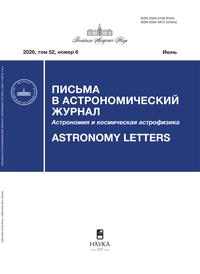
Письма в Астрономический журнал. Астрономия и космическая астрофизика, 2026, том 52, № 6
Покупка
Новинка
Тематика:
Астрономия
Издательство:
Наука
Год издания: 2026
Кол-во страниц: 84
Дополнительно
Доступ онлайн
3 585 ₽
В корзину
Тематика:
ББК:
УДК:
ОКСО:
ГРНТИ:
Скопировать запись
Фрагмент текстового слоя документа размещен для индексирующих роботов
ПИСЬМА В АСТРОНОМИЧЕСКИЙ ЖУРНАЛ
Астрономия и космическая астрофизика /
ASTRONOMY LETTERS

2026 Том 52 № 6
Основан в январе 1975 г. Выходит 12 раз в год ISSN 0320-0108 (Print) ISSN 0334-5812 (Online)
Журнал издается под руководством Отделения физических наук РАН

Главный редактор М.Р. Гильфанов
Редакционная коллегия И.Ф. Бикмаев, А.М. Быков, А.А. Вихлинин, Д.С. Горбунов, С.А. Гребенев (ответственный секретарь), А.В. Иванчик, В.В. Кочаровский, К.А. Постнов, С.Ю. Сазонов, Р.А. Сюняев, А.А. Токовинин, Н.Н. Чугай, Е.М. Чуразов, Л.Р. Юнгельсон

Зав. редакцией М.Л. Скоробогатова


Адрес редакции: 117342 Москва, ул. Бутлерова, д. 17Б, а/я 47 тел. +7 (495) 330-69-21
E-mail: pazh@pran.ru; pazh@pleiadesonline.com Сайт: https://pazhras.ru, https://pazh.cosmos.ru

Москва
ФГБУ «Издательство «Наука»


© Российская академия наук, 2026
                СОДЕРЖАНИЕ


Том 52, номер 6, 2026


Testing the Universality of Dark Matter Surface Density with Rotation Curves
  Israa Abdulqasim Mohammed Ali, Ahmed Hasan Abdullah                                       261

Поиск затмений рентгеновских источников компактными облаками Н₂ в гало Галактики
  А. В. Попкова, М. С. Пширков                                                              273

Ахроматическое плато гамма-всплеска GRB 210610В — следствие работы магнетара или результат столкновения ударных волн?
  Н. С. Панков, П. Ю. Минаев, А. С. Позаненко, В. В. Румянцев, А. С. Москвитин, В. Ким, С. Белкин,
  А. А. Вольнова, С.В. Назаров, О. А. Бурхонов, Ш.А. Эгамбердиев, А.Х. Кастро-Тирадо, Е. В. Клунко,
  М. А. Кругов, Р Я. Инасаридзе, М. Жужунадзе, О. А. Масленникова                           284

Логнормальное распределение длин групп солнечных пятен и их зависимость от площади группы
  А. А. Осипова, Ю.А. Наговицын, С. Н. Федосеева                                            324

Максимум 25-го солнечного цикла в контексте данных о солнечной активности
  М. Г. Огурцов                                                                             331
ПИСЬМА Б АСТРОНОМИЧЕСКИЙ ЖУРНАЛ, 2026, том 52, К 6, с. 261-272


            TESTING THE UNIVERSALITY OF DARK MATTER SURFACE DENSITY WITH ROTATION CURVES


© 2026 r. Israa Abdulqasim Mohammed Ali¹*, Ahmed Hasan Abdullah²
department of Remote Sensing, College of Remote Sensing and Geophysics College, Al-Karkh University of Science, Baghdad, Iraq ²Astronomy and Space, College of Science, University of Baghdad, Baghdad, Iraq
Поступила в редакцию 15.04.2026 г.
После доработки 22.06.2026 г.; принята к публикации 02.07.2026 г.

      We perform a systematic analysis of galaxy rotation curves using high-quality kinematic data from the SPARC database, focusing on a representative sample of 20 galaxies with extended 21-cm HI measurements that constrain the outer gravitational potential. The baryonic components: gas, stellar disc, and bulge are incorporated using the published SPARC mass decompositions to ensure consistent treatment of the luminous contribution to the rotation curves. We investigate three dynamical approaches under identical modeling assumptions: a baryonic model, a baryonic model supplemented by a cored pseudo-isothermal dark matter halo, and Conformal Gravity (CG). Model parameters are inferred using Metropolis-Hastings Markov Chain Monte Carlo sampling, while statistical performance is evaluated using reduced chi square /², the Bayesian Information Criterion (BIC), and residual diagnostics. Beyond individual galaxy fits, we found a population-level analysis of halo structural parameters by examining the relation between the halo core density p₀ and core radius r₀ and by testing the hypothesis of an approximately constant central dark-matter surface density p₀ = p₀r₀. Bootstrap and jackknife tests are employed to assess the robustness of this relation. Our results show that the GR framework with a cored dark-matter halo provides the most statistically consistent description of the SPARC rotation curves and supports the presence of an approximately universal dark-matter surface density across galaxies spanning a wide range of luminosities and disc scale lengths.

      Ключевые слова: dark matter, rotation curve, radio observation, galaxies

      DOI: 10.31857/S0320010826060016

1. INTRODUCTION
  The discrepancy between the rotation velocities of spiral galaxies and those predicted by Newtonian dynamics based on luminous matter remains one of the major outstanding problems in extragalactic astrophysics. The observation of galaxy rotation curves has shown that the rotation velocity is approximately constant over large galactocentric distance scales, even in regions where luminous matter is much less abundant. The initial radio-based observation of the 21-centimeter hydrogen line from neutral hydrogen (H I) provided the first indication of this problem by observing the kinematics of gas well beyond the optical disks of galaxies. These data showed that the gravitational potential derived from such rotation curves could not be accounted for by the baryonic mass distribution under classical gravitational laws (Rubin et al., 1980; Bosma, 1981; Sofue and Rubin, 2001; Ali, 2021; Ali et al., 2025).
  Over the past decades, substantial advances in observational techniques have resulted in increasingly accurate and homogeneous data on galaxy rotation curves. One of the most comprehensive sets of data presently available on the subject is the SPARC (Spitzer Photometry and Accurate Rotation Curves) database, which contains accurate rotation curves of nearby galaxies and precise photometric

   ’Электронный адрес: Israa.aq88@gmail.com

and baryonic mass models. The dataset includes extended H I kinematics and near-infrared photometry at 3.6 pm. This allows for the reliable decomposition of the baryonic mass into its stellar disk and bulge and gas components. Due to the accuracy of the data and the uniform data reduction strategy employed, the SPARC dataset has become the standard tool for testing theories of galaxy dynamics and gravitational physics on the galactic scale (Lelli et al., 2016; McGaugh et al., 2016).
   Within the context of the standard cosmological model, the apparent discrepancy between baryon mass distributions and rotation curves is taken as evidence for the presence of extended dark matter halos. Various parametric forms have been proposed for the density distributions of the dark matter halos. These include cuspy halos based on cosmological simulations and cored halos based on the observed properties of disk galaxies (Navarro, 1996; Begeman et al., 1991). Concurrently, a number of alternative theories of gravity have been proposed to account for the observed rotation curves without the need for dark matter. These include Conformal Gravity, which modifies the gravitational potential by the inclusion of universal linear and quadratic terms in the presence of the Newtonian term (Mannheim and Kazanas, 1989; Mannheim, 2006).
   Beyond fitting individual rotation curves, several studies have suggested that dark-matter halo parameters may

261
ISRAA ABDULQASIM MOHAMMED ALI, AHMED HASAN ABDULLAH

obey empirical scaling relations across galaxies. In particular, observational work has indicated that the product of the halo core density and core radius may remain approximately constant over a broad range of galaxy types, defining a central dark-matter surface density, p₀ = p₀r₀. The robustness and extent of universality of this relation also need to be quantitatively established for better comprehension of the inner structure of dark matter halos and for testing alternative explanations of galaxy dynamics.
   In the present paper, we carry out an extensive dynamical analysis of a representative subset of galaxies within the SPARC dataset based on the publicly accessible rotation curves and baryonic mass profiles. Three dynamical models are considered under the same set of observational constraints: baryonic model, a baryonic model supplemented by a cored pseudo-isothermal dark-matter halo, and an alternative Conformal Gravity model with universally set parameters. Parameters of the dynamical models were derived using Bayesian Markov Chain Monte Carlo sampling, while the performance of the models was tested using reduced chi-squared statistics %² * * * * * *, the Bayesian Information Criterion (BIC), Bayesian evidence, and residual diagnostics. Individual galaxy fits aside; we also perform an analysis on the population of the derived structural parameters of the halos. Of particular interest is the relation between the core density and the core radius of the halos and the distribution of the central dark matter surface density of the halos. Instead of directly assuming that the derived values of the halos’ structural parameters follow an exactly universal relation, we test if the derived values of the halos’ structural parameters, namely the values of the parameter p₀, follow a relation that is nearly constant and has limited scatter. To test the robustness of the derived relation, we also perform bootstrap resampling and jackknife tests.

2. SAMPLE DATA

The galaxy sample used in the analysis of the results presented in this work was obtained from the SPARC

database, which has high-quality rotation curves in addition to baryonic mass decompositions of nearby disc galaxies. However, instead of using the entire sample

of galaxies available in the database, a smaller sample

of a fixed set of 20 galaxies explicitly defined in the analysis pipeline was used in the analysis of the results. These galaxies include CamB, DDO154, IC2574, NGC3109, NGC3741, NGC2915, NGC2403, NGC3198, NGC6503,

NGC2976, NGC5585, NGC0024, NGC5055, NGC2841, NGC7331, NGC0891, NGC7814, NGC3953, F568-1, and F563-V2 (see Table 1). These galaxies have a wide range of luminosities and disc scale lengths, in addition to a variety of rotation curve shapes.

   The sample construction is tied directly to the requirements of the modelling code. Each galaxy is included only if the SPARC table provides the structural quantities required by the analysis, in particular the disc scale length Rd

Table 1. Summary of the galaxy sample used in this study

Galaxy  Rd(kpc) L 109 Lo    No.
                         of points
CamB     0.47    0.075       9
DDO154   0.37    0.053   12
IC2574   2.78    1.016   34
NGC3109  1.56    0.194   25
NGC3741   0.2    0.028   21
NGC2915  0.55    0.641   30
NGC2403  1.39    10.041  73
NGC3198  3.14    38.279  43
NGC6503  2.16    12.845  31
NGC2976  1.01    3.371   27
NGC5585  1.53    2.943   24
NGC0024  1.34    3.889   29
NGC5055   3.2   152.922  28
NGC2841  3.64   188.121  50
NGC7331  5.02   250.631  36
NGC0891  2.55    138.34  18
NGC7814  2.54    74.529  18
NGC3953  4.89   141.301      8
F568-1   5.18    6.252   12
F563-V2  2.43    2.986   10

and the 3.6-pm luminosity L ₃.₆, and if a corresponding rotmod mass-decomposition file is available in the local dataset. The rotation-curve data are then filtered to retain only physically usable measurements, requiring finite values of radius, observed circular velocity, velocity uncertainty, gas contribution, stellar disc contribution, and bulge contribution, together with R > 0 and strictly positive velocity errors. Galaxies with less than six valid radial points are not included. These criteria are imposed to allow the evaluation of all three dynamical frameworks and to provide a solid basis for the determination of the parameter constraints from the resolved rotation curves.

  The resulting subsample must thus be treated as a representative working sample, rather than a statistically representative subset of the full SPARC database. Instead, it is intended to offer a sufficient degree of variety in galaxy properties, while at the same time being computationally tractable for full galaxy-by-galaxy Bayesian inference. For each of the galaxies, the dark matter model is also examined via MCMC sampling. Extending the same full posterior analysis to all the galaxies in the SPARC sample would require substantial computational time. The selection of the specific set of 20 galaxies is seen to be a balance between data set diversity, data set quality, and computational time.
TESTING THE UNIVERSALITY OF DARK MATTER SURFACE DENSITY WITH ROTATION CURVES 263

3. METHODOLOGY
  The dynamical analysis performed in this work is based on the galaxy rotation curves provided by the SPARC database, where the published kinematic data are combined with the corresponding rotmod files that contain the baryonic mass decomposition for each galaxy. Instead of re-processing the original H I data, the current work is based on the data provided by the database, i.e., the circular velocity profile Vₒbₛ (R) and the corresponding errors, as well as the baryonic mass contributions from gas, stellar disc, and stellar bulge. This is due to the fact that the SPARC database is considered a standard benchmark for testing galaxy dynamics and mass models for galactic scales, as proposed by Lelli, McGaugh, & Schombert (Lelli et al., 2016; McGaugh et al., 2016). The modelling procedure is intended for a comparative analysis of the three dynamical models with the same statistical assumptions, which are the baryonic model, the baryonic model along with the cored pseudo-isothermal dark matter halo, and the Conformal Gravity model, separately for each galaxy without introducing any population-related considerations that can influence the dynamics of the galaxy itself.
  The baryonic contribution to the circular velocity is constructed from the gas, stellar disc, and bulge components contained in the SPARC mass-decomposition files. The stellar terms are scaled by a free stellar mass-to-light ratio at 3.6 pm, T₃.₆, assumed to be constant within each galaxy, so that the baryonic circular velocity is written as
V,ar(R) = VC(R) + Y3.6 [Ck(R) + F^(R)]•
  The use of 3.6 pm photometry is well justified because near-infrared luminosity provides a relatively stable tracer of the underlying stellar mass and is less sensitive to dust extinction and recent star formation than optical bands (McGaugh and Schombert, 2014). The baryonic model therefore serves as a transparent baseline against which the effects of additional halo or modified-gravity contributions can be tested.
  Within the dark-matter framework, the total circular velocity is obtained by adding the halo contribution in quadrature to the baryonic term,
V,t(R) =V C(R) + WR).
  The dark matter halo is described by a cored pseudoisothermal density profile. This parametrization is widely employed in the empirical study of the rotation curves of galaxies and is known to reproduce finite core densities and constant density cores in a number of low surface brightness and dwarf galaxies (Begeman et al., 1991; de Blok et al., 2001; de Blok and Bosma, 2002). The halo contribution is written as
Vhalo⁽R) = ⁴я GPoro² 1 ⁻ R taⁿ⁻¹ ⁽ R) . where pₒ is the central halo density and rₒ is the core radius. The free parameters of the dark-matter model are therefore T₃.₆, pₒ, and rₒ, with the halo parameters sampled in loga

rithmic space in order to improve numerical stability and posterior exploration over a broad dynamic range.
   As an alternative to the dark matter hypothesis, the so-called Conformal Gravity model is also considered. In the specific computational method employed in the present analysis, the CG circular velocity profile consists of the gas, stellar disc, and bulge components as well as the conformal gravity terms that include the discdependent term and the universal linear and quadratic terms. The specific formalism of the CG method is based on the formulation of conformal gravity and its application to the rotation curves of galaxies (Mannheim and Kazanas, 1989; Mannheim, 2006; O’Brien and Mannheim, 2012). The specific dependence on the stellar mass is based on the same free parameter T₃.₆, while the conformal gravity coefficients are universal. Thus, the specific CG method employs one free parameter per galaxy.
   Before fitting, the rotation-curve data are filtered to retain only physically usable measurements. The study requires finite values of radius, observed circular velocity, velocity uncertainty, and all baryonic contributions, together with R > o and strictly positive velocity errors. Galaxies with fewer than six valid radial points after filtering are excluded from the fitting stage. Parameter inference was performed under the assumption of independent Gaussian errors within a Bayesian framework. The baryonic model and the CG approaches required optimization of T₃.₆, while the dark-matter model sampled 9dm = (Y3.6> logioPo, logioro), under broad physically motivated priors. Posterior exploration employed an adaptive Metropolis-Hastings MCMC scheme Hastings, 1970), from which maximum a posteriori estimates were obtained.
   The likelihood function is defined through the standard Gaussian residual form, equivalently expressed through the chi-square statistic:

%² = S (—


V л,-r model,i

?У, i

) •

The reduced chi-square is then written as


                 A,=
Zred N - к

where N is the number of fitted radial points and к is the number of free parameters. Model comparison is performed using the Bayesian Information Criterion, BIC = %² + к ln N, following the standard formulation of Schwarz (1978). The relative preference between the dark-matter and conformal-gravity models is summarized through quantities such as ABIC = BICCG - BICDM, for which positive values favour the cored dark-matter halo model and negative values favour the CG model. In addition to BIC, Bayesian evidence is estimated through nested sampling, allowing direct computation of evidence differences such as A log ZDM = log ZDM - log ZCG. These evidence-based diagnostics will further supplement %2ₑd, BIC, and residuals in the final evaluation of the competing dynamical frameworks (Speagle, 2020). Moreover, the dark matter posteriors will be used to constrain
ISRAA ABDULQASIM MOHAMMED ALI, AHMED HASAN ABDULLAH

population-level halo properties via p₀, r₀, and the central dark matter surface density p₀ = p₀r₀.
   The analysis then examines the distribution of log₁₀ (p₀), the scaling relation between log₁₀(p₀) and log₁₀(r₀), and the dependence of p₀ on galaxy luminosity and disc scale length. To compare the global fitting quality of the three dynamical frameworks across the full sample, pooled fractional-residual diagnostics are also constructed from all fitted radial points. The fractional velocity deviation is defined as —-.
   Because a small number of galaxies may exert disproportionate influence on evidence histograms or populationlevel scaling relations, the final pipeline generates both raw and robust summaries. The raw outputs preserve all fitted systems, whereas the robust outputs are constructed using outlier-aware subsets identified with median absolute deviation diagnostics. Separate robust subsets are generated for the evidence differences, the p₀ distribution, and the p₀-r₀ scaling relation. This procedure does not alter the underlying galaxy-by-galaxy fits; rather, it affects only the high-level summary statistics and visualizations used to characterize the sample as a whole. The stability of the inferred p₀ relation is then examined using bootstrap resampling and jackknife leave-one-out tests applied to the galaxy-level values of log₁₀(p₀). In the current implementation, 5.000 bootstrap realizations and leave-one-out jackknife statistics are used to obtain stable estimates of the uncertainties and to test whether the dark-matter surface density relation inferred here represents the full sample rather than being dominated by a subset of extreme galaxies.

4. RESULTSAND DISCUSSION
4.1 Galaxy-by-galaxy rotation-curve fits
   Figures 1 and 2 display the reconstructed rotation curves for the 20 SPARC galaxies analysed in this study, with 10 galaxies shown in each panel. For every galaxy, the observed circular velocities and their associated error bars are compared with the best-fitting total rotation curves predicted by baryonic model, the baryonic plus cored darkmatter model and the Conformal Gravity model, together with the isolated halo contribution inferred from the darkmatter fit. The sample spans a broad range of dynamical environments, including dwarf galaxies such as DDO154 and NGC3741, gas-rich systems such as F563-V2 and F568-1, and more massive high-surface-brightness spirals such as NGC2841, NGC7331, and NGC7814.
   In most galaxies, the baryonic and cored-halo model reproduces the observed rotation curve over the full radial range with a high degree of consistency. This is particularly evident in systems showing a steep inner rise associated with the stellar disc and an extended outer region traced by H I kinematics. The separately plotted halo term further highlights the increasing dynamical importance of dark matter toward large radii, especially

in low-surface-brightness galaxies where the baryonic contribution declines rapidly.
   The Conformal Gravity model also improves substantially over the baryonic model and reproduces the overall amplitude of the rotation curve in a number of galaxies. In some systems, including NGC2403, NGC3198, and NGC6503, the CG curve remains close to the cored-halo total fit over a substantial radial interval. However, mild systematic differences are still visible in several cases, typically either in the detailed inner curvature or in the outermost radial behaviour. By contrast, the baryonic and cored halo model provides the most consistently accurate description across the heterogeneous sample. These galaxy-by-galaxy fits therefore show that, although both frameworks can reproduce the main kinematic trend in selected systems, the dark-matter model offers the most stable overall agreement with the observed SPARC rotation curves.

4.2  Statistical model comparison
   The visual hierarchy seen in the individual rotationcurve fits is fully consistent with the statistical diagnostics summarized in Table 2. For most galaxies in the sample, the baryonic model with a cored dark-matter halo yields substantially lower reduced %² values than the Conformal Gravity model, indicating a better overall match to the observed kinematics. This statistical advantage is frequently strong enough to compensate for the larger number of free parameters in the dark-matter framework. Although the halo model contains three free parameters per galaxy, (L₃.₆, p₀, r₀), compared with only one free parameter in the CG model, (L₃.₆), the resulting improvement in fit quality generally leads to positive values of ABIC = BICCG - BICDM, thus favouring the cored-halo interpretation for the majority of the analysed systems. A small number of systems remain inconclusive or show mild preference for the CG model.
   This work is reinforced by the global residual diagnostics shown in Figs. 3 and 4. In the cumulative fraction of fractional residuals (Fig. 3), the baryonic plus DM model rises much more steeply than both the baryonic and CG models, showing that a significantly larger fraction of all fitted data points is reproduced within small fractional-error thresholds. The residual-density diagram (Fig. 4) provides the same results in an alternative: the baryonic plus DM model generates a tighter concentration of points near low residual values over a wide range of galactocentric radii, whereas the baryonic model exhibits a much broader distribution and larger systematic deviations. The CG model again occupies an intermediate position, improving upon the baryons-only case but remaining less compact than the halo model.
   The evidence-based summary shown in Fig. 5 leads to the same qualitative interpretation. Most galaxies fall into categories favouring the baryonic plus darkmatter framework, and in many cases the preference is strong rather than marginal. Only a limited number
TESTING THE UNIVERSALITY OF DARK MATTER SURFACE DENSITY WITH ROTATION CURVES 265


0

80
70
60
50
40
30
20
10

50
40
30
20

10

140
120
100
  80
  60
  40
  20
   0

200
175
150
125
100
  75
  50

CamB | R d = 0.47 kpc

DDO154 | R d = 0.37 kpc

0       5       10      15     20 R, kpc

0.5        1.0       1.5        2.0 R, kpc

   Fig. 1. Rotation-curve reconstruction for the first ten galaxies of the sample. The observed circular velocities are shown with the error bars in comparison with the predictions by baryonic model, baryonic + cored-halo model, and Conformal Gravity model. The dashed curve represents the isolated contribution of the cored halo component from the dark-matter fit.

of systems remain inconclusive or show some preference for the CG model. Taken together, Table 2, Fig. 3, Fig. 4, and Fig. 5 indicate that the baryonic plus cored

dark-matter halo model provides the most statistically consistent overall description of the selected SPARC subsample.
ISRAA ABDULQASIM MOHAMMED ALI, AHMED HASAN ABDULLAH


NGC0024 | R d = 1.34 kpc


60

40

20

NGC5585 | R d = 1.53 kpc

   --- • Baryonic model
   --- Baryonic + cored halo
   -- CG
   - - Cored halo
Z  1 Observed

0

R, kpc

S

350
300
250
200
150
100
50 0

S

400
350
300
250

200

150
100
50

0    2.5 5.0 7.5 10.0 12.5 15.0 17.5 20.0

16 R, kpc

160
140
120
100
80
60
40
20
  0

175
150
125
100
75
50
25
  0

4      6       8     10      12     14     16

   Fig. 2. Second set of ten galaxies in the SPARC subsample.

   Table 3 presents the median values of the stellar mass-to-light ratio at 3.6 цт per individual galaxy and for the three models fit. The fitted values demonstrate a strong dependence on the dynamical model assumed. In particular, the baryonic model provides L₃.₆ values within the range

0.523-4.999, while the baryonic+cored halo model provides values from 0.038 to 4.238. The values derived using the CG model vary between 0.0007 and 4.520. High values of the Y₃.₆ obtained for some galaxies using the baryonic model may be explained by the need of the stars
Доступ онлайн
3 585 ₽
В корзину