
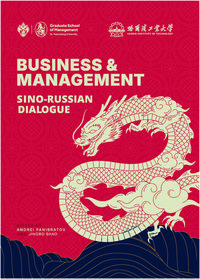
Business and Management: Sino-Russian Dialogue
Покупка
Новинка
Основная коллекция
Тематика:
Основы бизнеса
Издательство:
Санкт-Петербургский государственный университет
Год издания: 2026
Кол-во страниц: 249
Дополнительно
Вид издания:
Монография
Уровень образования:
Профессиональное образование
ISBN: 978-5-288-06538-5
Артикул: 895147.01.99
Доступ онлайн
831 ₽
В корзину
The collective monograph Business and Management: Sino-Russian Dialogue, edited by Professor A. Yu. Panibratov, presents a comprehensive analysis of the evolving strategic, economic, and institutional relations between China and Russia. Sixteen chapters, presented by leading scholars and practitioners from the two partner countries, discuss key aspects of bilateral cooperation, including the Belt and Road Initiative (BRI), the digitalization of countries, companies, and services, the implementation of the ESG agenda, and adaptation to the international business environment. The introductory chapter examines the BRI as a flexible and inclusive mechanism for globalization, using Russia as an example to illustrate its role in infrastructure development, trade facilitation, and geopolitical stability. Subsequent chapters explore empirical research on big data and green innovation, user behavior on digital platforms, and the development of digital logistics solutions to overcome institutional gaps in international trade. This monograph examines in detail sustainable development strategies in the context of technological competition, the financial implications of ESG ratings in mergers and acquisitions, and the pricing dynamics of yuan-denominated bonds in Russia. Institutional adaptation is explored through a comparative analysis of CSR disclosure, ESG compliance, and the transition to sustainable development in Russian and Chinese multinational enterprises. The book also examines sociocultural factors in tourism communications, policies to support small and medium-sized enterprises, and human resource management in the context of an aging population, offering recommendations tailored to national conditions. This monograph provides valuable insights into the mechanisms, challenges, and opportunities of Sino-Russian cooperation in business and management, serving as an important resource for scholars,
policymakers, and practitioners.
Тематика:
ББК:
УДК:
ОКСО:
- ВО - Бакалавриат
- 38.03.01: Экономика
- 38.03.02: Менеджмент
- ВО - Магистратура
- 38.04.01: Экономика
- 38.04.02: Менеджмент
ГРНТИ:
Скопировать запись
Фрагмент текстового слоя документа размещен для индексирующих роботов
ST. PETERSBURG  STATE  UNIVERSITY
Business and Management:
Sino-Russian Dialogue
Edited by
A.  Panibratov (Editor in Chief), J.  Shao
ST. PETERSBURG  UNIVERSITY  PRESS
ISBN 978-5-288-06538-5
©  St. Petersburg State University, 2026
УДК	 517.9:(0.75.8)
ББК
22.16
R e v i e w e r s:
Dr. Sci. in Economics, Professor S. F. Sutyrin (St. Petersburg State University),
Dr. Sci. in Economics, Professor S. L. Tkachenko (St. Petersburg State University)
E d i t o r s:
A.  Panibratov,  J.  Shao
A u t h o r s:
A. Abdulmanova, Yu. Aray, R. Bai, K. Bogatyreva, M. Bovsha, A. Budarin, Sh. Chen, A. Dalal,
D. Dmitrieva, L. Ermolaeva, Yu. Fan, F. Gao, O. Garanina, W. Guo, D. Klishevich, M. Latukha, J. Li,
M. Li, E. Nazarenko, Yo. Ogawa, V. Okulov, A. Panibratov, E. Rogova, A. Roman, J. Shao, E. Shirokova,
M. Smirnova, I. Staroverova, E. Valko, H. Wang, Sh. Wang, Yu. Wang, Sh. Wu, K. Yan, E. Zavyalova,
Yu. Zhang, Zh. Zhou, X. Zhu, D. Ziukova
Business and Management: Sino-Russian Dialogue: monograph /  ed. by
Andrei Panibratov and Jingbo Shao. — St. Petersburg: St. Petersburg University
Press, 2026. — 248 p.
ISBN 978-5-288-06538-5
The collective monograph Business and Management: Sino-Russian Dialogue, edited by
Professor A. Yu. Panibratov, presents a comprehensive analysis of the evolving strategic, economic, and
institutional relations between China and Russia. Sixteen chapters, presented by leading scholars and
practitioners from the two partner countries, discuss key aspects of bilateral cooperation, including
the Belt and Road Initiative (BRI), the digitalization of countries, companies, and services, the implementation of the ESG agenda, and adaptation to the international business environment. The introductory chapter examines the BRI as a flexible and inclusive mechanism for globalization, using Russia
as an example to illustrate its role in infrastructure development, trade facilitation, and geopolitical
stability. Subsequent chapters explore empirical research on big data and green innovation, user behavior on digital platforms, and the development of digital logistics solutions to overcome institutional
gaps in international trade. This monograph examines in detail sustainable development strategies in
the context of technological competition, the financial implications of ESG ratings in mergers and
acquisitions, and the pricing dynamics of yuan-denominated bonds in Russia. Institutional adaptation
is explored through a comparative analysis of CSR disclosure, ESG compliance, and the transition to
sustainable development in Russian and Chinese multinational enterprises. The book also examines
sociocultural factors in tourism communications, policies to support small and medium-sized enterprises, and human resource management in the context of an aging population, offering recommendations tailored to national conditions.
This monograph provides valuable insights into the mechanisms, challenges, and opportunities
of Sino-Russian cooperation in business and management, serving as an important resource for scholars, policymakers, and practitioners.
УДК 517.9:(0.75.8)
ББК 22.16
The publication was funded by the St. Petersburg Regional Public Foundation
“Charitable Foundation for the Development of the Graduate School of Management
of St. Petersburg State University”.
Contents
Foreword to the monograph “Business and Management:
Sino-Russian Dialogue” (Olga Dergunova).....................................................
Brief Overview of Chapter Themes and the Authors’ Contribution.............................
7
Introduction. Framing the Dialogue (Andrei Panibratov)..............................................
11
Chapter 1. Bridging Eurasia: Sino-Russian Cooperation under the BRI
(Andrei Panibratov, Chen Shenglong)...............................................................
14
Chapter 2. The Impact of Big Data Policies on Corporate Green Innovation
(Bai Rui, Li Jiaqi)................................................................................................
23
Chapter 3. The Impact of Multi-Account Operation on User Stickiness
on Online Video Platforms (Shao Jingbo, Zhu Xuanchen,
Zhou Zhuowen)...................................................................................................
34
Chapter 4. Digitalization as a Trade Facilitator for the BRI Partners:
Implications for the Sino-Russian Logistics (Gao Feiyi,
Andrei Panibratov, Elena Shirokova, Wang Yunping).....................................
47
Chapter 5. How Do Firms Maintain and Drive Sustainability Amid
Technological Turbulence? (Guo Wanting, Marina Latukha)......................
57
Chapter 6. ESG Ratings and their Impact on M&A Performance in
the Markets of China and Russia (Elena Rogova, Alfiya Abdulmanova).....
69
Chapter 7. Drivers of Foreign-Currency Bond Pricing: Evidence from
the Yuan-Denominated Market in Russia (Adel Dalal,
Aleksandr Budarin, Vitaliy Okulov)..................................................................
80
Chapter 8. The Influence of Geopolitical Risk on Inflation in
the Russian Federation (Ekaterina Valko, Li Meng).......................................
91
Chapter 9. Sustainability Transitions of Russian Multinationals:
Institutional Pressures Amid China’s Rise (Olga Garanina,
Daria Ziukova)....................................................................................................	 106
Contents
Chapter 10. CSR Disclosure of Russian and Chinese Companies:
The Impact of State Ownership and Financial Performance (Yulia Aray,
Diana Dmitrieva, Karina Bogatyreva, Yohei Ogawa).....................................	 121
Chapter 11. The Typology of Approaches to Study the Impact of Social
Responsibility on Consumer Behavior: Russian and Chinese Contexts
(Ekaterina Nazarenko, Maria Smirnova).........................................................	 134
Chapter 12. Livestream Marketing: A Systematic Literature Review and
Future Directions (Wang Shuqi, Wang Honglong, Wu Shaohui,
Zhang Yuhan)......................................................................................................	 146
Chapter 13. Managing Market-Based Assets: The Case of Russian and
Chinese Markets (Maria Smirnova, Irina Staroverova).................................	 163
Chapter 14. SME Support Policies through the Eyes of Entrepreneurs:
A Russia–China Comparison (Liubov Ermolaeva, Daria Klishevich,
Artem Roman).....................................................................................................	 176
Chapter 15. The Influence of Sociocultural Factors on Business Communications
in the Tourism Industry (Maria Bovsha, Elena Zavyalova)..........................	 188
Chapter 16. Are Employees Too Old to Work? Human Resource Management
Practices for the Aging Population in China and Its Implications for
the Russian Context (Marina Latukha, Fan Yuanxing, Yan Kaifeng)..........	 199
Afterword..............................................................................................................................	 212
Acknowledgement...............................................................................................................	 214
Literature	...............................................................................................................................	 215
About the Authors...............................................................................................................	 245
Foreword to the monograph
“Business and Management:
Sino-Russian Dialogue”
Today, the speed of global transformation has dramatically accelerated. Business now operates in an environment characterized by geopolitical tensions, technological rivalry, reorganization of trade routes, and new expectations about climate
policy and social responsibility. In such context, academic analysis and thoughtful
reflection become critically important tools for both corporate leaders and public
officials. This is why the volume “Business and Management: Sino-Russian Dialogue” represents particular relevance for the business community.
The strategic partnership between China and Russia has evolved into one
of the key pillars of Eurasian economic development. For companies navigating
these markets, understanding the broader institutional and policy context is now
a practical necessity. The chapters presented in this book shed light on the mechanisms that shape cooperation between the two countries — from mega projects
such as the Belt and Road Initiative to the fine-grained dynamics of digital transformation and corporate sustainability.
The value of this collective work lies not only in the breadth of topics covered
but also in the composition of its authors. The research was prepared with the
support of VTB Bank, for whom the development of scientific-practical knowledge and strengthening collaboration between Russian and Chinese scholars is
a key strategic priority. The work was carried out in partnership with the Bank’s
strategic academic partner — the Graduate School of Management at St. Petersburg State University (GSOM SPbU) — and one of China’s leading universities,
the Harbin Institute of Technology (HIT), which plays a crucial role in developing interaction between the PRC and the Russian Federation at the level of
Heilongjiang Province.
The authors examine issues that are directly connected to the daily decisions
of business leaders: the modernization of logistics corridors, the growing role
Foreword to the monograph “Business and Management: Sino-Russian Dialogue”
of digital platforms, the implications of ESG requirements for long-term investment, and the financial dimensions of yuan-denominated instruments in the
Russian market. These topics are discussed not in isolation but as interconnected
components of a wider strategic landscape.
This monograph stands out for its combination of academic depth and practical orientation. It offers readers a structured understanding of the forces shaping
Sino-Russian cooperation and highlights opportunities that arise from coordinated development. For the private sector, it provides a foundation for long-term
strategic planning; for policymakers, it offers evidence-based perspectives that
can inform future decisions.
Being involved in both business and public administration processes, I welcome the publication of the monograph “Business and Management: Sino-Russian Dialogue”. It makes a significant contribution to the ongoing dialogue about
how our two countries can jointly build stable and forward-looking economic
partnerships. I am confident that this work will prove valuable to executives, analysts, and officials seeking to better understand the evolving landscape of Eurasian cooperation.
Olga Dergunova,
Senior Vice President, VTB Bank (PJSC),
Head of VTB Education, Director of GSOM SPbU
Brief Overview of Chapter Themes and
the Authors’ Contribution
Introduction: Framing the Dialogue
In the introductory chapter, Professor Panibratov sets the stage by situating
the Sino-Russian partnership within the broader context of geopolitical shifts,
digital transformation, and sustainability imperatives. He introduces the Belt and
Road Initiative (BRI) as a flexible and inclusive mechanism for globalization, emphasizing Russia’s strategic role in energy, agriculture, and Arctic development.
This conceptual framing provides the foundation for the thematic coherence of
the volume, linking macro-level policy initiatives to micro-level business practices and institutional adaptations.
Chapter 1: Bridging Eurasia: Sino-Russian Cooperation under the BRI
Authored by Andrei Panibratov and Chen Shenglong, Chapter 1  offers a
comprehensive analysis of the BRI’s implementation in Russia. It examines the
initiative’s role in promoting inclusive globalization and regional integration, using Russia as a case study. The authors delve into three key sectors—energy (Power of Siberia pipeline), Arctic logistics (Northern Sea Route), and agriculture—
highlighting the institutional, financial, and geopolitical dimensions of Sino-Russian cooperation. Their empirical analysis is grounded in trade and investment
data, supported by policy and infrastructure agreements.
Chapter 2: The Impact of Big Data Policies on Corporate Green Innovation
Bai Rui and Li Jiaqi contribute a rigorous empirical study on the impact of big
data policies on corporate green innovation in China. Using a difference-in-differences (DID) methodology and a quasi-natural experiment based on National
Big Data Comprehensive Pilot Zones, they analyze data from A-share listed firms
(2010–2022). Their findings reveal that digital infrastructure and supply chain
integration significantly enhance green innovation performance. The authors
propose policy recommendations for both China and Russia, emphasizing the
role of digital transformation in achieving sustainability goals.
Brief Overview of Chapter Themes and the Authors’ Contribution
Chapter 3: The Impact of Multi-Account Operation on User Stickiness on
Online Video Platforms
Jingbo Shao, Xuanchen Zhu, and Zhuowen Zhou investigate the behavioral
dynamics of online video platform users, focusing on the impact of multi-account operation on user stickiness. Drawing on the Elaboration Likelihood Model (ELM), they construct a theoretical framework that incorporates perceived
information usefulness, relationship strength, and blogger type. Their survey of
224 respondents confirms that multi-account strategies enhance user engagement, particularly for celebrity bloggers. The chapter offers practical insights for
content creators and platform managers in both countries.
Chapter 4: Digitalization as a Trade Facilitator for BRI Partners: Implications for Sino-Russian Logistics
Gao Feiyi, Andrei Panibratov, Elena Shirokova, and Wang Yunping analyze
the role of digitalization in facilitating trade and logistics under the BRI. Using
the New Onshore Grain Corridor as a case study, they identify institutional and
technological barriers to cross-border cooperation. The authors propose a threestage digital platform model—B2B matching, compensation mechanisms, and
industrial integration—to address inefficiencies and enhance food safety. Their
multidisciplinary approach integrates institutional theory, environmental analysis, and policy design, offering a blueprint for digital infrastructure development.
Chapter 5: How Firms Maintain and Drive Sustainability amid Technological Turbulence
Guo Wanting and Marina Latukha explore how firms in China and Russia
maintain sustainability commitments in the face of rapid technological change.
Applying the SPAR-4-SLR protocol, they review 54 high-quality studies and develop an evolutionary model comprising three stages: internal capacity building,
technology adaptation, and strategic transformation. Their comparative analysis highlights differences in regulatory environments, innovation strategies, and
stakeholder engagement, providing actionable recommendations for corporate
leaders and policymakers.
Chapter 6: ESG Ratings and Their Impact on M&A Performance in the
Markets of China and Russia
Elena Rogova and Alfiya Abdulmanova examine the relationship between
ESG ratings and the financial performance of mergers and acquisitions in China
and Russia. Using data from Refinitiv Eikon and econometric modeling, they test
multiple hypotheses across sectors and time frames. Their findings show that environmental and governance factors positively influence long-term market valuation (Tobin’s Q), especially in green deals and regulated industries. The chapter
underscores the importance of ESG integration in strategic decision-making.
Brief Overview of Chapter Themes and the Authors’ Contribution
Chapter 7: Drivers of Foreign-Currency Bond Pricing: Evidence from the
Yuan-Denominated Market in Russia
Adel Dalal, Aleksandr Budarin, and Vitaliy Okulov investigate the pricing
dynamics of yuan-denominated corporate bonds in Russia. In a closed financial
environment with limited arbitrage and market segmentation, they find that currency risk persists despite the use of CNY instruments. Their analysis reveals that
domestic monetary expectations, rather than Chinese benchmarks, drive yield
formation. The chapter contributes to the literature on foreign currency debt
pricing and offers insights into the challenges of financial integration.
Chapter 8: The Influence of Geopolitical Risk on Inflation in the Russian
Federation
Ekaterina Valko and Li Meng assess the impact of geopolitical risk on inflation in Russia from 2003 to 2024. Using VAR models, Granger causality, and impulse response functions, they identify exchange rate fluctuations as the primary
transmission channel. Their findings suggest that monetary policy has limited
short-term effectiveness, and they advocate for deeper trade ties with China and
BRICS countries to enhance economic resilience.
Chapter 9: Sustainability Transitions of Russian Multinationals: Institutional Pressures amid China’s Rise
Olga Garanina and Daria Ziukova apply institutional theory to analyze ESG
disclosure practices among Russian and Chinese multinational enterprises. Their
content analysis reveals fragmented compliance and weak coercive pressures in
Russia, contrasted with systemic ESG integration in China. The chapter highlights strategic challenges for Russian firms expanding into China and offers recommendations for regulatory alignment and stakeholder engagement.
Chapter 10: CSR Disclosure of Russian and Chinese Companies: The Impact of State Ownership and Financial Performance
Yulia Aray, Diana Dmitrieva, Karina Bogatyreva, and Yohei Ogawa examine
the influence of state ownership and financial performance on CSR disclosure in
China and Russia. Using Poisson regression, they find significant positive effects
in China but not in Russia, reflecting differences in regulatory environments and
institutional incentives. The authors propose policy reforms to enhance transparency and accountability in Russian corporate governance.
Chapter 11: A Typology of Approaches to Studying the Impact of Social
Responsibility on Consumer Behavior: Russian and Chinese Contexts
Ekaterina Nazarenko and Maria Smirnova conduct a systematic literature
review to develop a typology of CSR’s impact on consumer behavior in Russia
and China. They identify multidimensional perceptions, mediating variables,
and cultural differences that shape consumer responses. The chapter emphasiz
Brief Overview of Chapter Themes and the Authors’ Contribution
es the need for industry-specific and cross-country studies to inform marketing
strategies and CSR communication.
Chapter 12: Livestream Marketing: A Systematic Literature Review and
Future Directions
Shuqi Wang, Honglong Wang, Shaohui Wu, and Yuhan Zhang review
282  publications on livestream marketing, applying bibliometric analysis and
visualization tools. They identify key theoretical frameworks (S-O-R, Flow, Signaling) and propose research agendas for Sino-Russian digital trade. Their recommendations include cultural adaptation, logistics optimization, and free trade
zone development.
Chapter 13: Managing Market-Based Assets: The Сase of Russian and Chinese Markets
Maria Smirnova and Irina Staroverova define and classify market-based assets in the context of emerging markets. They compare consumer behavior, brand
management, and strategic challenges in Russia and China, proposing localized
models and future research directions. The chapter integrates conceptual frameworks with empirical insights to guide asset management practices.
Chapter 14: SME Support Policies through the Eyes of Entrepreneurs:
A Russia–China Comparison
Liubov Ermolaeva, Daria Klishevich, and Artem Roman analyze SME support policies through qualitative interviews. Applying institutional theory, they
find that Russian entrepreneurs view support as a last resort, while Chinese counterparts see it as a strategic tool. The chapter discusses cultural dimensions, policy barriers, and recommendations for institutional reform.
Chapter 15: The Influence of Sociocultural Factors on Business Communications in the Tourism Industry
Maria Bovsha and Elena Zavyalova investigate the role of ethnic stereotypes
in tourism business communication. Their empirical study of Chinese students
in Russia reveals links between stereotypes, service satisfaction, and national image. The authors propose training programs and organizational practices to enhance intercultural competence.
Chapter 16: Are Employees Too Old to Work? Human Resource Management Practices for Aging Population in China and Its Implications for the Russian Context
Marina Latukha, Fan Yuanxing, and Yan Kaifeng address the challenges of
managing aging workforces in China and Russia. Using qualitative interviews,
they identify issues such as intergenerational conflict, productivity decline, and
knowledge transfer barriers. The chapter recommends age-inclusive HRM practices, employer branding, and government-enterprise cooperation.
Похожие Показать весь список
Доступ онлайн
831 ₽
В корзину