
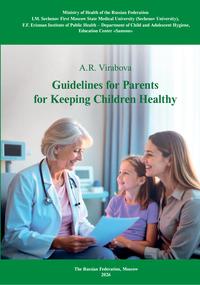
Guidelines for Parents for Keeping Children Healthy: Based on Practical Experience in Health-Promoting Education
Покупка
Новинка
Тематика:
Организация образования
Издательство:
Пробел-2000
Автор:
Вирабова Анна Рафаиловна
Год издания: 2026
Кол-во страниц: 145
Дополнительно
Вид издания:
Практическое пособие
Уровень образования:
Дополнительное образование
ISBN: 978-5-907975-35-4
Артикул: 889106.01.99
Доступ онлайн
300 ₽
В корзину
Guidelines for parents of children and adolescents from birth through early childhood to school age. Intended for use by preschool teachers, psychologists, speech therapists, and special educators in kindergartens and schools; public health officers and hygiene professionals;students at medical colleges and universities; social educators; pediatricians; preschool teacher assistants; and leaders of nurseries, kindergartens, schools, and short-term stay, developmental, and preparatory classes for school-age children. These practical recommendations are grounded in the principles of an evidence-based health-promotion approach for working with children, as implemented at the "Samson” Center for Continuous Person-Centered Health-Saving Education. The Center provides opportunities for monitoring and fostering the comprehensive development of children’s and adolescents’ health throughout the educational process. Established in 1992 in Moscow’s Southern Administrative District, the Center serves as a core educational institution under the supervision of the Department of Child and Adolescent Hygiene at the F.F. Erisman Institute of Public Health of the I.M. Sechenov First Moscow State Medical University (Sechenov University).
Тематика:
ББК:
УДК:
ОКСО:
- ВО - Бакалавриат
- 37.03.01: Психология
- 44.03.01: Педагогическое образование
- 44.03.02: Психолого-педагогическое образование
ГРНТИ:
Скопировать запись
Фрагмент текстового слоя документа размещен для индексирующих роботов
Ministry of Health of the Russian Federation
I.M. Sechenov First Moscow State Medical University (Sechenov University),
 F.F. Erisman Institute of Public Health-Department of Child & Adolescent Hygiene,
Education Center «Samson»
The Russian Federation, Moscow
2026
Guidelines for Parents
for Keeping Children Healthy
Based on Practical Experience in Health-Promoting Education
A.R. Virabova
UDC 373.17+373.04
LBC 74.200.55+74.202.4
V52
Professor of the Department of Child and Adolescent Hygiene
at the F.F. Erisman Institute of Public Health
of the I.M. Sechenov First Moscow State Medical University
Doctor of Medicine A.R. Virabova.
Reviewed by:
Vladislav Remirovich Kuchma, Head of the Department of Child and Adolescent Hygiene at F.F.
Erisman Institute of Public Health of the I.M. Sechenov First Moscow State Medical University
(Sechenov University); Scientific Director of the Institute of Complex Hygiene Problems at the
F.F. Erisman Federal Research Center for Hygiene under the Federal Service for the Oversight
of Consumer Protection and Welfare (Rospotrebnadzor); Corresponding Member of the Russian
Academy of Sciences; Doctor of Medicine, Professor.
Olga Anatolievna Shklyarova, Professor of the Department of Educational Systems Management
named after T.I. Shamova at the Institute of Social and Humanitarian Education under Moscow
Pedagogical State University, Candidate of Pedagogical Sciences, Associate Professor.

Virabova, Anna Rafailovna
V52
Guidelines for Parents for Keeping Children Healthy : Based on Practical Experience
in Health-Promoting Education / A.R. Virabova, Professor, Doctor of Medicine. – Moscow
Probel-2000, 2026. – 144 p. : ill.
ISBN 978-5-907975-35-4
Guidelines for parents of children and adolescents from birth through early childhood to school
age. Intended for use by preschool teachers, psychologists, speech therapists, and special
educators in kindergartens and schools; public health officers and hygiene professionals;
students at medical colleges and universities; social educators; pediatricians; preschool teacher
assistants; and leaders of nurseries, kindergartens, schools, and short-term stay, developmental,
and preparatory classes for school-age children. These practical recommendations are grounded
in the principles of an evidence-based health-promotion approach for working with children, as
implemented at the “Samson” Center for Continuous Person-Centered Health-Saving Education.
The Center provides opportunities for monitoring and fostering the comprehensive development
of children’s and adolescents’ health throughout the educational process. Established in 1992 in
Moscow’s Southern Administrative District, the Center serves as a core educational institution
under the supervision of the Department of Child and Adolescent Hygiene at the F.F. Erisman
Institute of Public Health of the I.M. Sechenov First Moscow State Medical University
(Sechenov University).
In addition to the author’s text, the book includes open-source illustrations without any attribution or
restrictions on usage.
ISBN 978-5-907975-35-
© Virabova A.R., 2026

© “Probel-2000” Publishing House, 2026
:
TABLE OF CONTENTS
INTRODUCTION.........................................................................................4
I.  PEDIATRICIAN’S ADVICE...................................................................6
1.  Child-Rearing in Their Early Years (Birth to 3 Years)...............................8
2.  A Healthy Diet Matters for Your Child’s Growth and Well-Being...........26
3.  Tips for Parents for Keeping Children Healthy........................................44
4.  Prevention of influenza and acute respiratory infections.........................50
5.  Myopia in children...................................................................................55
6.  Why is vaccination necessary?.................................................................61
7.  Seasonal prevention of viral infections.....................................................66
8.  Check-list for Parents for Keeping Children Healthy...............................72
II.  SPEECH THERAPIST’S ADVICE.....................................................77
9.  Early speech development........................................................................79
10.  Baby speech formation...........................................................................90
III.  PSYCHOLOGIST’S ADVICE...........................................................97
11.  ALL CHILDREN ARE DIFFERENT  (Auditory, Visual or
      Kinesthetic learners)................................................................................99
12.  Hyperactive children. Recommendations for parents and
      educators................................................................................................103
13.  Gifted children: peculiarities of education............................................109
14.  Aggressive behavior in children: what to do?.......................................115
15.  Computer addiction in children.............................................................120
16.  How to help a child with anxiety...........................................................124
17.  How to successfully prepare for the state final certification:
       Basic  State Examination (BSE) and Unified State Examination
       (USE).....................................................................................................129
REFERENCES...........................................................................................136
INTRODUCTION
In modern society, preserving the physical and moral health of
children and adolescents has become one of the most pressing national
priorities. The social mission here lies in fostering a literate, wellrounded, highly intelligent, humane, well-mannered, responsible,
psychologically stable, analytically minded, and physically and mentally
healthy individual. A crucial role in addressing these objectives belongs
to healthcare professionals and staff of preschools, schools, and other
educational institutions, including pediatricians, adolescent medicine
specialists, age-specific professionals, i. e. nosologists, paramedics,
nurses, physicians and hygienists, child and adolescent neurologists,
special educators, educational psychologists, speech therapists, as well
as preschool and school teachers.
Promoting and supporting the health and well-being of children within
educational settings is a key area of research conducted at Sechenov
University. This research employs an expanded range of concepts and
principles of child hygiene, aimed at creating conditions conducive
to maintaining and enhancing the health and proper development of
children.
Promoting strong sanitary practices in society, including children
and adolescents, is one of the principal components of a healthy
lifestyle. It involves educational and awareness-raising activities at all
stages of child growth and development, from infancy to adolescence.
These efforts are legally mandated (Article 36 of Federal Law No. 52-F
“On Sanitary and Epidemiological Welfare of Population”).
Adopting a healthy lifestyle among children and adolescents involves
practicing behaviors that promote and maintain good health. This
includes adhering to proper sanitation practices and avoiding harmful
habits that may contribute to various diseases.
This collection of recommendations for parents was developed by
the Department of Child and Adolescent Hygiene in collaboration
with experienced practitioners—psychologists, speech therapists,
teachers, and pediatricians—from the “Samson” Education Center,
which functions as the base school of the Department of Child and
Adolescent Hygiene at the F.F. Erisman Institute of Public Health of
the I.M. Sechenov First Moscow State Medical University (Sechenov
University).
The collection covers 17 areas of vital information related to health,
disease prevention, behavioral and age-specific characteristics, and the
correct formation of skills and abilities in children during their growth
and development. The recommendations provided aim to assist parents
and specialists in preschools and schools in working with students and
pupils. They seek to foster respect for personal and public health, promote
an understanding of the value of a healthy lifestyle and environment, and
guide the selection of teaching, educational, and preventive methods
designed to preserve the health of children and adolescents.
I.
Pediatrician’s Advice
“Taking care of health is one of the most important duties
of an educator. Children’s spiritual well-being, worldview,
intellectual development, strength of knowledge, and belief
in their own abilities all depend on their cheerfulness and
vitality.”
Vasily Sukhomlinsky
“All that is beautiful in a person comes from the sun and the
mother’s milk. That’s what fills us with love for life.”
Maxim Gorky
“Health is a priceless gift from nature. Alas, it is not eternal,
we must take care of it. In many ways, it depends on the individual
themselves—on their lifestyle, working conditions, diet, and habits.”
Ivan Pavlov
1.  Child-Rearing in Their Early Years (Birth to 3 Years)
 In the first years of life, a child’s brain is highly attuned to receiving
information from all senses: hearing, smell, taste, sight, and touch.
These senses are especially active during this time.
Pediatrician’s Advice
During the first months of a child’s life, their central nervous
system is still developing and is not fully functional. This means that it
is more easily overstimulated by external stimuli, causing it to quickly
become exhausted. As a result, the child’s period of active wakefulness
is relatively short, around 5 to 7 hours a day, and they need to sleep
every 1.5–2 hours.
With proper organization of a child’s daily routine, by the end of the
first month, a regular sleep-wake cycle is established.
Fresh air has most beneficial effect on sleep. It affects the skin and
mucous membranes of the nose and upper respiratory tract. As a result,
the central nervous system calms down and the child falls asleep quickly.

The average sleep duration for children in their first year of life is
between 17 and 18 hours each day, including 12 hours
of nighttime sleep and 5 to 6 hours of daytime sleep outdoors.
From one to two years old, children should get two naps of 2 hours
each during the day; for a total of 16 hours of sleep per day: 12 hours
at night and 4 hours  during the day.
The daily schedule for children aged three to four includes 12-12.5
hours of sleep, with 2 hours dedicated to a single nap.

The open air has a positive effect on the
body’s growth:
•	it activates metabolic processes,
•	and has a positive influence on the processes of
growth and development.
Sleep and bedtime routines
must not be enforced, but rather,
a child’s daily schedule should
be established so that they can
naturally wake up on their own.
Preparing for bed can include a
series of activities that help calm
a child: a warm bath, gentle
exercise with relaxing music,
and reading aloud.
Lack of sleep can have a
negative impact on higher
nervous activity. With lack of
sleep, people often experience
mood
swings,
tearfulness,
irritability,
reduced
interest
in activities, and decreased
productivity.
These
disorders
are
initially
reversible and can disappear when a
proper sleep schedule is established.
However, prolonged lack of sleep
can lead to over-fatigue and neurotic
disorders in children.
The total duration of time that
children spend outdoors in their
first year of life should be at least 5-6
hours per day.
Похожие Показать весь список
Доступ онлайн
300 ₽
В корзину