
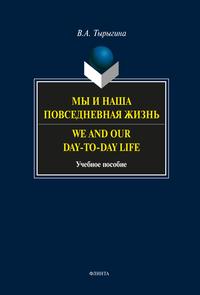
Мы и наша повседневная жизнь = We and our day-to-day life
Покупка
Новинка
Тематика:
Английский язык
Издательство:
ФЛИНТА
Год издания: 2026
Кол-во страниц: 192
Дополнительно
Вид издания:
Учебное пособие
Уровень образования:
ВО - Бакалавриат
ISBN: 978-5-9765-1458-4
Артикул: 619381.02.99
Доступ онлайн
300 ₽
В корзину
Цель учебного пособия - расширение активного словаря говорящего: если говорящий делает грамматическую ошибку, его так или иначе смогут понять, но если он не знает точного слова, то результативность общения оказывается под угрозой. Задача расширения и усвоения активного словаря говорящего решается в пособии в том числе и с помощью его сетевой организации.
Для студентов филологических факультетов и факультетов иностранных языков высших учебных заведений. Может быть рекомендовано всем лицам, изучающим английский язык.
Тематика:
ББК:
УДК:
ОКСО:
- ВО - Бакалавриат
- 45.03.01: Филология
- ВО - Магистратура
- 45.04.01: Филология
ГРНТИ:
Скопировать запись
Фрагмент текстового слоя документа размещен для индексирующих роботов
МЫ И НАША
ПОВСЕДНЕВНАЯ ЖИЗНЬ
В.А. Тырыгина
WE AND OUR
DAY-TO-DAY LIFE
Учебное пособие
3-е издание, стереотипное
Рекомендовано Учебно-методическим объединениeм
по образованию в области лингвистики
Министерства образования и науки Российской Федерации
в качестве учебного пособия для студентов,
обучающихся по специальностям направления
«Линвистика и межкультурная коммуникация»
Москва
Издательство «ФЛИНТА»
2026
Т93
ISBN 978-5-9765-1458-4
© Тырыгина В.А., 2022
©Издательство «ФЛИНТА», 2022
лицам, и зучающим английский язык..
УДК 811.111(075.8)
ББК 81.432.1я73
Т93
3
Contents
Introduction ..........................................................................................................4
Unit 1. Family life and ways ................................................................................7
Unit 2.  Describing people’s appearance ............................................................16
Unit 3. Describing character ..............................................................................26
Unit 4.  Occupations, trades and work ...............................................................52
Unit 5. College life .............................................................................................60
Unit 6. The best way to master a foreign language ............................................69
Unit 7. Daily routine ..........................................................................................77
Unit 8. Spending weekend .................................................................................84
Unit 9. Talking about time .................................................................................91
Unit 10. Around home ........................................................................................98
Unit 11. At home ..............................................................................................107
Unit 12.  Food and cooking ..............................................................................117
Unit 13. Eating habits ......................................................................................130
Unit 14. Talking about clothes .........................................................................138
Unit 15. Going to the doctor ............................................................................152
Unit  16. Travelling ..........................................................................................164
Unit  17. Visiting the theatre ............................................................................174
Unit 18. Feelings and emotions .......................................................................182
Sources .............................................................................................................191
Dictionaries. Reference Books .........................................................................191
INTRODUCTION
To the student
The purpose of the book
This book is intended to be a practical guide in your  lexical development. The vocabulary as distinct from grammar, which is a closed
set, is an open set and therefore requires a lot of students’ additional
efforts to expand  it. Moreover, when you make a grammar mistake, it
may be ‘wrong’ but very often people will understand you anyway. But
if you don’t know the exact word, it is very frustrating for you and the
person you talk with. Good English means having a good vocabulary.
You  yourself should assume the main responsibility for your vocabulary
thesaurus.
Ways of  expanding and learning vocabulary
One of the most painless and, perhaps, the most effective ways of
acquiring new words is by reading as much as possible, for in this way
words appear in a context and assimilation will take place subconsciously. The same is true when you explore websites, watch films or videos,
cable TV, listen to the radio, audio books, and songs.
Another no less effective vocabulary learning strategy is when you
keep record of words you come across and review the records regularly. There are many ways of keeping words but the best one is that
you  think is right for you. The information you need is the word, its part
of speech, its meaning, its pronunciation, how to use it in a sentence.
Whenever you pick up a new word be aware of who says it, and in what
situation. Unfortunately many students find the effort too much and stop
trying.
Still another way of organizing vocabulary is based on the idea of
word networks, i.e. recording vocabulary in related groups. This vocabulary learning habit may do you a great service. It is thinking about words
enough to create groups that makes memorizing them more effective. It
is this way of organizing vocabulary that the present book is concerned
with.
Organisation of the book
The handbook covers a wide range of topic areas linked with everyday practical or social situations involving names of their participants,
their actions and behaviour, objects and their qualities etc. Vocabulary
items within the topic are subgrouped in minitopics and indexed under
corresponding headings. The range of topics provided by the book meets
the needs of the curriculum in the 1st  and 2nd years of English departments of Universities. The book focuses first and foremost on the thematic vocabulary and in this sense it differs from students’ main practical manuals, which, as a rule, pursue many aims. The present  handbook
aims at systematizing topic items by presenting them in a compact, wellarranged way, thus giving easier access to them.
Each of the eighteen units of the book is made up of two sections.
The first one presents essential vocabulary on the suggested topic. Besides names of people, places, properties, actions etc. the first section
gives habitual sayings and collocations peculiar to the topic and making
your speech more natural and authentic.
The second section shows that each topic may be presented as a series of network diagrams or spider graphs and it supplies exercises aiming at further understanding and memorizing topic items by placing them
into various networks, matrices, graphs etc. Producing spider graphs as
a way of brainstorming vocabulary involves your creative quest in completing given branches  and adding new ones.
Some psychological tips
Here is one more tip on how to retain words in memory. Research
studies show that learners  remember new words much more easily if
they think about them in relation to their own experience and use them
in a context that is meaningful to them as individuals.
Research studies also show that repeating work is very important.
The manual will bear fruits if you go over  topics regularly or at least
now and then and of your own accord not only when you are forced or
obliged to do it due to the syllabus. The most effective way is to revise
the unit a week after you worked on it and again after a month.
The author hopes that you will find the book useful and enjoy working with it.
To the teacher
The present handbook covers lexis to be acquired by the 1st  and
2nd year students of English departments of Universities. The range of
topics chosen is done in conformity – with the curriculum for students
majoring in English.
It includes two sections: the first one offers vocabulary with vocabulary items put into smaller lexical units, thus making their study more
structured. The second one provides practice which helps the students
learn and build up their vocabulary. Although the book is designed for
self-study it may be used in class as a resource book while preparing for
discussion activities, writing activities or other creative tasks.
The author hopes that  the book will prove helpful.
Unit  1.
FAMILY LIFE AND WAYS
Members of the family
Parents (old folks)
Father (dad, daddy)
Mother (mamma, mum)
Son, daughter
Senior son = eldest son
Junior son = youngest son
Elder brother (sister)
Eldest brother (sister)
Younger brother (sister)
Twins
Ancestors
Grandparents
Grandfather (grandpa, granddad)
Grandmother (grandma, granny)
Great grandfather (~ mother)
Descendants
Grandchildren
Great grandchildren (~ son)
Family relationships
First cousin, second cousin
Father (mother)-in-law
Uncle (aunt)
Nephew (niece)
Son (daughter)-in-law
Step-father (~mother)
Step-child (~sister)
Have-brother (~sister)
Foster-father (~mother)
Godchild
(~son,
~daughter,
~father)
Orphan
Status
girlfriend – ex-girlfriend
husband – ex-husband
wife – ex-wife
bride (she) / fiancée
bridegroom (he) fiancé
engaged
newly-weds
widow (she) widower (he)
bachelor / single / spinster
divorced / married / widowed
Events
birth
engagement
marriage
wedding (silver, golden, diamond)
Age
teenager, child, baby, toddler
young (youngster, youth)
grown-up / adult
elderly / old
Happenings
to be born (Mike was born in
2010)
to give birth (Mary gave birth to
her first or: She has had her
first)
to take after (He takes after his
father in character and in
looks)
to bring up
to adopt (They adopted a
child)
to court (Jim is courting my elder
sister)
to go out (Jim is going out with
my sister)
to split up (They split up last
year)
sweetheart (That’s her sweetheart)
They are friends (lovers, rivals)
to be engaged
to marry (She married a doctor)
be married to
to divorce / to break up
to retire (He retired on a pension)
to die (He died of an illness)
Types of family
a one-parent family
a two-parent family
a blend family
an extended family
a nuclear family
Family relations
a friendly / united family
close-knit
to get on well (with)
to be deeply attached (to)
to love somebody deeply
to care for (each other)
to never (sometimes) quarrel
Can we avoid quarrels?
to be on best terms (with)
to have conflicts (with)
to support each other through
any crisis
Yet they always support each
other through any crisis
There is some misunderstanding
between us
We try to make peace as soon as
possible
Family ways and habits
In the evening the family come
together
to talk about the events of the day
to get together in the living room
for relaxation
to see little (much) of one another
to gather at table and discuss the
events of the day
Since we leave home at different
times in the morning supper /
evening is our one opportunity
of sitting down together
At weekends we see more of one
another
to receive gests
to go out for a walk
to celebrate our birthdays together
Our relatives (relations) join us
for tea (for dinner)
TV is not switched on because
this destroys conversation
We have our family archives / many
albums with family photos
Interests
to be keen on
to be fond of
to be mad about
to be interested in
sports
fashions
politics
music (pop, rock
techno, rap)
cars
computers
psychology
know-how books
books on art
    DIY books (do it yourself)
I like to get out on visits
 to discuss new fashions
 with my friends
 to have a chat with my
 friend over the phone
I like to see thrillers
comedies
musicals
soap operas
horror films
love stories
catastrophe films
I like to go on the Internet
Hobbies
to take up gardening
to give up gardening
traveling
drawing
sewing
knitting
embroidering
photography
taking pictures
shooting video
growing flowers
raising aquarium fish
collecting CDs / stamps /
calendars / badgers / coins
cooking
hiking
gig going
(performance of jazz or popular music)
playing the piano / guitar / violin
doing the shopping
reading fashion magazines
playing computer games
dancing
singing
performing in amateur
theatre
listening to music
– Are you relation to Jim Cochrane, a well-known TV presenter?
– No, he is just my namesake.

– What relationship is Owen to you?
– He is my remote kinsman.
– How’s your brother?
– Fine. He is again going out with his ex-fiancée.
– I’ve got  news for you. Have you heard that Eva Browning is getting married for the third time on September the tenth?
– Fancy that! She’s only got her second divorce in the spring. What
a dreadful woman she is!
– Her first marriage only lasted six months.
– That’s right.  At this rate she’ll lose count of her husbands before
she’s forty.
– She may lose count, but we certainly won’t.
– Is Johnny still a computer game fanatic?
– He is no longer keen on computer games, thank heavens. Now he
has taken up biking and is away from home all day long.
– I heard they quarrel much.
– Do you know the secret of avoiding quarrels? Anyway, they always support each other through any crisis.
– Who looks after your children while you are working?
– Well, there’s a kindergarten. And my mother also lends a hand.
She comes over to us when the children fall ill, and she babysits when
we are out for the evening.
Skills
Latin is not my forte (strong)
point
to be good at growing flowers,
knitting etc.
to be clever with hands
to be clever at computers / video /
shooting / taking pictures
to be handy with many things
he can fix almost everything
Похожие Показать весь список
Доступ онлайн
300 ₽
В корзину