
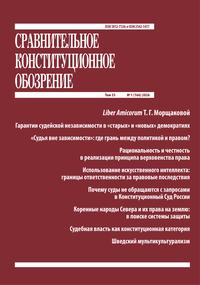
Сравнительное конституционное обозрение, 2026, № 1 (166)
научно-аналитичесий журнал
Покупка
Тематика:
Конституционное (государственное) право
Издательство:
ООО "Центр конституционных исследований"
Наименование: Сравнительное конституционное обозрение
Год издания: 2026
Кол-во страниц: 203
Дополнительно
Доступ онлайн
2 100 ₽
В корзину
Тематика:
ББК:
УДК:
ОКСО:
ГРНТИ:
Скопировать запись
Фрагмент текстового слоя документа размещен для индексирующих роботов
XV КОНКУРС СРЕДИ СТУДЕНЧЕСКИХ КОМАНД
ПО МОДЕЛИ КОНСТИТУЦИОННОГО СУДА РОССИЙСКОЙ ФЕДЕРАЦИИ
«ХРУСТАЛЬНАЯ ФЕМИДА»
Тема Конкурса 2025/2026 учебного года:
«В поисках утраченной приватности», или Дело о предпринимательской свободе
и подтверждении возраста в социальных сетях
Из 94 зарегистрированных команд 52 команды — 286 студентов — были допущены к устным раундам.
Конкурс cудили 76 экспертов в области конституционного правосудия.
28–31 января 2026 года состоялся финальный этап.
Победу в Конкурсе одержала
команда Санкт-Петербургского филиала
Национального исследовательского университета «Высшая школа экономики»
в составе
Кузьмич П. Г., Петровой А. А., Расулова И. Б., Хмелевского А. М.
Конкурс администрируется Центром конституционных исследований
https://constlawcenter.ru/
Спонсоры и партнёры Конкурса:
Федеральная палата адвокатов Российской Федерации; юридические фирмы VERBA LEGAL;
Orlova\Ermolenko, «Монастырский, Зюба, Степанов & Партнеры»; «Томашевская и партнеры»;
адвокатские бюро «Лидингс»; «Шварц и партнеры»; адвокатская контора «Аснис и партнеры»;
Regional Privacy Professionals Association и издательство «Инфотропик»; Центр международных
и сравнительно-правовых исследований; издательство «Социум»; научные журналы
«Сравнительное конституционное обозрение» и «Международное правосудие»,
а также частные спонсоры.
Центр конституционных исследований и участники Конкурса
благодарят спонсоров и партнёров за поддержку студенческого проекта
и верность конституционному правосудию!
Подробнее об итогах XV Конкурса:
https://mootcourt-crystal-themis.ru/hf2026
РАСПРОСТРАНЕНИЕ И ПОДПИСКА
Печатная версия
Россия
Через сайт журнала:
https://sko-journal.ru/
Через подписные агентства:
•	ООО «Урал-Пресс Периодика»
Тел.: (499) 700-05-07 • http://ural-press.ru
•	ООО «Коммуникационное Агентство Криэйтив Сервис Бэнд»
Тел.: (499) 685-13-30 • https://periodicals.ru/
•	ООО «Руспресса»
Тел.: (495) 369-11-22 • http://www.abcpress.ru/
•	ООО «Прессинформ»
Тел.: (812) 786-81-19 • http://presskiosk.ru/
Зарубежные страны
Оформить подписку на журнал можно через:
•	Агентство «Книга-Сервис»
Тел.: (495) 680-90-88 • https://www.akc.ru/
•	ООО «ИВИС»
Тел.: (495) 777-65-57 • http://www.ivis.ru/
•	ООО «Коммуникационное Агентство Криэйтив Сервис Бэнд»
Тел.: (499) 685-13-30 • https://periodicals.ru/
Электронная версия
Приобрести электронную версию любого выпуска или статьи журнала можно:
•	на сайте журнала:
https://sko-journal.ru/
•	через Научную электронную библиотеку elibrary.ru.
Страница журнала в электронном каталоге:
http://elibrary.ru/title_items.asp?id=9477
•	через Электронно-библиотечную систему Znanium:
https://znanium.ru/
Решением ВАК журнал включён
в «Перечень ведущих рецензируемых научных журналов и изданий,
в которых должны быть опубликованы основные научные результаты
диссертации на соискание учёной степени доктора и кандидата наук»
ПРИГЛАШЕНИЕ К ПУБЛИКАЦИИ
Приглашаем российских и зарубежных авторов к публикации
на страницах журнала статей, а также рецензий, обзоров, комментариев,
соответствующих профилю и тематике издания.
В журнале предусмотрена процедура обязательного рецензирования.
Полный перечень требований и порядок рецензирования размещены
на сайте: https://sko-journal.ru/informatsiya-dlya-avtorov/
Система платного размещения статей
в журнале не используется!
Материалы направлять в электронном виде (желательно
в формате Word) через сайт: https://sko-journal.ru/forma/
или по электронной почте: info@sko-journal.ru
Журнал входит в базу журналов
Russian Science Citation Index на платформе Web of Science,
а также в базу данных периодических и продолжающихся изданий
Ulrich's Periodicals Directory
Том 35
№ 1 (166) 2026
НАУЧНО-АНАЛИТИЧЕСКИЙ ЖУРНАЛ
Учредитель
О. Б. Сидорович
Издатель
ООО «Центр конституционных исследований»
Редакционный совет
А. С. АВТОНОМОВ (Институт международного права и экономики им. А. С. Грибоедова)
А. БЛАНКЕНАГЕЛЬ, сопредседатель (Университет им. Гумбольдта, Германия)
Н. А. БОГДАНОВА (Московский государственный университет им. М. В. Ломоносова)
А. Е. ВАШКЕВИЧ (Европейский гуманитарный университет, Литва)
Е. В. ГРИЦЕНКО (Санкт-Петербургский государственный университет)
А. В. ДОЛЖИКОВ (Санкт-Петербургский государственный университет)
И. П. КЕНЕНОВА (Московский государственный университет им. М. В. Ломоносова)
А. И. КОВЛЕР (Институт законодательства и сравнительного правоведения)
М. А. КРАСНОВ (НИУ «Высшая школа экономики»)
А. Н. МЕДУШЕВСКИЙ, сопредседатель (НИУ «Высшая школа экономики»)
Р. УИТЦ (Ройял Холлоуэй, Лондонский университет, Великобритания)
С. ХОЛМС (Нью-Йоркской университет, США)
А. ШАЙО (Венгерская академия наук, Венгрия)
Редакционная коллегия
И. А. АЛЕБАСТРОВА (независимый эксперт)
А. П. ЕВСЕЕВ (Российский государственный университет правосудия)
И. А. КРАВЕЦ (Новосибирский государственный университет)
О. Н. КРЯЖКОВА ( Российский государственный университет правосудия)
Б. НОБЛ (Университетский колледж Лондона, Великобритания)
У. ПартлетТ (Университет Мельбурна, Австралия)
А. Г. РУМЯНЦЕВ (независимый юрист-исследователь)
А. В. САЛЕНКО (Балтийский федеральный университет имени Иммануила Канта)
Д. СМИЛОВ (Софийский университет, Болгария)
А. А. ТРОИЦКАЯ (Московский государственный университет им. М. В. Ломоносова)
Т. М. ХРАМОВА (независимый эксперт)
П. ЧЕЙСТИ (Колледж Св. Антония, Оксфордский Университет, Великобритания)
А. М. ЧИРНИНОВ (Институт философии и права УрО РАН)
Главный редактор
О. Б. СИДОРОВИЧ (ООО «Центр конституционных исследований»)
Заместители главного редактора
А. Г. РУМЯНЦЕВ (независимый юрист-исследователь)
А. А. ТРОИЦКАЯ (Московский государственный университет им. М. В. Ломоносова)
Редактор
Д. А. МАМАЕВ
© ООО «Центр конституционных исследований», 2026
ПРАВОВОЕ ГОСУДАРСТВО
РАЦИОНАЛЬНОСТЬ И ЧЕСТНОСТЬ В РЕАЛИЗАЦИИ
5
ПРИНЦИПА ВЕРХОВЕНСТВА ПРАВА
Андраш Шайо
СУДЕЙСКАЯ НЕЗАВИСИМОСТЬ
НЕЗАВИСИМОСТЬ СУДЕБНОЙ ВЛАСТИ В ГОСУДАРСТВЕ,
18
ОСНОВАННОМ НА ВЕРХОВЕНСТВЕ ПРАВА
Ангелика Нуссбергер
ГАРАНТИИ НЕЗАВИСИМОСТИ СУДЕЙ КОНСТИТУЦИОННЫХ СУДОВ:
30
ТЕНДЕНЦИИ В РОССИИ И ЦЕНТРАЛЬНОЙ АЗИИ
Ирина Кузнецова
ВОПРОС ВОПРОСОВ: МОЖЕТ ЛИ СУДЬЯ БЫТЬ НЕЗАВИСИМ?
53
РАЗМЫШЛЕНИЯ О КНИГЕ: МОРЩАКОВА Т. СУДЬЯ ВНЕ ЗАВИСИМОСТИ.
М. : ФОНД «ПРЕЗИДЕНТСКИЙ ЦЕНТР Б. Н. ЕЛЬЦИНА», 2025
Андрей Медушевский
ПРАВО И НОВЫЕ ТЕХНОЛОГИИ
ОСНОВНЫЕ ПРОБЛЕМЫ ИСПОЛЬЗОВАНИЯ
78
ИСКУССТВЕННОГО ИНТЕЛЛЕКТА: ГРАНИЦЫ ИНДИВИДУАЛЬНОЙ
И КОЛЛЕКТИВНОЙ ОТВЕТСТВЕННОСТИ ЗА ПРАВОВЫЕ ПОСЛЕДСТВИЯ
Отто Люхтерхандт
СУДЫ И КОНСТИТУЦИОННОЕ ПРАВОСУДИЕ
КОНСТИТУЦИОНАЛИЗАЦИЯ ПРАВОПОРЯДКА
100
КАК ОБЩЕЕ ДЕЛО СУДОВ РОССИЙСКОЙ ФЕДЕРАЦИИ
К ЮБИЛЕЮ Т. Г. МОРЩАКОВОЙ
Алдар Чирнинов
ДОСТУПНАЯ РОСКОШЬ И ПРАВОВЫЕ ТАЛИСМАНЫ:
119
О КОНСТИТУЦИОННОМ ИЗМЕРЕНИИ ВНЕСУДЕБНОЙ ЮРИСДИКЦИИ
К ЮБИЛЕЮ Т. Г. МОРЩАКОВОЙ
Михаил Гальперин
ПРАВА МЕНЬШИНСТВ
ПРАВА КОРЕННЫХ МАЛОЧИСЛЕННЫХ НАРОДОВ СЕВЕРА
141
НА ЗЕМЛИ И ТРАДИЦИОННОЕ ПРИРОДОПОЛЬЗОВАНИЕ:
ПРАВОВОЕ РЕГУЛИРОВАНИЕ И СУДЕБНАЯ ПРАКТИКА
Владимир Кряжков, Кирилл Суханов
ЭТИКА КОНСТИТУЦИОНАЛИЗМА
ШВЕДСКИЙ МУЛЬТИКУЛЬТУРАЛИЗМ
162
ПЕРЕД ЛИЦОМ СОВРЕМЕННЫХ ВЫЗОВОВ
Александр Черкасов
КОНСТИТУЦИОННАЯ МЕМУАРИСТИКА
СУДЕБНАЯ ВЛАСТЬ КАК КОНСТИТУЦИОННАЯ КАТЕГОРИЯ
189
АКТУАЛЬНОСТЬ ИДЕЙ Т. Г. МОРЩАКОВОЙ
Анатолий Ковлер
Свидетельство о регистрации средства массовой информации ПИ № ФС77-82339
от 23 ноября 2021 года выдано Федеральной службой по надзору в сфере связи,
информационных технологий и массовых коммуникаций.
Тираж 300 экз. Периодичность – 4 номера в год. Цена свободная.
Дата выхода в свет: 31 марта 2026 года.
Адрес редакции: 129090 Москва, ул. Щепкина, д. 8.
Тел.: +7 (495) 608-69-59. Эл. почта: info@sko-journal.ru
Отпечатано в типографии ООО «Буки Веди»
117393, г. Москва, вн.тер.г. муниципальный округ Обручевский,
ул. Профсоюзная, д. 56, этаж 3, помещение XIX, ком. 321.
Тел.: +7 (495) 926-63-96; www.bukivedi.com; info@bukivedi.com
Позиции авторов статей могут не совпадать с мнением редакции.
При цитировании материалов ссылка на журнал и правообладателя обязательна.
ISSN 1812-7126; e-ISSN 2542-1417
Volume 35
1 (166) • 2026
Founder
O. Sidorovich
Publisher
Center for Constitutional Studies Ltd.
Editorial Advisory Board
A. AVTONOMOV (Griboedov Institute of International Law and Economics)
A. BLANKENAGEL, Co-Chairman (Humboldt University, Germany)
N. BOGDANOVA (Lomonosov Moscow State University)
A. DOLZHIKOV (Saint Petersburg State University)
E. GRITSENKO (Saint Petersburg State University)
S. HOLMES (New York University, USA)
I. KENENOVA (Lomonosov Moscow State University)
A. KOVLER (Institute of Legislation and Comparative Law)
M. KRASNOV (Higher School of Economics)
A. MEDUSHEVSKY, Co-Chairman (Higher School of Economics)
A. SAJÓ (Hungarian Academy of Sciences, Hungary)
R. UITZ (Royal Hollway University of London, UK)
A. VASHKEVICH (European Humanities University, Lithuania)
Editorial Board
I. ALEBASTROVA (Independent Expert)
P. CHAISTY (St. Antony’s College in the University of Oxford, UK)
A. CHIRNINOV (Institute of Philosophy and Law, UB RAS)
A. EVSEEV (Higher School of Economics)
T. KHRAMOVA (Independent Expert)
I. KRAVETS (Novosibirsk State University)
O. KRYAZHKOVA (Russian State University of Justice)
B. NOBLE (University College London, UK)
W. PARTLETT (Melbourne Law School, Australia)
A. RUMYANTSEV (Independent Legal Researcher)
A. SALENKO (Immanuel Kant Baltic Federal University)
D. SMILOV (Sofia University, Bulgaria)
A. TROITSKAYA (Lomonosov Moscow State University)
Editor-in-Chief
O. SIDOROVICH (Center for Constitutional Studies Ltd.)
Co-Editors-in-Chief
A. RUMYANTSEV (Independent Legal Researcher)
A. TROITSKAYA (Lomonosov Moscow State University)
Copy Editor
D. MAMAEV
Address: 8, Shchepkin Str., Moscow, 129090, Russian Federation
Tel.: +7 (495) 608-69-59
E-mail: info@sko-journal.ru
https://sko-journal.ru/
© Center for Constitutional Studies Ltd., 2026
RULE OF LAW
FOR A RATIONAL AND HONEST RULE OF LAW
5
András Sajó
JUDICIAL INDEPENDENCE
JUDICIAL INDEPENDENCE AS A FOUNDATION
18
OF A STATE BASED ON RULE OF LAW
Angelika Nußberger
GUARANTEES OF CONSTITUTIONAL COURT JUDGES INDEPENDENCE:
30
RECENT TRENDS IN RUSSIA AND CENTRAL ASIA
Irina Kuznetsova
THE QUESTION OF QUESTIONS: CAN A JUDGE BE INDEPENDENT?
53
REFLECTIONS ON THE BOOK: MORSHCHAKOVA T. G. A JUDGE
BEYOND DEPENDENCE. MOSCOW : BORIS YELTSIN
PRESIDENTIAL CENTER FOUNDATION, 2025
Andrey Medushevsky
LAW AND NEW TECHNOLOGIES
KEY ISSUES IN THE USE OF ARTIFICIAL INTELLIGENCE:
78
THE BOUNDARIES OF INDIVIDUAL AND COLLECTIVE RESPONSIBILITY
FOR LEGAL CONSEQUENCES
Otto Luchterhandt
COURTS AND CONSTITUTIONAL JUSTICE
CONSTITUTIONALIZATION OF THE LEGAL ORDER
100
AS A SHARED RESPONSIBILITY OF THE RUSSIAN JUDICIARY
ON THE ANNIVERSARY OF TAMARA MORSHCHAKOVA
Aldar Chirninov
AFFORDABLE LUXURY AND LEGAL TALISMANS:
119
THE CONSTITUTIONAL DIMENSION OF EXTRAJUDICIAL JURISDICTION
ON THE ANNIVERSARY OF TAMARA MORSHCHAKOVA
Mikhail Galperin
MINORITY RIGHTS
THE RIGHTS OF SMALL INDIGENOUS PEOPLES OF THE NORTH
141
TO LAND AND TRADITIONAL USE OF NATURAL RESOURCES:
LEGAL REGULATION AND JUDICIAL PRACTICE
Vladimir Kryazhkov, Kirill Sukhanov
ETHICS OF CONSTITUTIONALISM
SWEDISH MULTICULTURALISM FACING MODERN CHALLENGES
162
Alexander Cherkasov
CONSTITUTIONAL MEMOIRS
JUDICIAL POWER AS A CONSTITUTIONAL CATEGORY
189
THE CONTEMPORARY RELEVANCE OF T. G. MORSHCHAKOVA’S IDEAS
Anatoly Kovler
ISSN 1812-7126; e-ISSN 2542-1417
Значительная часть статей, вошедших в первый в 2026 году выпуск журнала, связана
с вопросами судебной власти и конституционной защитой отдельных прав и свобод.
Этот ракурс был выбран не случайно.
Прежде всего, 35 лет назад был подготовлен один из важных для демократизации
и перехода России к правовому государству документов — первая концепция судебной
реформы, заложившая основы современной судебной системы России, приблизив её
к международным стандартам. Однако на практике многие цели реформы (особенно
реальная независимость судов) за 35 лет реализованы лишь частично. Ранее на страницах журнала мы не раз инициировали дискуссию о ключевых идеях реформы судебной
власти: независимости судов от исполнительной и законодательной властей, реализации
принципа разделения властей, введении суда присяжных, состязательности процесса,
презумпции невиновности, доступа к правосудию, профессионализации судей и, конечно, конституционном контроле через Конституционный Суд, развитии арбитражных судов для экономических споров. В следующих выпусках мы вновь вернёмся ко многим
из перечисленных элементов реформы.
Кроме того, написанные для этого выпуска статьи составляют «книгу друзей» Тамары Георгиевны Морщаковой, одной из разработчиков той самой первой концепции
судебной реформы. Статьи подготовлены её российскими и зарубежными коллегами,
а также учениками в связи с 90-летним юбилеем, и во многом связаны с теми идеями,
продвижению и реализации которых Морщакова посвятила свою профессиональную
жизнь.
Тамара Георгиевна известна как последовательный сторонник независимого суда
(как абсолютной ценности), приоритета прав человека (права граждан должны защищаться даже тогда, когда это неудобно государству) и соблюдения Конституции (это
не формальность, а документ прямого действия). Как специалист по уголовному процессу, она всегда подчёркивает важность равных возможностей у обвинения и защиты.
Как судья Конституционного Суда она поддерживала решения, направленные на защиту
прав личности и ограничение произвольных действий государства, и исходила из того,
что Суд должен ограничивать власть, если та выходит за рамки Конституции. Морщакова не раз отмечала, что даже хорошие нормы могут «не работать», если суды не независимы или если процесс носит формальный характер. Если упростить, её философская позиция заключается в том, что сильное государство — это не то, которое подавляет, а то, которое ограничено правом и уважает свободы граждан.
Наши самые тёплые пожелания Тамаре Георгиевне здоровья и творческой активности!
ОТ РЕДАКЦИИ
A. Sajó. For a rational and honest rule of law 5 For a rational and honest rule of law András Sajó* Legality alone is insufficient to protect freedom and democracy. The rule of law is more than simple legality, it must be understood as a tradition-based practice that tempers arbitrary power. Legalism — mere obedience to enacted norms — has repeatedly enabled oppression, most notably under authoritarian and populist regimes that manipulate legality while hollowing out its moral and rational foundations. Against this, the present moral-formal conception of the rule of law emphasizes structured legality, professional legal tradition, rationality, procedural fairness, and minimal public morality. These elements constrain power not by imposing contested substantive values, but by shaping the form and operation of law itself. Drawing on Fuller’s internal morality of law, historical experience, and jurisprudential debate, this article shows how violations of formal rule-of-law requirements generate legal pathologies and enable abuse. The moralformal rule of law, though “thin”, provides indispensable protection against arbitrariness, sustains human dignity, and preserves ordered liberty. Its resilience lies in shared legal culture, interpretive discipline, and continuity over time. While vulnerable to distortion, the formal rule of law remains the most reliable framework for resisting legalized oppression and maintaining a legal order worthy of respect. ³ Rule of law; legality; formal and substantive conceptions; rationality; honesty 1. Conceptions of the rule of law As legal history indicates, legality, the axiom that public authorities are allowed to act only as is prescribed by foreseeable norms, quite often becomes the tool of oppression and an obstacle to follow moral judgment. It is legalism that disarms ill-prepared democracies when confronted with legalized populism. It is the shackle of legality that makes the restoration of the rule law — and to a considerable extent, of democracy — a precarious venture. The law as command has authoritarian roots, and legalism insists on law observance simply because law comes from Authority. Therefore, the legal order entails its own risks; the sovereign power’s monopoly on lawful violence and power of the purse makes the law a wild beast1. Legal perversion or pathology occurs in circumstances where the rule of law has failed in its domesticating mission. Is there anything in the rule of law capable of resisting legality, i. e. that damned statutory positivism which paralyzed the German legal profession after Hitler came to power? The rule of law is more than legality, and some of its less often recognized elements can be mobilized against legalistic oppression. This broader meaning of the rule of law entails the professional practice of lawyers, as is rooted in tradition. The rule of law mandates a rational legal system that respects facts, logic, and decency; whatever lies and mischiefs are * András Sajó — Doctor of Law, Member of Hungarian Academy of Sciences; Judge and Vice-President of the European Court of Human Rights (2008–2017) (e-mail: info@sko-journal.ru). 1 Raz J. The Authority of Law: Essays on Law and Morality. New York : Oxford University Press, 1979. P. 228. ПРАВОВОЕ ГОСУДАРСТВО
legalized by the despot and his servants in the civil service and some of the courts. The principles of the rule of law — accepted as tradition among lawyers and in society — can be
used to varying extents to resist legalized cheating.
The scholarly literature is divided on the meaning of the rule of law. Depending on the
underlying political agenda, some scholars consider it as a substantive characteristic of the
legal order, others prefer a “formal” concept. So-called substantive concepts of the rule of
law encompass requirements and demands which relate to the substantive, and consequently contested, content rather than the form of the law, e. g. human rights and social
justice. Substantive conceptualizations of the rule of law intend to provide “a complete social philosophy”2 and therefore invite constant conflict and contestation, as social philosophies always do. By a “formal” concept of the rule of law, I mean that the law must be structured in conformity with specific formalities and must operate in accordance with those formal expectations. Judgments must likewise follow certain formalities to be considered “legal” and must also adhere to standards of legal reasoning which satisfy the requirements of
the rule of law. This specific structure and modus operandi of the law must limit (or perhaps temper, to use Martin Krygier’s felicitous term3) state power. The rule of law provides
protection against an otherwise all-encompassing state power; in other words, it provides
protection against the law of the abusive state.
The “formal” understanding represents the common core of various competing conceptualizations of the rule of law. All servants of the modern law subscribe to this minimum,
simply by virtue of being professionals in modern society; adherence to these minimum
standards does not imply commitment to any divisive choice of values. Even if it looks “thin”
to its critics, the “formal” approach is clearer than — and thus analytically superior to —
its “thicker” counterparts; a “richer” concept of the rule of law is inevitably also richer in
confusion4. The history of what happens to people when the rule of law’s formal components
are lacking, however — e. g. under supreme revolutionary justice or divinely-commanded
religious law — is what manifestly proves that these formal aspects are the indispensable
essence of the rule of law.
“Formal” and “thin” are useful terms for indicating that one is not in the natural law
camp, but they can be misleading insofar as they reflect a binary understanding of the rule
of law, being the opposite of “substantive” or “thick” concepts. Humans have difficulties in
liberating themselves from Manichean dualism (left hand versus right hand; angels against
devils). Dualism is both powerful and helpful; after all, we have a right hand and a left hand,
and that is it. But even if dualism need not lead to a poverty of theory, black-and-white
thinking tends to complicate understanding the nature and complexity of fuzzy practical
phenomena like the rule of law, which has appeared in different forms and as a combination
of somewhat different components depending on historical circumstances. The habit of mutual exclusion — “this statute is law, that one is not” or “this legal system is good, that one
is evil” — is certainly helpful for virtue signaling and is well-adapted to the binary nature of
legal reasoning. The accused has either committed a crime or has not (or, to put into more
practical terms, he is either going to prison or not); the contract is either valid or it is not,
2	 Raz J. The Authority of Law: Essays on Law and Morality. P. 211.
3	 See Krygier M. Well-Tempered Power: “A Cultural Achievement of Universal Significance” // Hague Journal
on the Rule of Law. Vol. 16. 2024. No. 3. P. 479–507.
4	 In this respect, see Craig P. Formal and Substantive Conceptions of the Rule of Law: An Analytical Framework
// The Rule of Law and the Separation of Powers / ed. by R. Bellamy. Abingdon ; New York : Routledge, 2016.
P. 95–115.
A. Sajó. For a rational and honest rule of law 7 tertium non datur. A lot of certainty emerges from law’s habit of binarity. But in theory — and probably also in legal practice — this binarism is not quite correct, and the insistence that everything must conform to one abstraction or another runs the risk of “vicious abstractionism”5. A “thin” conception of the rule of law is one which considers human rights and material justice (i. e. substantive equality) to be a matter of separate consideration, beyond the rule of law; thus, the present “formal” approach is “thin”. “Formal” is the accepted term for this kind of approach, but the adjective “formal” may be misleading. The present conception is “formal” in the sense that it looks at the structured appearance of the law — i. e. the form or the shape in which it appears — and tries to identify the law’s constituent elements, i. e. the ideas, beliefs, and practices of the law which possess normative power. The rule of law entails the respect of certain forms and formalities, that these legal forms take on a certain quality, and that commands appear in a specific form which is traditionally associated with what is ordinarily called “law” in a given society. Because of this, it insists upon law being formulated in a certain way. This is inevitably formalistic, at least up to a point. The rule of law is an imperfect practice and human improvement through law has inherent shortcomings. Formalism comes at a price: the demise of the rule of law in its “formal” sense often results from the overly formalistic (i. e. rigid) approaches to law which the rule of law itself demands. I find the “formal” concept more satisfactory than its competitors, but the primary reason for the choice of the “formal” is precisely the tinkering with the elements of the formal concept in the name of substantive rule of law values that undermines the rule of law and democracy. Without the correctives offered by the “formal” rule of law, modern legal orders tend to lose their moral qualities, and their ordering capacity suffers too6. 2. Against substantive conceptions The abuse of the rule of law stems chiefly from violations of the “formal” elements of the rule of law. The illiberal regimes that have recently been carried to power on the shoulders of populism often justify violations of rule of law “formalities” in the name of substantive rule of law values, like justice for the “threatened nation”, “Christian values”, “social justice” or the “common good”. It is for this reason that rule of law is used as a “formal” conception, and militant rule of law protects and restores itself in this sense7. In order to conform with the requirements of the rule of law, a legal order must satisfy — or, more realistically, must recognize and at least approximate — specific form-related and 5 According to William James, “vicious abstractionism” reduces “the originally rich phenomenon to the naked suggestions of that name abstractly taken, treating it as a case of ‘nothing but’ that concept, and acting as if all the other characters from out of which the concept is abstracted were expunged. Abstraction, functioning in this way, becomes a means of arrest far more than a means of advance in thought”. See James W. The Meaning of Truth. London : Longmans, Green & Co. 1909. P. 240. 6 The rule of law is not a white knight; elements of the rule of law are capable of turning against the legal order, democracy, and the rule of law itself. 7 According to many scholars, the rule of law requires some kind of material justice and demands programs which correct material (economic) inequality. According to this interpretation, the rule of law requires not only equality before the law but also equality of results. This hidden socialist agenda is of course perfectly legitimate as a political ideology or as a political movement. However, Max Weber advocated a non-substantive Rechtsstaatlichkeit against the socialist impulse of material justice, and with good reason. The “rule of law as material justice” position remains confusing, among others because it authorizes the disregard of some of the rule of law’s basic rules in the name of an extended substantive rule of law.
structural requirements. The rule of law is a specific way of structuring the legal order,
which also influences the content of the law by providing it with a specific power-constraining structure. “Legal order” refers here to an abstraction of legal theory, namely the specific
normative order that is provided by — and exists through — the law. The legal order is
a normative system of the state, by the state, and for the state. Thanks to the structure provided by the rule of law, the legal order has a specific anti-despotic quality; the structures of
the legal order are framed in a specific way that facilitate social cooperation, among others
by providing foreseeability. This results in the law being endowed with a certain character
that makes it less arbitrary and which thereby ensures ordered liberty under the law, notwithstanding its contradictions and imperfections.
As a practical matter, the rule of law shapes the legal system. A legal system is the
structured and interrelated totality of legal norms and their application within the jurisdiction of a given state. Defects and pathologies of the rule of law make the legal system more
unjust or even evil than it would otherwise be8.
The rule of law — just like genuine equality before the law — is necessary for the respect of human dignity insofar as it treats all legal subjects with equal respect and as autonomous beings which are capable of making their own decisions within a predictable legal
environment. However, the multitude of substantive value claims which are often intertwined with substantive accounts of the rule of law — e. g. the permissibility of abortion and
same-sex marriage or climate policy as a human rights dictate — ought to be clearly distinguished from the quality of the legal order’s structure.
Proponents of a substantive concept of the rule of law tend to avoid acknowledging that
such an approach not only inevitably undermines legal certainty and the quality of the legal
order, but it makes law defenseless against all forms of arbitrariness. A substantive concept
of the rule of law brings raw social concepts which have not been “digested” for legal use
directly into the legal order. German law’s succumbing to Nazi “values” is instructive in
this respect: elements of Nazi ideology were brought into law by politically influenced interpretation, e. g. Nazi Ehre (German word for “honor”) in civil law undermined the formal,
equality based rational structures of civil law. This non-neutral value distorted the generality and reasonableness of the law. For the same reason, the introduction of undigested, ideologically biased, and non-legal values into law by illiberal regimes — such as Christianity,
Christian values, sharia, Hindutva etc., or constitutional, national, or historical identity —
undermines the rule of law and has a detrimental effect on rights and justice. Broad terms or
slogans imported to law from political discourse or practice may receive a definite legal
meaning when they are solidly anchored to extant legal texts and concepts; for example, the
concept of constitutional identity in German law is less problematic, so long as it is understood to refer to specific provisions of the Basic Law. The problem starts when the original
text-based meaning is unduly extended9.
8	 According to Raz, a legal system can be understood as it exists “at a particular moment of time” (a “momentary
legal system”) or as a continuous tradition; see Raz J. The Identity of Legal Systems // California Law Review.
Vol. 59. 1971. No. 3. P. 795–815, 798. The ideas and practices that collectively constitute the rule of law contribute to the continuity of the legal system. It was the radical changes in the ideas and practices of the law that
made the legal system of the NS state so different from that of the Weimar Republic, even though “legally speaking”, there was a high degree of continuity: only a small but decisive part of the legal texts in force were changed
during the first month of Hitler’s rule.
9	 See Fabbrini F., Sajó A. The Dangers of Constitutional Identity // European Law Journal. Vol. 25. 2019. No. 4.
P. 457–473. The “relaxation” of the law and the undermining of legal certainty is not exclusive to illiberal legal
systems.
A. Sajó. For a rational and honest rule of law 9 3. Ambiguity and virtue of the rule of law Ever since they came into being, the Rechtsstaat and “rule of law” have been rather vague terms. The rule of law is one of a growing number of essentially contested concepts in jurisprudence and practice10; consequently, terminological issues inevitably pop up. To declare a concept “contested” not only indicates the lack of any one prevalent or authoritative view on the matter, but also signals political or ideological divisions in the field. For the purportedly scientifically neutral legal scholar such motivations and bias are embarrassing. However, the competition between different understandings of the law and rule of law has always been a part of broader social struggles, and the very idea of the rule of law as the tradition of judges emerged from a political conflict in which Chief Justice Coke’s (1552–1634) common law doctrine became associated with Parliament’s desire to limit royal absolutism. As E. P. Thompson aptly noted in his discussion of 18th century English law: “The law… was an arm of politics and politics was one of its arms; it was an academic discipline, subjected to the rigour of its own autonomous logic; it contributed to the definition of the self-identity both of rulers and of ruled; above all, it afforded an arena for class struggle, within which alternative notions of law were fought out”11. Taking E. P. Thompson’s observation into account, the disclosure of which struggles shape a given rule of law concept or practice seems warranted. Divergent concepts are often a consequence of conflicts between social movements or worldview, and these conceptual conflicts have real-life consequences regardless of whether the ivory towers of academia take notice12. Socialists claim that the formalism of the law serves an “unjust” status quo and thus the rich (i. e. the propertied classes); republican populists and their unwilling supporters — e. g. popular constitutionalists — deem the formal rule of law to be an obstacle to popular democracy and the people’s will. Neocolonial theorists and activists consider the rule of law to be a legacy of their long-gone colonial masters, an inherited shackle, or alternatively, a symptom of ongoing neocolonial imperial dynamics where formal rule of law serves globalization dictated by the West. On the other hand, the high priests of mainstream legal positivism, with its narrow understanding of formalism as legality, push the struggle against evil political regimes outside of the domain of legal theory and law, while modern dictators and despots pay lip service to the rule of law while simultaneously twisting the rule of law’s meaning, falsifying legality so as to consolidate their arbitrariness and provide a refuge from liability for their plunder. There is enough empirical evidence to support the notion that the rule of law as an idea is the embodiment of an “unqualified human good”, as E. P. Thompson once noted to the memorable astonishment of his Marxist comrades13. There is also no reason not to accept Martin Krygier’s normative position that the rule of law protects against the arbitrariness of 10 According to Böckenförde, the rule of law is not even a unified concept; instead, it is a set of problems in the legal order and in the relationship between the public and private sectors. See Böckenförde E.-W. State, Society, and Liberty: Studies in Political Theory and Constitutional Law. New York ; Oxford : Berg, 1991. For a review of different approaches, see Fallon R. H., Jr. “The Rule of Law” as a Concept in Constitutional Discourse // Columbia Law Review. Vol. 97. 1997. No. 1. P. 1–56. 11 Thompson E. P. Poverty of Theory, or an Orrery of Errors. London : Merlin Press, 1995. P. 130. 12 For Uberto Scarpelli, even legal positivism as science should be replaced with a conception of political activities. See Scarpelli U. Cos’é il positivismo giuridico. Milano : Edizioni di Comunità, 1965. P. 77, 53–89, 127–134. 13 Thompson E. P. Whigs and Hunters: The Origin of the Black Act. Harmondsworth : Penguin Peregrine, 1977. P. 266–267.
Доступ онлайн
2 100 ₽
В корзину