
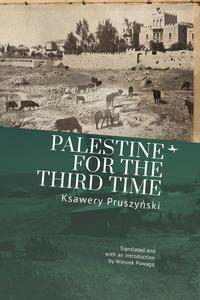
Palestine for the Third Time
Покупка
Издательство:
Academic Studies Press
Автор:
Pruszyński Ksawery
Год издания: 2020
Кол-во страниц: 201
Дополнительно
Вид издания:
Монография
Уровень образования:
Дополнительное профессиональное образование
ISBN: 978-1-64469-478-7
Артикул: 872943.01.99
Доступ онлайн
1 800 ₽
В корзину
Palestine for the Third Time is a book of reportage originally published in Poland in 1933 by Ksawery Pruszyński, a young reporter working for a Polish newspaper, who went to Mandate Palestine to see for himself whether the Zionist dream of returning to Eretz Yisrael had a chance of turning into reality. Travelling widely and talking to people he happened to meet on his way — Jews, Arabs, committed dreamers and the disaffected — he was trying to explain to his readers what he was seeing. This book is a unique firsthand account of the early stages in formation of the state and nation of Israel. But it's not just a nostalgic vignette. It resonates powerfully today, linking Tony Judt, Edward Said, and Amos Oz, illuminating the hotly debated questions of modern Israel.
Скопировать запись
Фрагмент текстового слоя документа размещен для индексирующих роботов
PALESTINE
FOR THE
THIRD TIME
Jews of Poland
Series Editor: Antony Polonsky (Brandeis University)
Boston
PALESTINE
FOR THE
THIRD TIME
Ksawery Pruszyński
Translated and with an introduction
by Wiesiek Powaga
Foreword by Antony Polonsky
Library of Congress Cataloging-in-Publication Data
Names: Pruszyński, Ksawery, 1907-1950, author. | Powaga, Wiesiek,
1958- translator, writer of introduction. | Polonsky, Antony, writer of
foreword.
Title: Palestine for the third time / Ksawery Pruszyński ; translated with an
introduction by Wiesiek Powaga ; foreword by Antony Polonsky.
Other titles: Palestyna po raz trzeci. English  | Jews of Poland.
Description:
Boston, MA : Academic Studies Press, 2020. | Series: Jews of Poland
Identifiers: LCCN 2020030464 (print) | LCCN 2020030465 (ebook) |
ISBN 9781644694770 (hardback) | ISBN 9781644694787 (adobe pdf) |
ISBN 9781644694794 (epub)
Subjects: LCSH: Pruszyński, Ksawery, 1907-1950--Travel--Palestine. |
Authors, Polish--20th century--Travel. | Palestine--Description and travel.
Classification: LCC DS107.3 .P813 2020  (print) | LCC DS107.3  (ebook) |
DDC 956.94/04--dc23
LC record available at https://lccn.loc.gov/2020030464
LC ebook record available at https://lccn.loc.gov/2020030465
Copyright, English translation © 2020 Wiesiek Powaga
All rights reserved.
Book design by Kryon Publishing Services (P) Ltd.
Illustrations remastering by Anna Carson. Cover design by Ivan Grave
Published by Academic Studies Press
1577 Beacon St.
Brookline, MA 02446
press@academicstudiespress.com
www.academicstudiespress.com
“I dedicate this book to my
university friend—MOJŻESZ POMERANZ”
Contents
Foreword: Ksawery Pruszyński
ix
By Antony Polonsky
Selected Bibliography of the Works of Ksawery Pruszyński
xxi
Introduction
xxiii
By Wiesiek Powaga
Foreword
xxx
    1.  On a Bunk Bed with the Halutzim
1
    2.  The Dust of the Road
8
    3.  The Land without Crises
11
    4.  More Beautiful than Paris
15
    5.  The Jews Who Do Not Like It Here
22
    6.  The Onward March of Israel
28
    7.  Suppliers of Men and Money
31
    8.  Malaria and Millions
34
    9.  Histadrut Haovdim
38
  10.  Like Stones Thrown against a Bulwark
45
  11.  Trekking across Emek Israel
52
  12.  Sabras of Ein Harod
57
  13.  Gesher
61
  14.  Glass Towers Are not a Myth
64
  15.  From Ghetto to Kibbutz
71
  16.  The Dollar Falls Twenty Percent
72
  17.  Only Four Weeks
74
  18.  The Wailing Wall
77
  19.  Socialism
80
  20.  Collective Love
83
  21.  Kibbutz, Kolkhoz, Cloister
84
  22.  The Jewish Population Catches Up
  23.  In the Eyes of Young Islam
  24.  Arabs in the Eyes of Jews
101
  25.  Christian Jerusalem
105
  26.  Nineteen Centuries after Pilate: A Night in Gethsemane
109
  27.  The Way of the Cross
112
  28.  Resurrexit
117
  29.  So Many Different Roads: “Das Wirkliche Deutschland”
118
  30.  “A Daemonio Meridiano . . .”
123
  31.  Roads
129
  32.  The Threat of Soviet Cannons
133
Afterword
139
Appendix: Ksawery Pruszyński’s Speeches to the UN
145
Photographs
154
Index
166
Foreword:
Ksawery Pruszyn´ski
We, Polish people, have special reasons to promote the State of Israel.
We have fought for too long time for a state of our own not to understand such a fight, when undertaken by others. We know unfortunately better than many other nations what it means for a nation to
have a state of its own. Our nation knows the gas chambers like the
Jewish people did and our nation has not forgotten, like some others,
the sad lesson of this war.
—Ksawery Pruszyński, speech delivered at the UN as chairman of
the United Nations Subcommittee Number One on Palestine in
November 19471
I
n his relatively brief life, Ksawery Pruszyński (December 4, 1907–June 13,
1950) embodied the tragic fate of Poland in the first half of the twentieth century.
He was born into a noble family near the village of Wolica Kierekieszyna (today
Volytsya-Kerekeshyna) on the Zbrucz River in southern Volhynia (Ukraine). The
founder of the village was a Tartar, Kierekiesza, and the area was characterized by
its mixture of religions and ethnicities. As Pruszyński himself put it:
I came into the world at a crossroad of worlds and times, cultures
and beliefs, languages and races, classes and nations, on a snowy
December day in a blizzard, when a sleigh was sent for the Jewish
“barber”—the doctor was already there, but courtesy required the
presence of the barber.2
1
This speech is reproduced as it was delivered in Pruszyński’s characteristic English.
2
Quoted in Józef Hen, Nie boję się bezsennych nocy (Czytelnik: Warzsawa, 2001), 23.
x
Foreword: Ksawery Pruszyn´ski
This area, part of Tim Snyder’s “Bloodlands,” saw considerable violence in
the twentieth century. When Pruszyński was barely three, his father Edward was
killed, probably in a clash with a horse thief. His mother Anna was a member of
a magnate family, the Chodkiewiczes, who had fallen on difficult times, which
was why they were willing for her to marry Edward, who was thirty-five years
her senior.3 She was now responsible, on her own, for bringing up her two sons,
Ksawery and his younger brother Mieczysław.
In 1918, during the Russian Civil War, Anna was forced to flee the area
with her sons and settle, in somewhat impoverished circumstances, in Kraków;
there, and with her family’s help, she was able to support herself by giving
French lessons. After the Treaty of Riga, which ended the Polish-Soviet war,
all the Pruszyński properties were located within the Soviet Union. Pruszyński
always had a powerful sense of being a “boy from the Kresy” and clearly greatly
missed his lost “little homeland.” When he served in the Polish consulate in
Kiev in 1933–1934, he went illegally to Wolica Kierekieszyna, only to find that
nothing remained of his family’s wooden manor house. He was certainly very
conscious of his roots. As he told Józef Hen, a Polish Jewish writer with whom
he became friendly in the Soviet Union during the war, what inspired all his
writing was “[a]bove all the fact that the past of the Rzeczpospolita [pre-partition Poland-Lithuania] was our past.”4
Pruszyński completed the first part of his secondary education in
Żytomierz and continued it at the Jesuit school in Chyrów (now in Ukraine),
near Przemyśl, one of the most prestigious in Poland. He then studied law at
Jagiellonian University, specializing in medieval German law under a leading conservative historian Stanisław Estreicher, working briefly as his assistant. While at university, he was president of the Akademickie Koło Kresowe
(Academic Club of Those from the Kresy) and joined the organization Myśl
Mocarstwowa (Aspirations to Great Power Status), which sought to recreate
the political tradition of the Polish-Lithuanian Commonwealth. He was also
hostile to antisemitism. According to Janusz Roszko, “he actively opposed
the fascist takeover of higher education and defended his colleagues who
had a ‘Semitic’ appearance against pogroms and the violence organized by
student corporations.”5 His defense of Jewish students is also confirmed in
3
See Anna Pruszyńska, Między Bohem a Słuczą (Wrocław: Zakład Narodowy im.
Ossolińskich, 2001).
4
Hen, Nie boję się bezsennych nocy, 26.
5
Quoted in Jarosław Kurski, “Pruszyński, Ksawery (1907–1950)—pisarz, reporter, dyplomata PRL,” Gazeta Wyborcza, April 18, 1998.
Похожие Показать весь список
Доступ онлайн
1 800 ₽
В корзину