
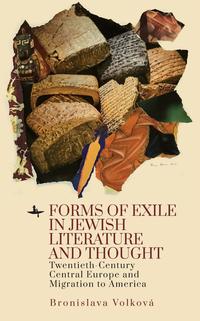
Forms of Exile in Jewish Literature and Thought: Twentieth-Century Central Europe and Migration to America
Покупка
Тематика:
Теория литературы
Издательство:
Academic Studies Press
Автор:
Volková Bronislava
Год издания: 2021
Кол-во страниц: 120
Дополнительно
Вид издания:
Монография
Уровень образования:
Дополнительное профессиональное образование
ISBN: 978-1-64469-406-0
Артикул: 872938.01.99
Доступ онлайн
1 800 ₽
В корзину
Forms of Exile in Jewish Literature and Thought deals with the concept of exile on many levels — from the literal to the metaphorical. It combines analyses of predominantly Jewish authors of Central Europe of the twentieth century who are not usually connected, including Kafka, Kraus, Levi, Lustig, Wiesel, and Frankl. It follows the typical routes that exiled writers took, from East to West and later often as far as America. The concept and forms of exile are analyzed from many different points of view and great importance is devoted especially to the forms of inner exile. In Forms of Exile in Jewish Literature and Thought, Bronislava Volková, an exile herself and thus intimately familiar with the topic through her own experience, develops a unique typology of exile that will enrich the field of intellectual and literary history of twentieth-century Europe and America.
Скопировать запись
Фрагмент текстового слоя документа размещен для индексирующих роботов
FORMS OF EXILE
IN JEWISH
LITERATURE
AND THOUGHT
Twentieth-Century
Central Europe and
Migration to America
An electronic version of this book is freely available, thanks to the support
of libraries working with Knowledge Unlatched. KU is a collaborative
initiative designed to make high quality books Open Access for the
public good. The Open Access ISBN for this book is 978-1-64469-406-0.
More information about the initiative and links to the Open Access version
can be found at www.knowledgeunlatched.org.
B O S T O N
2 0 2 1
FORMS OF EXILE
IN JEWISH
LITERATURE
AND THOUGHT
B RO N I S L AVA VO L KOVÁ
Twentieth-Century
Central Europe and
Migration to America
Library of Congress Cataloging-in-Publication Data:
A catalog record for this book as available from the Library of Congress.
Copyright © 2021 Academic Studies Press
All rights reserved.
ISBN 9781644694053 (hardback)
ISBN 9781644694060 (open access PDF)
ISBN 9781644694077 (ePub)
On the cover: “Talking Stones,” by Bronislava Volková. Collage.
Cover design by Ivan Grave.
Book design by Tatiana Vernikov.
Published by Academic Studies Press
1577 Beacon Street
Brookline, MA 02446, USA
press@academicstudiespress.com
www.academicstudiespress.com
Contents
Acknowledgements
Introduction: A General History of Concepts of Exile
11
1.  Exile as Expulsion and Wandering:
20
Joseph Roth, Sholem Aleichem, Stefan Zweig
2.  Exile as Aesthetic Revolt and an Inward Turn:
27
Hugo von Hofmannsthal, Robert Musil, Hermann Broch
3.  Exile as Social Renewal: Theodor Herzl, Max Nordau
31
4.  Exile as Resistance and a Moral Stance:
35
Karl Kraus, Arthur Schnitzler
5.  Exile as Gender Marginalization and the Independence
40
of the Femme Fatale: Alma Mahler
6.  Exile as an Escape from Patriarchal Oppression:
44
Franz Werfel
7.  Exile as Anxiety and Involuntary Memory:
47
Franz Kafka, Sigmund Freud, Marcel Proust, Bruno Schulz
8.  Exile as Doom and Revenge: Hermann Ungar
52
9.  Exile as a Loss of Identity: Saul Friedländer
55
10. Exile as Abandonment: Peter Weiss
60
11. Exile as Bearing Witness: Elie Wiesel
67
12. Exile as Dehumanization: Primo Levi
74
13. Exile as an Awakening of Consciousness:
80
Jiří Weil, Ladislav Fuks, Arnošt Lustig
14. Exile as a Feeling of Meaninglessness: Egon Hostovský
87
15. Exile as Transformation and a Will to Meaning:
90
Viktor Frankl, Simon Wiesenthal
Conclusion
101
Bibliography
104
Index
114
Acknowledgements
The publication of this book was possible thanks to a grant from the
Robert A. and Sandra S. Borns Jewish Studies Program, at Indiana
University.
The book was also selected by the Knowledge Unlatched Selection
Committee 2020 (comprised of specialist subject librarians from
all over the world) to be part of the “KU Select Books Collection
2020, Humanities and Social Science” as one of 343 titles worldwide
selected for Open Access release.
Behind the city! Understand? Behind!
Outside! Across the dam!
Life here is a place where it’s impossible to live.
A Jewish quarter . . .
Thus is it not a hundred times better
to become an Eternal Jew?
Because for everyone who is not a swine,
a Jewish pogrom stews.
Life. It’s alive only through renegades!
Through the Judases of the faiths!
Onto Solomon’s islands!
To hell! To anywhere but
to life, which suffers only renegades, only
sheep for the executioner!
I trample the certificate permitting my right to live
with my feet!
I tread it down! For David’s shield!
Into the compost of the bodies!
Isn’t it intoxicating that a Yid
did not want to live?!
A ghetto of chosen gatherings! Dam and ditch.
Do not seek indulgence!
In this most Christian of worlds
poets are treated as Yids!
—Marina Tsvetaeva:
Poem of the End, part 12, stanzas 7–12.
Translated by Bronislava Volková
Modern Western culture is in large part the work of exiles,
émigrés, refugees. In the United States, academic, intellectual
and aesthetic thought is what it is today because of refugees from
fascism, communism, and other regimes given to the oppression
and expulsion of dissidents.
And while it is true that literature and history contain heroic,
romantic, glorious, even triumphant episodes in an exile’s life,
these are no more than efforts meant to overcome the crippling
sorrow of estrangement.
—Edward Said:
Reflections on Exile
It seems proper that those who create art in a civilization
of quasi-barbarism, which has made so many homeless, should
themselves be poets unhoused and wanderers across language.
Eccentric, aloof, nostalgic, deliberately untimely . . .
—George Steiner
[I]t is part of morality not to be at home in one’s home.
—Theodor Adorno
The person who finds his homeland sweet is a tender
beginner; he to whom every soil is as his native one is already
strong; but he is perfect to whom the entire world is as a foreign
place. The tender soul has fixed his love on one spot in the world;
the strong person has extended his love to all places; the perfect
man has extinguished his.
—Hugh of St. Victor
(twelfth-century theologian)
Похожие Показать весь список
Доступ онлайн
1 800 ₽
В корзину