
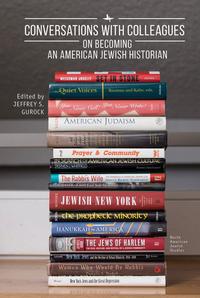
Conversations with Colleagues. On Becoming an American Jewish Historian
Покупка
Тематика:
Иудаизм
Издательство:
Academic Studies Press
Под ред.:
Gurock Jeffrey S.
Год издания: 2018
Кол-во страниц: 272
Дополнительно
Вид издания:
Монография
Уровень образования:
Дополнительное профессиональное образование
ISBN: 978-1-61811-857-8
Артикул: 872818.01.99
Доступ онлайн
1 800 ₽
В корзину
Sixteen senior scholars of American Jewish history — among the men and women whose work and advocacy have moved their discipline into the mainstream of academia — converse on the intellectual and personal roads they have traveled in becoming leaders in their areas of expertise. Through their thoughtful and candid recollections of the challenges they faced in becoming accepted academics, they retell the story of how the study of the Jews and Judaism in the United States rose from being long dismissed as an amateurish enterprise not worthy of serious consideration in the world of ideas to its position today as a respected field in communication with all humanities scholars. They also imagine and chart the direction the writing on American Jews will take in the coming era.
Скопировать запись
Фрагмент текстового слоя документа размещен для индексирующих роботов
con v er s at ions w i t h col l e agu e s
On Becoming an American Jewish Historian
north American Jewish studies
series editor: ira robinson (Concordia university)
Boston
Conversations
w ith Colle agues
On Becoming
an American Jewish Historian
Edited by Jeffrey S. Gurock
Library of Congress Cataloging-in-Publication Data:
A catalog reference for this title is available from the Library
of Congress.
ISBN (hardback) 978-1-61811-856-1
ISBN (electronic) 978-1-61811-857-8
Copyright © 2018 Academic Studies Press
All rights reserved
Cover design by Ivan Grave

Published by Academic Studies Press in 2018
28 Montfern Avenue
Brighton, MA 02135, USA
press@academicstudiespress.com
www.academicstudiespress.com
Grateful acknowledgment and thanks
is extended to Yeshiva University
for its generous support of this book.
Table of Contents
Introduction: A Community of Scholars Who Grew a Field
Jeffrey S. Gurock
Finding My Way: Uniting American Jewish
24
Women’s History and U.S. Women’s History
Joyce Antler
Reconstructing American Jewish Historical Studies
36
Dianne Ashton
A Meandering and Surprising Career
50
Mark K. Bauman
How I Became an American Jewish Historian
65
and What That Meant for My Professional Life
Hasia Diner
A Scholar-Athlete’s Discovery of American
77
Jewish History
Jeffrey S. Gurock
Object Lessons
90
Jenna Weissman Joselit
How I Learned to Call America “the States”
98
and Became an American Jewish Historian
Eli Lederhendler
Sidewalk Histories, or Uncovering the Venacular
110
Jewishness of New York City
Deborah Dash Moore
Becoming an “All-of-a-Kind” Jewish Historian
Pamela S. Nadell
Joining Historians as an Anthropologist
146
at the Table of American Jewish Culture
Riv–Ellen Prell
My Life in American Jewish History
161
Jonathan D. Sarna
From Kremenets to New York:
188
My Personal Journey as a Historian
Shuly Rubin Schwartz
Finding My Place in “the Great Tradition”
198
Gerald Sorin
Peripatetic Journeys
212
Beth S. Wenger
The Past from the Periphery
226
Stephen J. Whitfield
On Rabbis, Doctors, & the American
240
Jewish Experience
Gary Phillip Zola
Index
258
Contributions to Conversations
Joyce Antler is the Samuel Lane Professor of American Jewish
History and Culture and Professor of Women’s, Gender,
and Sexuality Studies Emerita at Brandeis University.
Dianne Ashton is Professor of Religion Studies at Rowan
University.
Mark K. Bauman is the editor of Southern Jewish History
and Professor of History (retired) at Atlanta Metropolitan
College.
Hasia Diner is the Paul and Sylvia Steinberg Professor
of American Jewish History at New York University and
Director of the Goldstein-Goren Center for American Jewish
History also at NYU.
Jeffrey S. Gurock is Libby M. Klaperman Professor of Jewish
history at Yeshiva University.
Jenna Weissman Joselit is the Charles E. Smith Professor of Judaic
Studies & Professor of History at The George Washington
University, where she also directs its graduate program in
Jewish cultural arts.
Eli Lederhendler is the Stephen S. Wise Professor of American
Jewish History and Institutions at the Hebrew University
of Jerusalem.
Deborah Dash Moore is the Frederick G. L. Huetwell Professor
of History and Judaic Studies at the University of Michigan.
Pamela Nadell holds the Patrick Clendenen Chair in Women’s
and Gender History at American University and is a past
president of the Association for Jewish Studies.
Riv-Ellen Prell, an anthropologist, is Professor Emerita
of American Studies at the University of Minnesota.
Contributions to Conversations
Jonathan D. Sarna is University Professor and Joseph H. & Belle
R. Braun Professor of American Jewish History at Brandeis
University, where he also chairs its Hornstein Jewish
Professional Leadership Program. He is, in addition,
the Chief Historian of the National Museum of American
Jewish History, and Chair of the Academic Advisory
and Editorial Board of the Jacob Rader Marcus Center
of the American Jewish Archives.
Shuly Rubin Schwartz is the Irving Lehrman Research Associate
Professor of American Jewish History and Walter and Sarah
Schlesinger Dean of Graduate and Undergraduate Studies
at The Jewish Theological Seminary.
Gerald Sorin is Distinguished Professor Emeritus of American
and Jewish Studies at SUNY, New Paltz.
Beth S. Wenger is Moritz and Josephine Berg Professor and Chair
of the History Department at the University of Pennsylvania.
Stephen J. Whitfield holds the Max Richter Chair in American
Civilization at Brandeis University.
Gary Phillip Zola is the Edward M. Ackerman Family
Distinguished Professor of the American Jewish Experience
& Reform Jewish History at Hebrew Union College-Jewish
Institute of Religion in Cincinnati, as well as the Executive
Director of The Jacob Rader Marcus Center of the American
Jewish Archives.
 I n t r o d u c t i o n
A Community of Scholars Who Grew a Field
Jeffrey S. Gurock
At the turn of the second decade of the new millennium, the study
of American Jewish history is well positioned as a humanities
discipline in academic conversation with scholars of American
and Jewish studies. Its scholars publish regularly in the field’s two
foremost journals, American Jewish History and the American Jewish
Archives Journal. Occasionally, a cutting-edge piece find its way in
the quarterlies or annuals of the American Historical Association
[AHA], the Organization of American Historians or the Association
for Jewish Studies; organizations that regularly invite panels on
subjects relating to Jewish life in America. Every two years, the
Academic Council of the American Jewish Historical Society [AJHS],
composed of more than 125 men and women who teach and write
in about all aspects of that group’s experience—many occupying
chairs in that specific area—returns the favor. It invites to a plenary
session of its Scholars Conference a senior scholar who does not
work in American Jewish studies, and the guest respectfully
compares council members’ work to important labors in the wider
arenas of American and Jewish studies. The American Academy for
Jewish Research—an elite, elected association of academics of all
areas and periods of Jewish studies—has its Fellows who specialize
in the American Jewish experience
Occupying this perch, the field has fulfilled the dream
Professor Cyrus Adler had more than a century ago. As a president
of the AJHS, this first major Jewish academician to associate
Похожие Показать весь список
Доступ онлайн
1 800 ₽
В корзину