
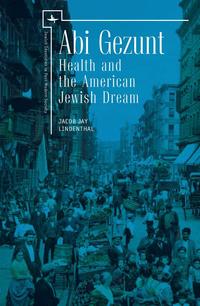
Abi Gezunt. Explorations into the Role of Health and the American Jewish Dream
Покупка
Тематика:
Этнография народов зарубежных стран
Издательство:
Academic Studies Press
Автор:
Lindenthal Jacob Jay
Год издания: 2017
Кол-во страниц: 572
Дополнительно
Вид издания:
Монография
Уровень образования:
Дополнительное профессиональное образование
ISBN: 978-1-61811-537-9
Артикул: 872803.01.99
Доступ онлайн
1 800 ₽
В корзину
This book consists of a series of investigations into the cultural and behavioral patterns of east European immigrant Jews known to promote health and prevent disease beginning in the late 19th and into the 20th centuries. Drawing on data pointing to health as an economic commodity, leading to economic strength and social development, the author suggests that the high value accorded to health played a role in the relative economic prosperity of American Jews. The book explores the implications of good health as a source of human capital worthy of investment and its significance for recent immigrants.
Тематика:
ББК:
УДК:
- 39: Этнология. Этнография. Обычаи. Манеры. Традиции. Образ жизни. Фольклор (изучение)
- 614: Социальная гигиена. Организация здравоохранения. Санитария. Защита от несчаст. случаев и их предупр.
ОКСО:
- ВО - Бакалавриат
- 46.03.01: История
- 46.03.03: Антропология и этнология
ГРНТИ:
Скопировать запись
Фрагмент текстового слоя документа размещен для индексирующих роботов
Explorations into the
Role of Health and the
American Jewish Dream
Jewish Identities in Post-Modern Society
Series Editor
Roberta Rosenberg Farber (Yeshiva University)
Editorial Board
Sara Abosch (University of Memphis)
Geoffrey Alderman (University of Buckingham)
Yoram Bilu (Hebrew University)
Steven M. Cohen (Hebrew Union College – Jewish Institute of Religion)
Bryan Daves (Yeshiva University)
Sergio Della Pergola (Hebrew University)
Simcha Fishbane (Touro College)
Deborah Dash Moore (University of Michigan)
Uzi Rebhun (Hebrew University)
Reeva Simon (Yeshiva University)
Chaim I. Waxman (Rutgers University)
Jacob Jay Lindenthal
Boston
2017
Explorations into the
Role of Health and the
American Jewish Dream
Library of Congress Cataloging-in-Publication DataNames: Lindenthal, Jacob Jay, author.
Title: Abi gezunt: explorations into the role of health and the American Jewish dream / Jacob Jay
Lindenthal, PhD, Dr PH. Description: Boston: Academic Studies Press, 2016. | Series: Jewish
identities in post-modern society | Includes bibliographical references and index. Identifiers:
LCCN 2016037754 (print) | LCCN 2016038131 (ebook) | ISBN 9781618115362 (hardback) |
ISBN 9781618115379 (e-book) Subjects: LCSH: Jews—Health and hygiene—History. | Jews, East
European—Health and hygiene—United States—History. | Jews, East European—United
States—Social conditions—19th century. | Jews, East European—United States—Social
conditions—20th century. | Immigrants—Health and hygiene—United States—History. | United
States—Ethnic relations. | BISAC: SOCIAL SCIENCE / Emigration & Immigration. | SOCIAL
SCIENCE / Social Classes. | SOCIAL SCIENCE / Disease & Health Issues. Classification: LCC
RA561. L56 2016 (print) | LCC RA561 (ebook) | DDC 610.89/924073—dc23LC record available
at https://lccn.loc.gov/2016037754
© Academic Studies Press, 2017
All rights reserved
ISBN 9781618115362 (hardback)
ISBN 9781618115379 (e-book)
Book design by Kryon Publishing,
www.kryonpublishing.com
Academic Studies Press
28 Montfern Avenue
Brighton MA 02135
USA
press@academicstudiespress.com
www.academicstudiespress.com
Table of Contents
Foreword
viii
Preface
xi
Acknowledgements
xviii
Introduction
xix
Chapter 1.  Halakha—The Foundation of Jewish Law and Life
1
Chapter 2.  Education and Literacy: The Path to Good Health
13
Social Support
Chapter 3.  Charity—Das Jüdische Herz
47
Chapter 4.  Family First
62
Health-Related Behaviors
Chapter 5.  Childrearing Practices and Attitudes
81
Chapter 6.  Alcoholism among the Jews
93
Human Capital
Chapter 7.  Housing and Jobs in the New World—Health Against All Odds	 107
Implications
Chapter 8.  Socioeconomic Status and Health
135
Chapter 9.  Health, Culture, and Wealth
150
Appendix I
169
Woodbury Data on Neonatal and Infant Mortality
169
Maternal Mortality and Maternal Age
171
Birth Intervals
Breastfeeding and Infant Mortality
vi
Table of Contents
Housing Congestion and Neonatal Survival
173
Maternal Employment During Pregnancy
174
Mortality in Later Ages
174
Pulmonary Data
175
Appendix II
177
Sources Corroborating Comparatively Low Rates of Tuberculosis
among Jews in Eastern Europe
177
Sources Corroborating Comparatively Low Rates of Infection
among Jews
178
Sources Corroborating Comparatively Low Rates of Influenza
among Jews
178
Sources Corroborating Comparatively Low Rates of Typhoid
Fever among Jews
178
Sources Corroborating Comparatively Low Rates of Mortality
Associated with Whooping Cough, Scarlet Fever, and
Measles among Jews
179
Sources Corroborating Comparatively Low Rates of Syphilis
among Jews
179
Sources Corroborating Alcohol Consumption Among Jews
180
Appendix III
181
Additional Reading
Index
A Personal Note
My reading of the literature of Jewish history and law served as the
seedbed for the hypothesis of this work. Two important factors served
to motivate the writing of this book: completion of the Lindex project,
a National Library of Medicine-supported, Internet-based review of
the disease experience of American Jews from 1874 until 1903, and
the rising number of large-scale quality prospective studies pointing
to the positive economic value of good health. The time was propitious
several years ago to begin assembling this volume.
It is quite possible that some of my readers may misinterpret this
work as an exercise in ethnocentrism. There is, indeed, a joy I take in
the accomplishments of my co-ethnics, coupled with a sense of sadness
upon learning of their misdeeds. Nevertheless, as a member of the social
science academic community, it is incumbent, once a topic is chosen, to
assemble and offer the facts with as much impartiality as possible.
Jacob Jay Lindenthal, PhD, Dr  PH
Foreword
The late American Jewish journalist and humorist Harry Golden entitled one of
his last books, published in 1970, So Long As You’re Healthy (Abee Gezundt). He
knew that the Yiddish phrase, usually transliterated as abi gezunt, resonated
with Jews and, for a time, with the larger American community beyond. On the
Lower East Side of New York, he recalled, “if the livelihood was not so good,
and even if the shopkeeper went bankrupt, his relatives and friends” would say,
consolingly, abi gezunt, “so long as you’re healthy.”1
Back in 1938, Molly Picon’s signature song in the Yiddish film Mamele
(“Little Mama”) did much to popularize the expression abi gezunt. The song’s
Depression-era message—“abi gezunt ken men gliklekh zayn,” (so long as you’re
healthy you can be happy)—offered a timely rebuke to those who linked happiness to the pursuit of power and money. What was truly important, the song
insisted, was good health, the basis for everything else.2
A year later, Cab Calloway, the great African American jazz singer and
band leader, likewise penned a song entitled “Abi Gezunt” (“If You’ve Got Your
Health, You Can Be Happy”). Drawing upon his acquaintance with his Jewish
manager, Irving Mills, and clearly influenced by the lyrics of Molly Picon’s
popular Yiddish song, he mischievously combined African American (“Hepster”)
slang with the funny-sounding Yiddish phrase , and crooned, “I’m hip de dip, a
1	 Harry Golden, So Long as You’re Healthy (Abee Gezundt) (New York: G. P. Putnam’s Sons,
1970), 19–20; see Kimberly Marlowe Hartnett, Carolina Israelite: How Harry Golden Made
Us Care About Jews, the South, and Civil Rights (Chapel Hill: University of North Carolina
Press, 2015), esp. 257.
2	 Neil Levin, “Abi Gezunt,” The Milken Archive of Jewish Music, accessed January 24, 2016,
http://www.milkenarchive.org/works/view/547#/works/view/547/full. Molly Picon wrote
the lyrics; Abraham Ellstein composed the music.
ix
Foreword
solid sender, a very close friend to Mrs. Bender, Bender, shmender, abi gezunt, I’m the
cat that’s in the know!” As Hankus Netsky has observed, Calloway “knew one of
the sweetest secrets of life: that a ‘cat’ that knows the meaning of Abi Gezunt is
a cat that’s in the know.”3
Dr. Jacob Jay Lindenthal has spent a lifetime exploring this same secret of
life. As an accomplished sociologist and highly respected health educator,
Dr. Lindenthal has dedicated a lifetime to exploring social relationships. Indeed,
he has personally worked to restore countless people to health and happiness,
and he has trained legions of medical students to do the same.
His interest in abi gezunt, however, goes far beyond his own medical
practice. In this book, he seeks to understand how health shaped the destiny
of the American Jewish community as a whole. American Jews’ rapid socioeconomic rise, he argues, is connected to their abiding concern with health.
Knowledge of risk and protective factors—some mandated by Jewish law,
others learned from books, still others passed down mimetically from parents
to children—resulted in healthful behaviors. In particular, the high value that
Jews placed upon “health, education, cohesive family life and communal
social support,” he shows, “played a particularly important role in helping
immunize the Jews against . . . the deterioration of their health status.” Better
health, in turn, led to the formation of capital and ultimately to the community’s
overall socioeconomic rise.
Dr. Lindenthal’s study rests upon a mountain of medical evidence, much
of it buried in obscure medical journals rarely consulted by historians. The
footnotes and bibliography alone open up a world of long-forgotten articles
detailing diverse aspects of immigrant Jewish health. Invaluable data are also
found in the appendices. Nobody, to my knowledge, knows this medical literature better than Dr. Lindenthal.4 Fortunately, he has now created a database
and index to this literature—what he calls The Lindex, the “first ethnic database of disease”—so that others may follow in his tracks and build upon his
extraordinary contribution. Hundreds of studies relating to the diseases and
3	 His rendition of the song, translated as “A Bee Gezindt,” can be viewed on https://www.
youtube.com/watch?v=_-ca4HbD7hY; see Hankus Netsky, “Cab Calloway: On the Yiddish
Side of the Street,” JBooks.com, accessed January 24, 2016, http://www.jbooks.com/
secularculture/Netsky.htm#.
4	 For an important earlier survey, see Deborah Dwork, “Health Conditions of Immigrant Jews
on the Lower East Side of New York: 1800–1914,” Medical History 25 (1981): 1–40.
x
Foreword
health conditions of Jews (1874-2000) are found in The Lindex. Historians of
medicine will forever be grateful for his assiduous collection of this primary
material.
The question that lies at the heart of this book—how American Jews
rose from rags to riches—has long captivated scholars and policy-makers
alike. Some, influenced by Max Weber’s The Protestant Ethic and the Spirit of
Capitalism,5 point to Jewish values and culture, particularly the Jewish
proclivity for education, as the engine of their success.6 Others credit America,
observing that Jews did not enjoy the same rapid rise in less hospitable countries. Still others point to freedom and free-market capitalism, which Jews
were able to exploit more than some of their peers. Luck, timing, history,
even Jews’ sexual habits have likewise been adduced to explain their rise. Nor
has the last word on this subject likely been written.7
Thanks to this book, historians will henceforward also need to consider
the vital importance of health in explaining American Jewish success. Knowledge about health, healthy behaviors (“protective factors”), and the avoidance
of unhealthy, risky habits and ways have, readers will see, prolonged Jewish lives
and increased Jewish wealth.
Abi gezunt encapsulates one of the sweetest secrets of American Jewish life.
Jonathan D. Sarna
Joseph H. & Belle R. Braun Professor of American Jewish History
Brandeis University
5	 Max Weber, The Protestant Ethic and the Spirit of Capitalism, trans. Talcott Parsons (New York:
Routledge, 2001 [orig. 1903]).
6	 For a recent controversial discussion of “How Education Shaped Jewish History,” see
Maristella Botticini and Zvi Eckstein, The Chosen Few (Princeton: Princeton University
Press, 2012), and the critique by Shaul Stampfer in Jewish History 29 (December 2015):
373–379.
7	 See Nathan Glazer’s pioneering discussion in “Social Characteristics of American Jews,
1654–1954,” American Jewish Year Book 56 (1955): 3–41. Recent discussions may be found
in Jerry Z. Muller, Capitalism and the Jews (Princeton: Princeton University Press, 2010);
Rebecca Kobrin (ed.), Chosen Capital: The Jewish Encounter with American Capitalism
(New Brunswick: Rutgers, 2012); Adam D. Mendelsohn, The Rag Race: How Jews Sewed
Their Way to Success in America and the British Empire (New York: New York University Press,
2015); and Rebecca Kobrin and Adam Teller, eds., Purchasing Power: The Economics of
Modern Jewish History (Philadelphia: University of Pennsylvania, 2015).
Похожие Показать весь список
Доступ онлайн
1 800 ₽
В корзину