
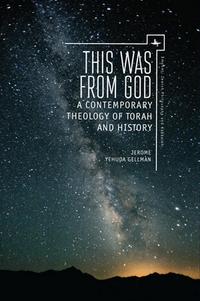
This Was from God. A Contemporary Theology of Torah and History
Покупка
Тематика:
Иудаизм
Издательство:
Academic Studies Press
Автор:
Gellman Jerome (Yehuda)
Год издания: 2016
Кол-во страниц: 223
Дополнительно
Вид издания:
Монография
Уровень образования:
Дополнительное профессиональное образование
ISBN: 978-1-61811-520-1
Артикул: 694287.02.99
Доступ онлайн
1 800 ₽
В корзину
Publicly or secretly, traditional Jews increasingly doubt the historical reliability of the Torah. Here, Gellman provides an "old-fashioned" Jewish theology for accepting the contemporary critique of Torah and history. Gellman presents an outline of the scholarly conclusions, and then examines faith responses and rejects apologetic attempts to evade the challenge. The book elucidates the notions of Divine Providence and Divine Accommodation that then provide a basis for the thesis that for centuries Divine Providence has been guiding toward a non-historical, non-literal understanding of the Torah. This was from God. Gellman advocates Hasidic-type non-literal approaches as most fitting for our times. Then, in light of the book's thesis, Gellman offers his understanding of Torah from Heaven, prayer, and the continuing validity of the commandments, for present-day traditional Judaism.
Скопировать запись
Фрагмент текстового слоя документа размещен для индексирующих роботов
T h i s  Wa s  f r o m  G o d
A Contemporary Theology of Torah and History
Emunot: Jewish Philosophy and Kabbalah
Series Editor
Dov Schwartz (Bar-Ilan University, Ramat Gan)
Editorial Board
Ada Rapoport Albert (University College, London)
Gad Freudenthal (CNRS, Paris)
Gideon Freudenthal (Tel Aviv University, Ramat Aviv)
Moshe Idel (Hebrew University, Jerusalem)
Raphael Jospe (Bar-Ilan University, Ramat Gan)
Ephraim Kanarfogel (Yeshiva University, New York)
Menachem Kellner (Haifa University, Haifa)
Daniel Lasker (Ben-Gurion University, Beer Sheva)
This Was from God
Jerome Yehuda Gellman
A Contemporar y Theolog y
of Torah and Histor y
Boston  /  2016
Library of Congress Cataloging-in-Publication Data:
A bibliographic record for this title is available
from the Library of Congress.
Copyright © 2016 Academic Studies Press
All rights reserved.
ISBN 978-1-61811-519-5 (cloth)
ISBN 978-1-61811-520-1 (electronic)
Cover design by Ivan Grave
Published by Academic Studies Press in 2016
28 Montfern Avenue
Brighton, MA 02135, USA
press@academicstudiespress.com
www.academicstudiespress.com
 תרדוף נפשי, וכו׳-  בתורותיך, ובמצוותיך- פתח לבי
With Your Torah—open my heart;
And with Your commandments—pursue my soul.
T a b l e  o f  C o n t e n t s
Preface
Introduction
11
Part I. Challenge and Response
Chapter 1. The Challenge
29
Chapter 2. Faith-Responses
45
Chapter 3. Apologetics
58
Chapter 4. A Counterproof
73
Part II. My Theological Toolbox
Chapter 5. Divine Providence
92
Chapter 6. Divine Accommodation
112
Part III. This Was from God
Chapter 7. This Was from God
128
Chapter 8. Torah from Heaven
149
Part IV. Torah Today
Chapter 9. Reading Torah with the Hasidim
167
Chapter 10. Prayer and Commandments
189
Bibliography
203
Index
214
P r e f a c e
Increasingly, well-informed traditional Jews may find themselves
distrustful of the reliability of Torah as history because of the
conclusions of scholarly research from natural science, history,
linguistics, Bible criticism, and archaeology. And, they may not be
swayed by attempts to restore their trust. If they do not have
a fitting theology for their new predicament, they may well give up
on Judaism altogether or else give up on their traditional Judaism.
Or, they may simply repress their difficulty because they see no
way of dealing with it that will allow them to retain their traditional
religious loyalty. They will carry on as if they believed in the historical
veracity of the Torah, when in fact they do not.
As one who has lived this problem, I want to now propose that
a person with prior emunah, belief and faith/loyalty in God and in the
holiness of the Torah remain faithful to keeping God and the holiness
of the Torah at the center of his or her life. What is needed is
a theology that appreciates the force of the challenge to Torah as
history and preserves one’s traditional religious loyalty. That is the
task of the present book.
Others before me have attempted this task. Yet, I am convinced
that in trying to deal with this issue others have departed from Jewish
tradition more than is required. Their theologies are more liberal than
necessary. The method of my book is to embrace as much of “old-time
religion” as possible while recognizing the new situation that more
and more traditional Jews are facing. The key is to begin to think of
the new developments not as a religious problem but as a religious
opening.
My debt is great to many people who were of help when I was
writing this book. Menachem Kellner was encouraging on many
occasions when I was unsure about proceeding with this book. He
made many helpful comments and also provided some sources
P r e f a c e
from medieval Jewish philosophy. I very much appreciate his
friendship.
Early on, Alan Zaitchik read several chapters and challenged
me with important philosophical objections, and he offered good
advice. I continue to benefit from the many years of our friendship.
Rabbi Michael Graetz read a few of the chapters of the book,
and I benefited from his knowledge of haggadic literature. Jonathan
Malino read most of the chapters and with his logical sharpness
helped me to clarify just what I was trying to argue in this book.
Although we do not see eye to eye on theological matters, he met
me on my own grounds and made this a far better book than it
otherwise would have been.
Baruch Schwartz was helpful in conversation on my questions
regarding the present situation in the discipline of biblical criticism.
David Gilad was kind enough to check carefully on some of my
claims about the challenge to history in the Torah in Chapter 1.
Yehudah D. Zirkind provided pointed and wise comments, but
I cannot say he agrees with the position of this book. I greatly
appreciate his input. Eliot Sacks was a careful reader of some of the
central chapters of this book. He brought to bear his philosophy
studies at Cambridge, which were not easy for me to work around.
I am grateful to him for forcing me to tackle some issues head-on.
Haim Waxman advised wisely at a number of crucial places in the
book. I am also thankful to Alick Isaacs for his encouragement and
good advice. I also want to thank Cass Fisher for his important
comments on realist language about  God.
Tamar Ross and I share a deep concern for the topic of this book,
and I admire her masterful work and her dedication to Torah and
Jewish Law. Yet we disagree about what should be said. Ross read
and graciously made various comments on some of the chapters.
For that I am greatly appreciative. Her remarks forced me to state
some of my positions with more care than I had, and to try to defend
them the best I could. Benjamin Sommer checked, and corrected, what
I attributed to him in this book. And, in personal communication he
was most obliging in discussing his views. We have fundamental
disagreements, yet I respect Sommer’s devotion to Torah, and to the
truth. I should also mention the work of Samuel Fleishacker, which
P r e f a c e
serves as a good complement to what I am doing here, and I have
gained from reading his thoughts.
I am greatly indebted to my teacher of philosophy, a devout
Christian, Alvin Plantinga, from whom I learned the art of careful
argumentation and from whom I learned to have the courage to
defend religious belief when unfairly attacked. Without his guidance,
personally and in his writings, this book could never have come
into being.
Rabbi Dr. Nathan Lopes Cardozo has a great fault—he vastly
overrates the value of my writings. This fault, however, is well
redeemed by his constant encouragement and by his readiness
to stay by my side. His example has been helpful in my decision
to publish this book. His David Cardozo Think-tank graciously
invited me early on to present a chapter of this book, from which
I gained much.
Much of the religious background I bring to this book lies in
Hasidic teachings and spirit, and in the thought of Rabbi Yehuda Leib
Ashlag (1885–1954). Rabbi Ashlag’s teachings have been distorted and
corrupted in various ways by some popularizers of Kabbalah. This is
most unfortunate. I have been privileged to study “Ashlag” writings
under a gifted, authentic teacher, Rabbi Avraham Mordechai Gottlieb,
a pupil of Rabbi Baruch Shalom Ashlag (1907–91), son of Rabbi
Yehuda Ashlag. Obviously, the thesis of this book is mine alone.
I wish to thank Scott Barker, Kira Nemirovsky, Gregg Stern and
the rest of the staff of Academic Studies Press for their efforts in the
production of this book. This is my second book with Academic
Studies Press, and I am most pleased to have published with them.
I am forever grateful to my wife, Edie (a.k.a. Edith Esther), who
above all others has consistently and strongly encouraged me to
publish this book. For a good while, I was deeply conflicted about
publishing this book because it marks a serious departure from
the customary teachings of the Orthodox Jewish community, to
which I belong. Edie’s understanding of me and her persistence in
encouraging me to go ahead with the project are the reasons this
book is being published. To her I dedicate this book with love and
devotion. May she be blessed.
***
P r e f a c e
Let me tell you a story. One day, at a time that I was unsure whether
to publish this book, because of its going “off the way” of Orthodoxy,
I went to a nearby synagogue to pray the afternoon minchah prayer.
As I sat down to pray, I noticed high on a nearby shelf several
volumes of the collected letters, the Igrot, of the late Rabbi Menachem
Mendel Schneerson, the “Rebbe” of Chabad-Lubavitch Hasidism.
I am not a Chabad-Lubavitch Hasid, but I knew that there are
followers of the Rebbe who believe that through the volumes of
the Igrot the Rebbe can communicate advice to those who seek his
counsel. They ask the Rebbe a question. Then completely at random
they select a volume of the Igrot. Then again completely at random
they open the volume to any page that comes up and pick a side of
the two pages they find open, left or right, again at random. When
they scrutinize the page they have selected, they are supposed to be
able to find there, on that page, in the words of the Rebbe, the answer
to their question.
Looking at the volumes of the Igrot on the synagogue shelf,
worried about what I should do about the book, quite impulsively
I asked the Rebbe (out loud): “Rebbe, should I publish this book?”
I then reached up, and without looking I took down a volume of
the Igrot. I then opened the volume, without looking, and slapped
my hand down on the volume on the page on the right side, again
without looking.
When I began to read that right-hand page, I was stunned. For
the very first sentence, at the very top of the page I had picked at
random, in the very volume I had picked at random, read as follows:
אני מקווה שאתה מפרסם ותפרסם
“I hope that you are publishing and that you will publish.”
I do not fool myself into thinking that the Rebbe would approve
of this book, but maybe, just maybe, he thought it worth something
nonetheless, or, perhaps more plausibly, thinking he could not stop
me in any case, he thought he might do what he can to make my book
better than it would have been by telling me to go ahead with it, with
his approval.
Похожие Показать весь список
Доступ онлайн
1 800 ₽
В корзину