
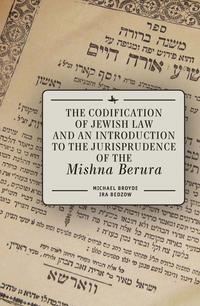
The Codification of Jewish Law and an Introduction to the Jurisprudence of the Mishna Berura
Покупка
Тематика:
Иудаизм
Издательство:
Academic Studies Press
Год издания: 2014
Кол-во страниц: 397
Дополнительно
Вид издания:
Монография
Уровень образования:
Дополнительное профессиональное образование
ISBN: 978-1-61811-279-8
Артикул: 694016.02.99
Доступ онлайн
1 800 ₽
В корзину
The Mishna Berura is, without a doubt, Rabbi Israel Meir Kagan's greatest and most complex contribution to the canon of Orthodox Jewish Law; it is a singular work that synthesizes Jewish traditions, laws, and mores into a practical halakhic guide to daily religious life. For all of his traditionalism, Rabbi Kagan was an iconoclast, and the Mishna Berura broke from many of the traditional approaches of deciding halakhic directives. Instead, he favored studying, engaging, and asserting decisions in a nuanced, almost natural approach to how ethical people should live their daily lives consistent with Jewish law. Today, the Mishna Berura has gained widespread recognition and is considered authoritative by essentially all of contemporary Orthodox Jewry, a measure of greatness that few works of Halakha have attained. Michael J. Broyde and Ira Bedzow here investigate this seminal text and explore its background and decision-making process.
Скопировать запись
Фрагмент текстового слоя документа размещен для индексирующих роботов
and an
Introduction to the
Jurisprudence of the Mishna Berura
Boston 2014
The Codification of
Jewish Law
and an
Introduction to the
Jurisprudence of the
Mishna Berura
Michael J. Broyde and Ira Bedzow
Library of Congress Cataloging-in-Publication Data:
A catalog record for this title is available from the Library of Congress.
Copyright ©2014 Academic Studies Press
All rights reserved
Cover design by Ivan Grave
ISBN 978-1-61811-278-1 (hardback)
ISBN 978-1-61811-279-8 (ebook)
Published by Academic Studies Press in 2014
28 Montfern Avenue
Brighton, MA 02135, USA
press@academicstudiespress.com
www.academicstudiespress.com
ACKNOWLEDGMENTS M any people have contributed in different ways to the writing of this book and we would like to thank them: Thank you to the Center for the Study of Law and Religion, the Law School and the Tam Institute of Jewish studies, all at Emory University, who supported us in writing this work, and the editors at Hamline Law Review for reviewing and publishing an earlier version of portions of this book as an article. We particularly also want to thank Jerry and Chaya Weinberger, who supported our work in dedication to their son’s, Shmuel’s, bar mitzvah. Their support was a demonstration of the ideal that parents wish for their children to continue to grow and study works of Torah and Halakha, and that their learning enhances their practice and observance. We would like to thank the many different people who helped with production of the manuscript. In particular, Sharona Vedol of Academic Studies Press helped us in many different ways. Thank you as well to Leah Levy, Judah Berger, and Avraham Lewis, who proofread various parts of this work. Many people—too many to name and thank individually—read different portions of this work, and we are grateful to each of them. M ost importantly, each of us has been privileged to be married to wonderful women without whose patience, love, affection, and kindness we would be lost, and we dedicate this book to Channah S. Broyde and Rachel Johanna Bedzow. We are both truly blessed to be married to women who have supported us in so many ways. “The heart of her husband safely trusts in her, and [therefore] he has no lack of gain.”
TABLE OF CONTENTS

Acknowledgments........................................................................................v
and an Introduction to the Jurisprudence of the Mishna Berura
I.
General Methodology of Codification of Jewish Law..................................... 1
II.
History of Codification..................................................................................6
III.
Introduction to Rabbi Israel Meir Kagan and the Mishna Berura................ 18
IV.
Mishna Berura’s Philosophy of Jewish Law................................................. 23
V.
Mishna Berura’s Jurisprudence................................................................... 27
VI.
The Mishna Berura’s Technique of Legal Interpretation.............................. 61
VII.	 The Mishna Berura’s Use of Key Terms........................................................ 65
VIII.	 Examples of the Mishna Berura’s Methodology..........................................69
(A)
Adding a New Dimension to Resolve a Disagreement................................. 72

Example 1—Androgynous and Tumtum: Intersex and Jewish Law.......................... 72

Example 2—Tefillin (Phylacteries) of Rabbenu Tam and

Tefillin on Hol HaMoed................................................................................... 76

Example 3—Praying the Morning Prayer (Shaharit) Late...................................... 82
(B)
Inclusion of all Jews................................................................................... 85

Example 4—Calling One who is Blind or who Cannot Read to the Torah................ 85

Example 5—Reciting Birkat HaMazon for Those Who Cannot............................... 87

Example 6—Giving Food to One who Doesn’t Know the Blessing..........................89
(C)
Jewish-Gentile Relations............................................................................. 91

Example 7—Carrying for a Gentile on Yom Tov................................................... 91

Example 8—Giving Mail to a Gentile before Shabbat........................................... 93

Example 9—Having a Gentile Buy Things for a Jew............................................. 95
(D)
The Existence of Erroneous Customs..........................................................96
viii
Table of Contents

Example 10—Eruv and Public Domains.............................................................96

Example 11—Saying “Amen” After “Ga’al Israel”.................................................99

Example 12—Eating Hadash...........................................................................102
IX.
Alternative Views of the Mishna Berura’s Methodology............................ 104

Simcha Fishbane’s Method and Meaning of the Mishna Berura.......................... 104

Benjamin Brown’s “Soft Stringency”.............................................................. 106
X.
Conclusion................................................................................................113
Two Hundred Fifty Illustrative Examples from the Mishna Berura............115
Terminology ....................................................................................................  119
Juridical Strategy ............................................................................................ 144
Interpretative Strategy ....................................................................................185
The Accretive Technique

In Addition to Juridical Strategy .................................................................... 238

In Addition to Interpretative Strategy ............................................................. 272
Reliance on the Gra

In Addition to Juridical Strategy .................................................................... 287

In Addition to Interpretative Strategy ............................................................. 302
The Role of Custom ......................................................................................... 319

Appendix A: A Summary Index of the Examples .................................... 357

Appendix B: A Brief Note on the History of Halakha .............................  368

Appendix C: Biography of Selected Rabbis Mentioned

                           in Mishna Berura.................................................................371

Appendix D: A Brief Note in the Names of Jewish Books......................... 379

Index........................................................................................................ 382
I
General Methodology of
Codification of Jewish Law
D
ue to its exilic development since the beginning of the Common
Era, Jewish law1 lacks a clear method for resolving disputes.
Talmudic, medieval, and contemporary debates linger, since direct,
categorical rules of resolution, such as majority votes of the Supreme
Court in the United States or Papal pronouncements in canon law,
do not exist. The exact reason for this is beyond the scope of this
introduction, yet some methodological explanation will allow the
reader to have a better understanding of the relationship of the
modern classical work of Jewish law, the Mishna Berura,2 to other
jurisprudential approaches to obedience to Jewish law.
Until about two thousand years ago, the Jewish community
had a “supreme court” called the Sanhedrin,3 a (parliamentary)
joint legislative and judicial assembly that resolved disputes in
matters of Jewish law by majority vote.4 Following the destruction
1
For a brief note on the history of Halakha, see appendix B.
2
Though the Mishna Berura was written by Rabbi Israel Meir Kagan, and we
provide a brief biography of the author, this article addresses the book and not
the author. It is the methodology of the Mishna Berura as a book, not Rabbi
Kagan as a jurist, that we seek to examine. See infra text accompanying notes
52–97 (providing more information on Rabbi Kagan, as well as on the book the
Mishna Berura).
3
From the Greek Synedrion, the Aramaic word is commonly thought to be a
translation of the Hebrew term “members of the Great Assembly,” a body which
derives its authority from a set of biblical verses in Exodus.
4
Maimonides, Mishna Torah, Sefer Shoftim, Hilkhot Sanhedrin Vehaonashin
Hamesurin Lahem (Laws of the Sanhedrin and the punishments they are authorized to administer) 1:1, 3.
of the Second Temple in Jerusalem around 70 CE, this body ceased
having undisputed juridical authority. Despite its temporary reconstitution in Yavneh and subsequent locations, the Sanhedrin could
no longer impose uniformity of practice. The Mishna (c. 200 CE)
bears witness to this phenomenon and illustrates the devolution of
the Court by recounting various conflicts among the Sages without
attempting to resolve them.
From the time of the disbanding of the Sanhedrin through the
centuries following the redaction of the two Talmuds5 (c. 650–700
CE), disputes as to what the Jewish law should be in any specific case
were resolved by an informal, consensus-based voting process in
which the ordained rabbis of the generation participated.6 Not every
dispute, however, reached a resolution, and since there was no
consensus on what the normative practice should be, the law was
left open.7
From about the year 700 CE until the modern era the process
for resolving disputes further deteriorated, to the point that even
informal consensus was no longer possible. Moreover, diverse
halakhic opinions began to proliferate. This combination had
various reasons: for example, geography made communication
across communities difficult, and increased interest in Talmud
study in areas with very diverse living conditions led to different
ways to understand the Talmudic texts as influenced by location.
Regardless of the reason, however, disagreements on points of law
became common, and methods of dispute resolution became highly
analytical. Support for one opinion over another rested upon which
opinion was seen to be more consistent with the accepted Talmudic
sources. The opinion that was shown to be a more accurate
5
Indeed, though the Babylonian (c. 500 ce) and Palestinian (c. 350–400 ce)
Talmuds are often in accord, the very notion of two Talmuds points to a decline
in any ability to develop a unified consensus authority for Jewish law.
6
Thus, for example, the Talmud sometimes concludes a dispute with the word
“vehilcheta,” which is generally understood to mean “and this is the proper
practice,” denoting the consensus that is mentioned above.
7
In some instances a consensus developed, but uncertainty has since arisen as to
what that consensus ruling actually was.
Похожие Показать весь список
Доступ онлайн
1 800 ₽
В корзину