
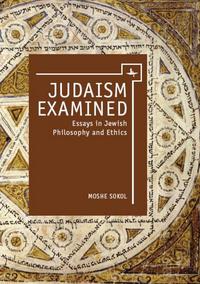
Judaism Examined. Essays in Jewish Philosophy and Ethics
Покупка
Тематика:
Иудаизм
Издательство:
Academic Studies Press
Автор:
Sokol Moshe
Год издания: 2013
Кол-во страниц: 523
Дополнительно
Вид издания:
Монография
Уровень образования:
Дополнительное профессиональное образование
ISBN: 978-1-61811-187-6
Артикул: 872801.01.99
Доступ онлайн
1 800 ₽
В корзину
Are there theoretical grounds for tolerance in the classical Jewish tradition? Is human autonomy endorsed by Judaism? What is the range of attitudes towards pleasure that have found their expression in Jewish sources? What does Maimonides have to say about joy, and what does Rabbi Joseph B. Soloveitchik teach about human suffering? This volume of essays examines these and many other key questions about Judaism from the rigorous perspective of philosophical analysis. Unlike most scholarship in Jewish philosophy, which approaches the field primarily from the perspective of intellectual history, this volume also engages in active philosophical dialogue with the texts and thinkers it addresses. Judaism Examined is a much-needed voice to the perennial questions of Jewish philosophy.
Тематика:
ББК:
УДК:
ОКСО:
- ВО - Бакалавриат
- 47.03.01: Философия
- 47.03.02: Прикладная этика
- 47.03.03: Религиоведение
ГРНТИ:
Скопировать запись
Фрагмент текстового слоя документа размещен для индексирующих роботов
-----------------------------------------  • ----------------------------------------------JUDAISM EXAMINED
Essays in Jewish philosophy and ethics
-------------------------------  Moshe Sokol ------------------------------------
touro college press
New york
New York
2013
-----------------------------------------  • ----------------------------------------------JUDAISM EXAMINED
Essays in Jewish Philosophy and ethics
----------------------  Dr. Moshe Sokol --------------------------Dean and professor of philosophy
Lander college for men of Touro college
Library of Congress Cataloging-in-Publication Data:
a catalog record for this title is available from the Library of Congress.

ISBN  978-1-618811-165-4
©Touro College Press, 2013
Published by Touro College Press and Academic Studies Press.
Typeset, printed and distributed by Academic Studies Press.
Book design by Olga Grabovsky, Ivan Grave
Touro College Press
Michael A. Shmidman and Simcha Fishbane, Editors
43 West 23rd Street
New York, NY 10010
USA
touropress.admin@touro.edu
Academic Studies Press
28 Montfern Avenue
Brighton, MA 02135, USA
www.academicstudiespress.com
— v —
Contents
Acknowledgements  .   .   .   .   .   .   .   .   .   .   .   .   .   .   .   .   .   .   .   .   .   .   .   .vii
INTRODUCTION .   .   .   .   .   .   .   .   .   .   .   .   .   .   .   .   .   .   .   .   .   .   .   .   .   .   .   . x
LIVING A JEWISH LIFE
Chapter I
Maimonides on Joy .   .   .   .   .   .   .   .   .   .   .   .   .   .   .   .   .   .   .   .   .   .   .   .   .   .  12
Chapter II
Maimonides on the Philosophical Life .   .   .   .   .   .   .   .   .   .   .   .   .   .   .   .   .   .  31
Chapter III
Is There a “Halakhic” Response to the Problem of Evil?  .   .   .   .   .   .   .   .   .   .   67
Chapter IV
Attitudes Toward Pleasure in Jewish Thought: A Typological Proposal  .   .   .   83
Chapter V
Mitzvah as Metaphor:
Towards a Philosophical Theory of Ta’amei Ha-Mitzvot .   .   .   .   .   .   .   .   .   .   .112
AUTONOMY, FREEDOM, AND TOLERANCE
Chapter VI
Maimonides on Freedom of the Will and Moral Responsibility .   .   .   .   .   .   .140
Chapter VII
Master or Slave?
Rabbi Joseph B. Soloveitchik on Human Autonomy in the Presence of God .  158
Chapter VIII
The Autonomy of Reason, Revealed Morality and Jewish Law .   .   .   .   .   .   .  205
--------------------------------------------------------------------------  Contents -------------------------------------------------------------------------— vi —
Chapter IX
Theoretical Grounds for Tolerance in the Jewish Tradition .   .   .   .   .   .   .   .   .225
Chapter X
Personal Autonomy and Religious Authority .   .   .   .   .   .   .   .   .   .   .   .   .   .   .263
TOPICS IN APPLIED JEWISH ETHICS AND PHILOSOPHY
Applied Jewish Ethics
Chapter Xi
The Allocation of Scarce Medical Resources:
A Philosophical Analysis of the Halakhic Sources .   .   .   .   .   .   .   .   .   .   .   .   .305
Chapter XIi
Some Tensions in the Jewish Attitude Toward the Taking of Human Life  .   . 338
Chapter XIIi
What Are the Ethical Implications of Jewish
Theological Conceptions of the Natural World? .   .   .   .   .   .   .   .   .   .   .   .   .   .355
Rabbi Joseph B. Soloveitchik
Chapter XIV
Joseph B. Soloveitchik: Lonely Man of Faith .   .   .   .   .   .   .   .   .   .   .   .   .   .   .378
Chapter XV
Ger Ve-Toshav Anokhi: Modernity and Traditionalism
in the Life and Thought of Rabbi Joseph B. Soloveitchik .   .   .   .   .   .   .   .   .   .434
Chapter XVI
Transcending Time:
Elements of Romanticism in the Thought of Rabbi Joseph B. Soloveitchik .   . 451
Interpreting Jewish Texts
Chapter XVII
What Does A Jewish Text Mean?
Theories of E’lu Ve-Elu Divrei Elohim Hayyim in Rabbinic Literature .   .   .   .   . 467
Chapter XVIII
How Do Modern Jewish Thinkers Interpret Religious Texts? .   .   .   .   .   .   .   .481
CITATIONS INDEX .   .   .   .   .   .   .   .   .   .   .   .   .   .   .   .   .   .   .   .   .   .   .   .   .   .509
GENERAL INDEX  .   .   .   .   .   .   .   .   .   .   .   .   .   .   .   .   .   .   .   .   .   .   .   .   .   .  512
--------------------------------------------------------------  ACKNOWLEDGEMENTS -------------------------------------------------------------— vii —
ACKNOWLEDGEMENTS
The chapters in this volume, with the exception of Chapter Two, all
appeared as papers published in numerous contexts over the course of
many years, and many friends and colleagues have helped me sharpen
and refine my ideas. I have thanked them at the outset of each chapter.
I wish to thank here Dr. Simcha Fishbane, who long encouraged me to
publish my essays, and Dr. Alan Kadish, president and CEO of Touro
College, for providing the academic leadership, vision, and resources
that have made this volume a reality. Dr. Michael Shmidman, dean
of the Touro Graduate School of Jewish Studies, played a pivotal
role in bringing this volume to fruition, sharing his sage advice,
encouragement, and precious time from beginning to end. I am deeply
indebted to him. Susan Moskowitz, administrator of the Office of the
Dean, and Joan Wagner, librarian, both at Lander College for Men,
provided invaluable and time-consuming assistance, as did Abigail
Yusupova. Sharona Vedol and Kira Nemirovsky of Academic Studies
Press were a true pleasure to work with.
My brother Mayer Sokol, my sister Raisy and her husband
Dovid Barnett, and my brothers- and sisters-in-law, Malky and
Shaya Abraham and Blim and Arnon Frager, have contributed
in uncountable ways to my life, and therefore to this volume, for
which I am profoundly grateful. The love of my children and their
spouses, Zvi and Dina, Estee and Daniel, Aliza and Uri, Yonah and
Zehava, and Yosef and Devorah, nourishes my heart, soul and mind.
They and their children are my greatest sources of blessing, joy, and
delight, and I wonder who and where I would be without them all.
My mother-in-law, Mrs. Helen Wagh, a woman of wisdom, courage,
determination, and love, together with her late husband, Isaac, a
--------------------------------------------------------------  ACKNOWLEDGEMENTS -------------------------------------------------------------— viii —
man of kindness, honesty, and good nature, have been the best inlaws any man could have. My parents Albert and Shirley, more than
any other persons, are responsible for whatever good I possess. They
raised me to respect knowledge, creativity, and moral and intellectual
integrity, to care for those who need care, to be compassionate, and
to act on that compassion. Their own lives model these virtues, and
their love has nurtured me from infancy. Although I am very far from
infancy indeed, I still feel nurtured by their love. May they continue
to enjoy many happy and healthy years ahead, for they still have
much to teach me, and my children and grandchildren too.
Ever since we married many years ago, I have been sustained by
the love, care, and practical wisdom of my wonderful wife Chaya. Hers
is the most wonderful neshama, and her sweetness, purity of spirit,
integrity, and clarity of thought have blessed me, and our children and
grandchildren, in more ways than I can begin to enumerate. May she
see much nachas from us all for many, many years to come.
Finally, we all owe the greatest debt of gratitude to Him who has
made everything possible.
Most chapters in this volume first appeared in the following
publications, and I am grateful for the editors’ permission to publish
them here.
“Elements of Romanticism in the Thought of Rabbi Joseph B.
Soloveitchik,” Modern Judaism 30: 3 (2011).
“Maimonides on Joy,” in Maimonides and His Time, ed. Lenn E.
Goodman (Albany, NY: SUNY Press, 2009).
“Theoretical Grounds for Tolerance in the Jewish Tradition,” in
Tolerance, Dissent and Democracy, ed. Moshe Sokol (New York:
Jason Aronson, 2002).
“What Are the Ethical Implications of the Jewish Theological
Conceptions of the Natural World?,” in Judaism and the Natural
World : Philosophical and Ethical Perspectives, ed. Hava Tirosh
Samuelson (Cambridge, MA: Harvard University Press, 2002).
“Is There a ‘Halakhic’ Response to the Problem of Evil?,” Harvard
Theological Review 92:3 (1999).
--------------------------------------------------------------  ACKNOWLEDGEMENTS -------------------------------------------------------------— ix —
“Maimonides on Freedom of the Will and Moral Responsibility,”
Harvard Theological Review 91:1 (1998).
“What Does a Jewish Text Mean? Theories of E’lu—Ve’Elu Divrei
Elohim Hayyim in Rabbinic Literature,“ Da’at 13:1 (1994).
“Ger ve –Toshav Anokhi: Modernity and Traditionalism in the Life and
Thought of Rabbi Joseph B. Soloveitchik,” Tradition 29:1 (1994).
“Personal Autonomy and Religious Authority,” in Personal Autonomy
and Rabbinic Authority, ed. Moshe Sokol (New York: Rowman &
Littlefield Publishing Group, 1992), 169-216.
“How Do Modern Thinkers Interpret Religious Texts?” Modern
Judaism 13 (1993): 25-48.
“Mitzvah as Metaphor: Towards a Philosophical Theory of Ta’amei
Ha- Mitzvot,” in A People Apart: Chosenness and Ritual in Jewish
Phillosophical Thought, ed. Daniel Frank (Albany: SUNY Press, 1993).
“Attitudes Towards Pleasure in Jewish Thought: A Typological
Proposal,” in Reverence, Righteousness and  Rahmanut, ed. Jacob
J. Schacter (New York: Rowman & Littlefield Publishing Group,
1992).
“The Allocation of Scarce Medical Resources: A Philosophical
Analysis of the Halakhic Sources,” AJS Review XV:1 (Spring
1990): 63-83.
“The Autonomy of Reason, Revealed Morality and Jewish Law,”
Religious Studies 22 (1986): 423-427.
“Joseph B. Soloveitchik: Lonely Man of Faith,” with David Singer,
Modern Judaism 2 (1982): 227-272.
“Some Tensions in the Jewish Attitude Toward the Taking of Jewish
Life,” Jewish Law Annual VII (1988): 97-114.
“Master or Slave? Rabbi Joseph B. Soloveitchik on Human
Autonomy in the Presence of God,” in Turim: Studies in Jewish
History and Literature Presented to Dr. Bernard Lander, ed.
Michael Shmidman (Jersey City, NJ: Touro College Press/Ktav,
2007), 275-330.
---------------------------------------------------------------------  Introduction --------------------------------------------------------------------— x —
Introduction
Most, although by no means all, scholars of Jewish philosophy
approach the field primarily from the perspective of intellectual Jewish
history. What does a particular thinker maintain, how were his ideas
influenced by those of his predecessors and contemporaries and the
general cultural milieu in which he lived and worked, and how did
his ideas influence others? This is surely a valuable mode of inquiry.
Nevertheless, it hardly exhausts the range of possibilities.
This is so in several senses. First, what has sometimes been called
“constructive” Jewish thought is by very definition not the province
of history. Those who wish to make creative and contemporary
contributions to the very same problems that have long preoccupied
Jewish thinkers, or to new problems never even envisioned in the past,
are hardly engaged in an historical task. While what they do often is,
and should be, informed by the past, its very ambition is to liberate
itself from that past and approach questions anew.
Second, even when great Jewish thinkers are studied, they can and
should be considered not only as historical artifacts embedded in the
past, but in active dialogue with the present. After all, they wanted
to be taken seriously, took themselves to be engaged in a quest for
the truth, and believed in the eternal truth of what they wrote. But
this would require them to be open to active and critical conversation
not only with their contemporaries, but with their successors as well.
Such a conversation will raise questions about the clarity of the ideas
of these thinkers, their justification, and their internal coherence, and
apply the conceptual frameworks and ideas of recent and contemporary
philosophers to bear on those great efforts of the past.
Похожие Показать весь список
Доступ онлайн
1 800 ₽
В корзину