
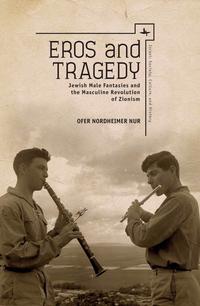
Eros and Tragedy. Jewish Male Fantasies and the Masculine Revolution of Zionism
Покупка
Тематика:
Социология
Издательство:
Academic Studies Press
Автор:
Ofer Nordheimer Nur
Год издания: 2014
Кол-во страниц: 247
Дополнительно
Вид издания:
Монография
Уровень образования:
Дополнительное профессиональное образование
ISBN: 978-1-61811-073-2
Артикул: 693944.02.99
Доступ онлайн
1 800 ₽
В корзину
Between 1920 and 1922, hundreds of members of the Hashomer Hatzair youth movement left the defunct Habsburg Monarchy and sailed to Palestine, where a small group of members of the movement established Upper Bitania, one of the communities that laid the foundation for Israel’s kibbutz movement. Their social experiment lasted only eight months, but it gave birth to a powerful myth among Jewish youth which combined a story about a heroic Zionist deed, based on the trope of tragedy, with a model for a new type of community that promised no less than a total, absolute elimination of all physical and mental barriers between isolated individuals and their fusion into one entity. This entity was named "the erotic community.” In its quest for human regeneration, Upper Bitania embarked on a journey into a highly specific variant of modern life that, at its core, tried to combine the most profound Nietzscheanism with the insights of Sigmund Freud, all in an anti-capitalist quest for an organic community of "new men.” The quest for a "new man” was to compensate for a crisis of manliness and betrays an obsession with masculinity and male bonding, and their effects on the ideal man and woman.
Тематика:
ББК:
УДК:
ОКСО:
ГРНТИ:
Скопировать запись
Фрагмент текстового слоя документа размещен для индексирующих роботов
Israel: Society, Culture and History
Yaacov Yadgar
(Political Studies, Bar-Ilan University), Series Editor
Editorial board:
Alan Dowty,
Political Science and Middle Eastern
Studies, University of Notre Dame
Tamar Katriel,
Communication Ethnography,
University of Haifa
Avi Sagi,
Hermeneutics, Cultural studies,
and Philosophy, Bar-Ilan University
Allan Silver,
Sociology,
Columbia University
Anthony D. Smith,
Nationalism and Ethnicity,
London School of Economics
Yael Zerubavel,
Jewish Studies and History, Rutgers University
BOSTON /2014
Library of Congress Cataloging-in-Publication Data:
A catalog record for this title is available from the Library of Congress.
Copyright © 2014 Academic Studies Press All rights reserved
ISBN 978-1-936235-85-8 (Cloth)
ISBN 978-1-61811-073-2 (Electronic)
Cover design by Ivan Grave
On the cover: Kibbutz Beit Alfa, photo from Eliezer Sklartz collection,
reproduced by permission of Dan Saar.
Published by Academic Studies Press in 2014
28 Montfern Avenue
Brighton, MA 02135, USA
press@academicstudiespress.com
www.academicstudiespress.com
To the memory of my grandmother Judith Nordheimer
Table of Contents
Preface and Acknowledgments
vii
xii
Chapter I. Eastern Galicia and Vienna: Hashomer, Tse’irei Tsiyon,
and the Origins of Hashomer Hatzair
1
Chapter II. The “Sexual Problem” in the Youth Movement: From
Denial, to Love, to Eros
43
Chapter III. Tragic Man: An Aesthetic of Anarchism
66
Chapter IV. Eros and Tragedy: Dionysos in the Galilee
80
Chapter V. Martin Buber and Gustav Landauer: Gemeinschaft and
Subterranean Judaism
103
Chapter VI. Dancing, Working, and Public Confessions: The Eda
Takes Its Form
136
Chapter VII. The Eda of Hashomer Hatzair as Männerbund: A Jewish
Male Fantasy Comes Full Central European Circle
150
Chapter VIII. The Tragic Hero Metamorphoses into a Sensitive
Man
169
Bibliography
Index
Preface and Acknowledgements
In this book I claim that wishing to heal the injured masculinity of
a generation of young Jews in central Europe is at the very heart of
Zionism as a project for national regeneration. This dimension must
be added to a well-researched catalogue list of reasons that address
the question of why Zionism as a political, ideological, and practical
movement rose davka in central Europe and what made it so appealing and so effective. Zionism should be understood in this perspective as the manly response to one of the most insulting dimensions of
modern antisemitism: its venomous view of the Jewish body as ugly,
abject, deformed, repulsive. Not only repulsive but also unmanly: the
German fraternity charters at the University of Vienna, for example,
explicitly forbade fencing with Jewish students because fencing is
an honorable engagement, reserved exclusively for “real men.” This
strand of the “golden age” of antisemitism in Europe (1870s–1945) was
especially offensive to the young Jewish men of central Europe, more
pointedly sensitive to this insult than Jews living in Western nations
such as England or France, or those living in the Pale of Settlement.
By and large, the Zionist movement (not unlike a host of other
modern movements, from the maskilim of the late eighteenth century to anti-Semites) accepted the corporeal claims against the Jews
and was conditioned by them. It derided the Jews of the Diaspora as
Luftmeschen. This is one of the reasons why it was supremely important in the first decades of Zionist activity to make the movement visibly muscular, athletic, tanned, and attractive. The negation of the
Diaspora, at the core of the Zionist discourse of recognition and justification, was a negation of a particular Jewish powerlessness, a powerlessness that mentally conditions peoples and groups in exile, termed
by Yuri Slezkine “service nomads.” This type of existence as an entrepreneurial minority, living without legitimate access to military power
or claims to recognized territorial sovereignty, made the Jewish communities vulnerable, dependent on some form of protection. As was
suggested by Daniel Boyarin, this condition of exile made its mark on
Jewish masculinity. Living without territory, they became disembodied, imagined as sickly. It made them conciliatory, compromise-seeking, and averse to violence.
—  VIII  —
Preface and Acknowledgements
In the case of Hashomer Hatzair, the turn to Zionism was
embedded in the most profound central European realm of discourse.
I identified Eros and Tragedy as two core tropes in that German central European discourse that serves as the foundation upon which the
“new man” of Hashomer Hatzair was imagined. These two tropes
were borrowed to allow the rehabilitation of the Jewish young male,
and then of the entire Jewish nation, including women, the elderly,
and those still living in the Diaspora. Eros was adopted as a metaphor
for the necessary yet invisible glue that cements and binds communities. Hashomer Hatzair wished to create small communities where
Eros bound people together. In the first years in Palestine, these communities were imagined as exclusively male and the presence of malemale Eros in hyper-virile (and potentially homosexual) secretive male
societies was explored as an important condition for the generation
of authentic culture and even entire civilizations. Tragedy served as
denoting the particularly heroic aspect of the new man-as-man of
Hashomer Hatzair. This man sought to bravely fulfill his destiny and
change history, whatever the consequences. These two tropes were not
the only ones that served in fantasies of new manliness, a new society — national, socialist, or anarchist. In many ways, the “new man” of
Hashomer Hatzair is peculiar to the movement. At the same time, it is
no more than a self-consciously radical variation of the other Zionist
core fantasies.
The young men of Hashomer Hatzair wished to reinvent themselves as “real men.” At the same time, paradoxically, the wish to
create a hyper-virile “new man” contained alongside it a manifestation of a self-reflective, sensitive masculinity. Tragic man eventually
proved to be a man conscious of his feelings and willing to express
them in public, a practice shunned by other forms of machismo and
virility. During the early years of Bitania Ilit, the wish for heroic masculinity melted seamlessly into a  softer construction of manliness.
Ironically, the male fantasies that fueled a drive to rehabilitate the Jew
of the Diaspora into a heroic tragic man brought about alongside it
a construction of a thoughtful, sensitive, caring manliness. So at this
point it is important to make the following note: the title of this book
is inspired by Klaus Theweleit’s classic interpretation of the German
Freikorps units of World War I, who roamed Germany after the war
and during the traumatized first years of the Weimar Republic. The
young men and women of Hashomer Hatzair lived during the same
period and in the same intellectual atmosphere of German central
—  IX  —
Preface and Acknowledgements
Europe. Whereas understanding both groups in terms of male fantasies is fruitful, the Freikorps male fantasies reflect levels of aggression
and brutality that are most alien to the world of fantasies that can be
discerned from the sources of Hashomer Hatzair.
This book was very long in the making and I wish to express
my gratitude to all those that made a contribution to what seems to be
a solitary exercise of research and writing. I am grateful, first, to David
Myers, my advisor, who always trusted me and my erratic path, and
did not let me give up at times of crisis. His sincere interest in the dissertation as well as his attentive reading of every line of it not only
inspired me to continue, but will also serve as a model for my own
future as a teacher and scholar.
I had the great fortune of having Saul Friedländer as my teacher,
first at Tel Aviv University, then at UCLA, and finally on my dissertation committee. Saul’s advice, intuition, and his unique ability to know
what I actually meant to write and where I was really going, at times
far better than myself, have amazed me and helped me a great deal.
It was Carlo Ginzburg who first sensed that this particular topic
was my passion and encouraged me to pursue it. His research seminars at UCLA were a turning point in how I do research in history ever
since. Arnold Band read the manuscript with great care and saved me
from many pitfalls. I have benefitted from his critique of my language
and style and from his great experience as a teacher and scholar. Peter
Hammond from the department of anthropology at UCLA served as
an outside reader. His care and support, as well as his rich experience in observing people and the social interactions which shaped the
world in which they lived, sensitized me to observe my own subject
in greater detail.
I am grateful for the generous financial support I have received,
first and foremost from the department of history at UCLA, and the
Regents of the University of California. A dissertation research fellowship at the Max Planck Institute at Göttingen was made possible through a generous grant from the DAAD. I was also fortunate
to have received grants from the Center for German and European
Studies at Berkeley, the French government, the Monkarsh Fund, and
the Franklin D. Murphy Funds at UCLA, as well as very generous support from the Van Leer Jerusalem Institute which facilitated the publication of this book.
Two post-doctoral grants made for four doctoral convalescent
years: two of these years were at the Centre d’Études Juives at the
—  X  —
Preface and Acknowledgements
EHESS in Paris with thanks to Elie Barnavi and Michael Löwy for
supporting me and to my dear friend Gil Mihaely for his companionship and friendship. I spent the two following years at the Franz
Rosenzweig Minerva Research Center for German-Jewish Literature
and Cultural History at the Hebrew University of Jerusalem where
I enjoyed Gabi Motzkin’s trust in my work.
At the Central Archive of Hashomer Hatzair in Givat Haviva,
I received the friendly support of Dalia Moran, Josepha Fecher, and
Talma Nasi, who were always ready and willing to help me find the
material I needed, and were protective or perhaps suspicious enough
to keep certain files for future research. I thank them for their hospitality. At the Beit Alpha Archive, I received the kind assistance of the
all-knowing archivist Meira Hacohen. Elimelech Levron, a veteran of
Hashomer Hatzair, enthusiastically helped in deciphering handwritten documents in Polish.
Matityahu Mintz from Tel Aviv University, the foremost expert in
the study of Hashomer Hatzair, showed great enthusiasm for my project and read several versions of the manuscript. I have benefitted immensely from his expertise and will always cherish our long conversations on Jews in the modern world. David Sabean at UCLA invigorated
my intellectual curiosity and never turned me away when I needed advice. Peter Loewenberg made very useful comments on two chapters.
Moshe Sluhovsky from the Hebrew University read several drafts of the
manuscript with a peculiar mix of stimulating intellectual reading and
compassionate support for a struggling writer. Benny Arbel from Tel
Aviv University also read earlier drafts of the manuscript with great care
and attention, and made critical comments that set me thinking about
what it was I wanted to say. Igal Halfin invited me to present a chapter
of this work in a colloquium he organized at Tel Aviv University and
gave me valuable comments and friendly support. Derek Penslar encouraged me with friendly comments, which were greatly needed. Paul
Mendes-Flohr read an earlier draft of this work and inspired me with
his warm encouragement. At the Max Planck Institute, I had extremely
fruitful discussions about my project with Hans Medick. I had the great
opportunity to discuss my project and rethink its implications with Dan
Diner at the Simon Dubnow Institute for Jewish History and Culture at
Leipzig. David Biale was enthusiastic and critical at once and I am anxious to have him read the book in its final form.
This book would have never been completed without the intellectual camaraderie of Avner Ben Zaken, Zvi Ben Dor, Jeffrey Blutinger,
Похожие Показать весь список
Доступ онлайн
1 800 ₽
В корзину