
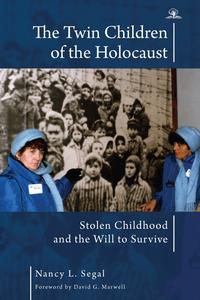
The Twin Children of the Holocaust: Stolen Childhood and the Will to Survive
Покупка
Издательство:
Academic Studies Press
Автор:
L. Segal Nancy
Год издания: 2023
Кол-во страниц: 110
Дополнительно
Вид издания:
Монография
Уровень образования:
Дополнительное профессиональное образование
ISBN: 979-8-88719-087-7
Артикул: 872470.01.99
Доступ онлайн
1 800 ₽
В корзину
This volume is an annotated collection of original, informative, and moving photographs of the twins who survived the brutal medical experiments conducted at the Auschwitz-Birkenau death camp (1943-1945). The experiments were conducted by the infamous physician, Josef Mengele. These never-before-seen photographs were taken by the author (Segal) at the 40th anniversary of the camp’s liberation (January 27, 1985) and the public hearing on Mengele’s crimes at Yad Vashem (A Memorial and a Name) in Jerusalem that followed. Other memorable moments, captured in photographs, include traveling to Krakow, visiting Warsaw and hearing survivors’ testimonies. The photographs are organized into ten sections that unfold chronologically — each section is accompanied by a brief essay to provide compelling context and each photograph has an informative caption.
Скопировать запись
Фрагмент текстового слоя документа размещен для индексирующих роботов
B O S T O N
2 0 2 3
Th e Twin Children
of the Holocaust
Stolen Childhood
and the Will to Survive
Nancy L. Segal
Photographs From the Twins
40TH Anniversary Reunion at Auschwitz -Birkenau
Foreword by David G. Marwell
For the Twins Whose Lives Were Irreparably Altered
by Horrific Events at Auschwitz-Birkenau,
and
the Twins Whose Lives Were Lost—
We Remember You
Library of Congress Cataloging-in-Publication Data
Names: Segal, Nancy L., 1951- author.
Title: The twin children of the Holocaust : stolen childhoods and the will
   to survive, photographs from the twins' 40th anniversary reunion at
Auschwitz-Birkenau / Nancy L. Segal.
Other titles: Stolen childhoods and the will to survive, pictures from the
   twins' 40th anniversary reunion at Auschwitz-Birkenau
Description: Boston : Cherry Orchard Books, 2023. | Includes
   bibliographical references.
Identifiers: LCCN 2022049348 (print) | LCCN 2022049349 (ebook) |
   ISBN 9798887190860 (paperback) | ISBN 9798887190877 (adobe pdf) |
   ISBN 9798887190884 (epub)
Subjects: LCSH: Jewish children in the Holocaust—Pictorial works. | Jewish
   children in the Holocaust—History. | Holocaust, Jewish
   (1939-1945)—Pictorial works. | Holocaust, Jewish (1939-1945)—History.
   | Twins—Poland—Pictorial works. | Auschwitz (Concentration
   camp)—Pictorial works. | Birkenau (Concentration camp)—Pictorial
   works. | Human experimentation in medicine—History—20th century. |
   CYAC: Holocaust survivors—Pictorial works.
Classification: LCC D804.48 .S443 2023 (print) | LCC D804.48 (ebook) |
   DDC 940.53/18083—dc23/eng/20221018
LC record available at https://lccn.loc.gov/2022049348
LC ebook record available at https://lccn.loc.gov/2022049349
Copyright © 2023 Academic Studies Press.
All rights reserved.
ISBN 9798887190860 (paperback)
ISBN 9798887190877 (adobe pdf)
ISBN 9798887190884 (epub)
Book design by Tatiana Vernikov
Cover design by Ivan Grave
Published by Cherry Orchard Books, and imprint of Academic Studies Press
1577 Beacon St.
Brookline, MA 02446, USA
press@academicstudiespress.com
www.academicstudiespress.com
Contents
Foreword by David G. Marwell
Preface
10
1. Minneapolis to Auschwitz and Jerusalem: How Did it Happen?
12
2. Pre-event Activities: Meeting Twins
16
3. Traveling to Poland
19
4. Visiting Auschwitz-Birkenau: Reunion and Re-enactment
22
5. Exploring Auschwitz-Birkenau: An Art Museum,
36
a Chance Meeting, and a Trip to the Polish Border
6. Medical Experiments: Process and Purpose
49
7. Touring Warsaw: War Memorials and Everyday Life
61
8. Twin Testimonies: Public Hearing on Josef Mengele’s War Crimes
67
9. Aftermath: Inquiries and Inquest
90
10. Twin Children of the Holocaust: After the Hearing and Beyond
98
Parting Words
106
Acknowledgments
107
About the Author
108
Other Books by Nancy L. Segal
109
The Twin Children
of the Holocaust
Foreword by David G. Marwell
It is one of the many ironies of the story of Josef Mengele and his escape from
justice that the first coordinated and effective international search for him
should have been launched only after he had been dead for six years. I tell this
story in the second half of my recent book, Mengele:Unmasking the “Angel of
Death,” in which I trace the origins of that investigation which, although it did
not locate a living Mengele, led to the discovery of his body and accounted
for his whereabouts from the time he left Auschwitz in January 1945 until his
death by natural causes on a beach in Brazil in 1979. A second striking irony is
that it took the effective efforts of his victims—rather than those of the institutions of justice—to provide the moral and political pressure that impelled the
investigation. Those who were exploited precisely because of their powerlessness were able to orchestrate the instruments of power and move governments
to action.
The agents of this campaign for justice were the surviving twins of
Mengele’s experiments, led by Eva Mozes Kor, a real estate agent from Indiana.
Aware of the power of publicity and the strategic use of spectacle, Eva played
a major role in organizing two events at the beginning of 1985. First was the return to Auschwitz of a group of twins on the 40th anniversary of its liberation,
and, shortly thereafter, a mock trial of Josef Mengele in Israel.
Nearly outnumbered by camera crews from around the world, Eva and
her fellow twins, including her twin sister Miriam, made the painful return
journey to Auschwitz—the place that had changed their lives forever. Eva described to the press how she still suffered under the weight of having “never
said goodbye” to her mother. Marc Berkowitz said he was “searching for the
child” he was before “this happened.” If the trip to Auschwitz represented an
emotional tsunami for the twins who made the journey, the mock trial at Yad
Vashem provided a searing indictment of the man who embodied the evil that
took their families and their childhoods and left an unbounded expanse of
physical and emotional pain.
The mock trial was held in conjunction with “The World Convention
of Twins and Others Who Underwent Experiments by Mengele.” To add
pedigree and credibility to the proceeding, key figures in the history of war
crimes investigations and prosecution were chosen to serve on the six-member
board of inquiry, among them Gideon Hausner, the former Israeli Attorney
General and lead prosecutor of Adolph Eichmann; Gen. Telford Taylor, the
former American Chief Counsel for War Crimes at Nuremberg; and Simon
Wiesenthal, the famed Nazi hunter. The thirty witnesses at the trial included
Simone Veil, the Auschwitz survivor and former French minister and President of the European Parliament, and one of the dwarfs who had been subjected to Mengele’s experiments, but they were mostly twins. Forty years after
the liberation of Auschwitz, dramatic testimony, much of it heard for the first
time, detailed the crimes that were perpetrated there. The remarkable event,
held at Israel’s national Holocaust memorial in Jerusalem over three days in
early February 1985, would, it turned out, be the first and only public forum—
despite lacking legal authority and the empty dock—available for Mengele’s
victims to testify about their experience with the man who became known as
the Angel of Death.
The story of the twins and their ordeal at the hands of Mengele, which had
been movingly described the previous year in a cover story in Parade Magazine by the late, crusading reporter Lucette Lagnado, provided a face—or, perhaps better expressed, twin faces—to the crimes of the Nazis and the failure
of their victors and victims to have attained justice. This story was crystalized
in the twins’ traumatic return to Auschwitz and their agonizing testimony at
Yad Vashem, and it catalyzed a powerful mixture of politics, pressure, and potent memory that moved those in power to act. It is no accident that on the
final day of the mock trial in Jerusalem, U.S. Attorney General William French
Smith announced in Washington the launch of the Justice Department’s investigation into the “whereabouts of Josef Mengele.” Germany, which had carefully followed the planning for the trial, soon joined the U.S. in the investigation
as did the State of Israel.
Now, nearly forty years later, thanks to Nancy Segal, we can catch a glimpse
for ourselves of these extraordinary gatherings and their assembly of witnesses
and memories. Readers should not expect to see carefully composed photographs or artistically rendered images; these are, instead, mostly simple snapshots: the quotidian record of an extraordinary event. It is as if Nancy Segal,
who was both witness and chronicler of the twins’ journey in 1985, forgot to
P r e f a c e  b y  D a v i d  G .  M a r w e l l
retrieve the rolls of film from the drugstore where she dropped them off decades ago, only to pick them up now and share them with us along with her
memories of that historic trip. They are displayed here, providing an eloquent
photographic memory that connects us across time to a truly remarkable slice
of history.
Preface
The Twin Children of the Holocaust: Stolen Childhood and the Will to Survive will
have universal meaning for those who care deeply about the injustices and cruelties done to innocent children. Between the Spring 1943 and January 1945,
several hundred twins were subjected to unthinkable medical experiments at
the Auschwitz-Birkenau death camp. Dr. Josef Mengele was the physician behind the experimentation and other atrocities that involved not just the twins,
but also people with various genetic anomalies.
I was privileged to attend the twins’ 40th anniversary reunion held at the
camp, located in the southern Polish town of Oświęcim, about 45 miles west
of Krakow. A record compiled by a prison doctor and bacteriologist forced
to work for Mengele showed that 732 pairs of twins were studied;1 however,
estimates have ranged as high as 1,500.2 It is thought that approximately 200
twins survived, but this estimate has also varied, so it is likely that the exact
number will never be known. Having attended the reunion event in Poland I
can affirm that only nine twins were present, given the difficulties of obtaining
visas and the hardships of winter travel. The nine twins included the members
of one complete pair, six individual twins from different pairs, and one nontwin “assigned” as a twin upon arrival; see photograph 6.3. The reunion was
followed by a three-day public hearing on Dr. Josef Mengele’s war crimes, held
at Yad Vashem (“A Memorial and a Name”), the World Holocaust Remembrance Center in Jerusalem, Israel. Many more twins attended this hearing,
most likely because a substantial number of them live in Israel.
As I listened to the twins’ memories of horror, pain, and fear, I marveled
at the clever tricks these young children used and the tall tales they told to
unsuspecting officers to obtain extra food, visit a twin sister, or escape from
the infirmary. Their resolve and reliance were extraordinary. Whenever possible, they have rebuilt their lives by getting married, raising children, and pur1
Andy Walker, “The Twins of Auschwitz.” BBC News, https://www.bbc.com/news/magazine-30933718, January 28, 2015.
2
Jennifer Rosenberg, “A History of Mengele’s Gruesome Experiments on Twins.” ThoughtCo, https://www.thoughtco.com/mengeles-children-twins-of-auschwitz-1779486, January 1, 2021; Nancy L. Segal (1985). “Holocaust twins: Their special bond.” Psychology
Today, 19 (8), 52-58.
Похожие Показать весь список
Доступ онлайн
1 800 ₽
В корзину