
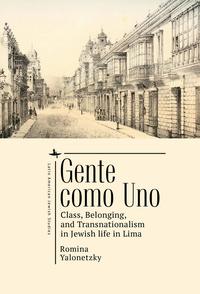
Gente Como Uno: Class, Belonging, and Transnationalism in Jewish Life in Lima
Покупка
Издательство:
Academic Studies Press
Автор:
Yalonetzky Romina
Год издания: 2021
Кол-во страниц: 177
Дополнительно
Вид издания:
Монография
Уровень образования:
Дополнительное профессиональное образование
ISBN: 978-1-64469-743-6
Артикул: 872462.01.99
Доступ онлайн
1 800 ₽
В корзину
In San Isidro, Lima, the only Jewish school in Peru stands on a street widely known as "Los Manzanos” ("The Apple Trees”) but whose name changes to "Maimonides” (the Jewish sage) depending on which sign you look at. As she takes us on a stroll through this six-block street and its different names, Dr. Romina Yalonetzky introduces readers to a physical microcosm of the intersection between Peruvian and Jewish identity, elucidated through the varied voices and experiences of Peruvian Jews. This book sheds a novel light on both Jewish and Peruvian identities.
Скопировать запись
Фрагмент текстового слоя документа размещен для индексирующих роботов
Gente
Como Uno
Class, Belonging,
and Transnationalism
in Jewish Life in Lima
Jewish Latin American Studies
Series Editor
Darrell B. Lockhart (University of Nevada, Reno)
B O S T O N
2 0 2 1
Gente
Como Uno
Romina
Yalonetzky
Class, Belonging,
and Transnationalism
in Jewish Life in Lima
Library of Congress Cataloging-in-Publication Data
Names: Yalonetzky, Romina, 1980- author.
Title: Gente como uno : class, belonging, and transnationalism in Jewish life
in Lima / Romina Yalonetzky.
Other titles: Class, belonging, and transnationalism in Jewish life in Lima
Description: Boston : Academic Studies Press, 2021. | Series: Jewish latin
american studies
Identifiers: LCCN 2021039139 (print) | LCCN 2021039140 (ebook) |
ISBN 9781644697429 (hardback) | ISBN 9781644697436 (adobe pdf) |
ISBN 9781644697443 (epub)
Subjects: LCSH: Jews—Peru—Lima—History—20th century. |
Jews—Peru—Lima—History—21st century. |
Immigrants—Peru—Lima—History—20th century. |
Immigrants—Peru—Lima—History—21st century. |
Jews—Peru—Lima—Identity. | National characteristics, Peruvian. |
Lima (Peru)—Social life and Custorms—20th century. | Lima (Peru)—Social
life and Custorms—21st century. | San Isidro (Lima,
Peru)—History—20th century. | San Isidro (Lima, Peru)—History—21st century.
Classification: LCC F3601.9.J5 Y35 2021  (print) | LCC F3601.9.J5  (ebook) |
DDC 985/.255004924—dc23
LC record available at https://lccn.loc.gov/2021039139
LC ebook record available at https://lccn.loc.gov/2021039140
Copyright © 2021 Academic Studies Press All rights reserved.
ISBN 9781644697429 (hardback)
ISBN 9781644697436 (adobe pdf)
ISBN 9781644697443 (epub)
Cover design by Ivan Grave
Book design by Tatiana Vernikov
Published by Academic Studies Press
1577 Beacon Street
Brookline, MA, 02446, USA
press@academicstudiespress.com
www.academicstdiespress.com
Para Hilá
Contents
Acknowledgements
11
1. The Intersection Between Peruvian-ness and Jewishness
31
2. Orthodox-ish: Religious Judaism in Lima
46
3. Agents of Socialization: Israel, the Jewish Agency,
70
and the Jewish Day School
4. Elective Affinity and Changes in Family Formation
89
5. From Immigrants to Peruvians: Jews in the Public Sphere
116
6. Final Remarks
134
Bibliography
Index
List of Tables
1. Jewish Religious Diversity in Lima
2. Changes in Attitudes Towards Family Formation
140
among Jews and Non-Jews in Lima According to Gender
3. Chronology of Landmarks for the Analysis
144
of Jewish Limeño Organized Life, 1944-2014
4. Interviewees from Cohort 1 (over 75 years old)
164
5. Interviewees from Cohort 2 (51-74 years old)
165
6. Interviewees from Cohort 3 (40-50 years old)
166
List of Images
1. Calle Judíos (Judíos Street), next to Lima’s cathedral, ca. 1910
10
2. Altered Street Sign on the Forth Block
15
of Maimónides Street, San Isidro
3. Rivalrous New and Old Street Signs in San Isidro
15
4. Old Street Sign with New Addition
16
5. Commemorative street sign in Lima’s main square
30
6. Efrain Goldenberg (right) stands next to president
133
Alberto Fujimori and first lady Susana Higuchi
7. David Waisman (right) and president Alejandro Toledo
8. Salomon Lerner (right) and president Ollanta Humala
Acknowledgments
The research behind Gente como Uno: Class, Belonging, and Transnationalism
in Jewish Life in Lima was made possible by a grant from the Memorial
Foundation for Jewish Culture.
I would like to thank the following relatives, friends, and scholars for
their kind support throughout the writing process: Catalina Wainerman,
Felipe Portocarrero, Narda Henriquez, Veronique Lecaros, Liuba Kogan,
Leon Trahtemberg, Rabbi Guillermo Bronstein, Rabbi Abraham Benhamu,
Judith Schneider, and Celia Bazan.
I am especially grateful to those who agreed to being interviewed.
I would also like to thank my doctoral advisor Catalina Romero and
my colleagues at PUCP’s Seminario Interdisciplinario de Estudios de Religión (Interdisciplinary Seminar on Religious Studies).
I am extremely grateful to Jeffrey Lesser, who was kind enough to share
his academic brilliance with me while I was working on my doctorate.
The experience of my immigrant parents, Daniel Yalonetzky (z”l) and
Luisa Mankevich, has also motivated this research, and I am grateful for
their love and encouragement. My brother’s advice has been invaluable all
along.
Finally, I could not have written Gente como Uno, or accomplished anything at all, without the constant support of my family. My husband, Ari,
deserves my eternal love and gratitude. He has believed in me as no one else
has. He has been there for me through it all. He has rejoiced with me and
has stood by me every time I suffered a setback. Sharing my life with him
and our beautiful Hila makes me happy.
Fig. 1. Calle de los judíos (Judíos Street), next to Lima’s cathedral, ca. 1910.
Photo credit: Carlos Ausejo, Repositorio PUCP.
Похожие Показать весь список
Доступ онлайн
1 800 ₽
В корзину