
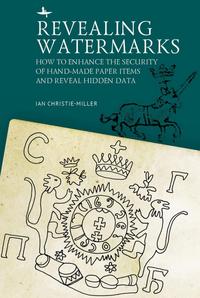
Revealing Watermarks: How to Enhance the Security of Hand-Made Paper Items and Reveal Hidden Data
Покупка
Тематика:
Культура отдельных стран и народов
Издательство:
Academic Studies Press
Автор:
Christie-Miller Ian
Год издания: 2021
Кол-во страниц: 91
Дополнительно
Вид издания:
Монография
Уровень образования:
Дополнительное профессиональное образование
ISBN: 978-1-64469-625-5
Артикул: 872451.01.99
Доступ онлайн
1 800 ₽
В корзину
Watermarks reflect the very stuff of the origin, date, distribution, composition, history, and culture of paper-based items. Digital imaging of watermarks releases the research potential as widely as the internet itself. One example is the digital "fingerprinting” of paper in order to enhance the security of items, such as valuable and vulnerable maps. Revealing Watermarks offers detailed instructions of this process, through the author's own PaperPrint method, and by means of the case study of a sixteenth-century watermark—a crown from the arms of Danzig — it illustrates how cultural influences spread and have endured across the centuries, in this case from Sweden to Russia.
Скопировать запись
Фрагмент текстового слоя документа размещен для индексирующих роботов
REVEALING
WATERMARKS
HOW TO ENHANCE THE SECURITY
OF HAND-MADE PAPER ITEMS
AND REVEAL HIDDEN DATA
B O S T O N
2 0 2 1
IAN CHRISTIE-MILLER
REVEALING
WATERMARKS
HOW TO ENHANCE THE SECURITY
OF HAND-MADE PAPER ITEMS
AND REVEAL HIDDEN DATA
Library of Congress Cataloging-in-Publication Data
Names: Christie-Miller, Ian, author.
Title: Revealing watermarks : how to enhance the security of hand-made
   paper items and reveal hidden data / Ian Christie-Miller.
Description: Boston : Academic Studies Press, 2021. | Includes
   bibliographical references.
Identifiers: LCCN 2021011433 (print) | LCCN 2021011434 (ebook) | ISBN
   9781644696248 (hardback) | ISBN 9781644696255 (adobe pdf) | ISBN
   9781644696262 (epub)
Subjects: LCSH: Watermarks--Europe--Identification. | Handmade
   paper--Europe--History--16th century. | Paper--Analysis--Data
   processing. | Image processing--Digital techniques.
Classification: LCC Z237 .C47 2021  (print) | LCC Z237  (ebook) | DDC
   676/.28027--dc23
LC record available at https://lccn.loc.gov/2021011433
LC ebook record available at https://lccn.loc.gov/2021011434
Copyright © 2021 Academic Studies Press
All rights reserved.
ISBN 9781644696248 (hardback)
ISBN 9781644696255 (adobe pdf)
ISBN 9781644696262 (epub)
Book design by Kryon Publishing Services
www.kryonpublishing.com
Cover design by Ivan Grave
Published by Academic Studies Press
1577 Beacon Street
Brookline, MA 02446, USA
press@academicstudiespress.com
www.academicstudiespress.com
Contents
Acknowledgements
vi
Introduction
vii
First Part
PaperPrint—Security
1
Method
1
The Lindley Library and Other Examples of PaperPrint in Use
6
Second Part
Paper, Pages, and Finding Watermarks
12
How to Reveal Watermarks
12
Imaging Procedure
19
Image Processing and Archiving
19
Third Part
Case Study—Lithuania to Russia and Sweden—Cultural—the Danzig
Connection
29
Fourth Part
Case Study—Estonia—Number of Pages
44
Fifth Part
Composition and Dating
55
Downloads
60
Bibliography
75
Index
79
Acknowledgements
G
rateful thanks and words of appreciation need to be recorded to:
Mika Hakkarainen Special Collection Curator Helsinki for supply of
back-lit images of ABCKiria.
Claudia Ludwig and Lucy Finn at Sotheby’s, New York for locating and
supplying the 26th November 2013 The Bay Psalm Book Catalogue.
Dr. Brent Elliott and Ms. Debbie Lane, both formerly of the Royal
Horticultural Society, who were leaders in recognizing, encouraging and supporting watermark research at the Lindley Library.
Staff at the Vilnius University Library for not only allowing the imaging
of Cathechismus, 1547 but also enabling it. Aušrinė Aurelia Apanavičiūtė for
her recordings of the music in the Vilnius copy and for the ready approval for
those recordings granted by Father Petras Tverijonas at St Casimir’s Lithuanian
Roman Catholic Church in London.
Mr. Simon Green for his expert guidance about paper moulds.
Allard Pierson at the University of Amsterdam for efficiently supplying
the Sheremetew watermark image, and to Alexander Khmelevsky for the fulsome comments on the Sheremetew family.
Dr Fred Hocker, Head of Research, Vasamuseet Stockholm for his immediate and most helpful information about cannons and heraldry.
The Bibliographical Society, The Paul Mellon Centre for Studies in
British Art and The Lutheran Church—Missouri Synod for their considerable
and essential funding support.
Charlotte Tancin at the Hunt Institute for Botanical Documentation,
Carnegie Mellon University, to Catherine Sambrook at King’s College
London, Foyle Special Collections Library and to Stephen Tabor at the
Huntington Library for their invaluable suggestions for improving the early draft.
Alessandra Anzani of Academic Studies Press, who has patiently guided
the production of the book through many months.
Introduction
R
esearchers have long appreciated the potential of watermark research, but
it is the advent of digital resources which is allowing that potential to be
achieved. Not only is security being improved, but valuable research resources
are being created.
The First Part of this book opens with a description of the PaperPrint
method, devised by the author, as used at the Lindley Library, Royal
Horticultural Society for prints, at Marsh’s Library, Dublin for copies of a
Cyrillic printed book, and at the Boston Public Library for The Bay Psalm Book.
PaperPrint effectively creates a digital ‘fingerprint’ of the paper and enhances
the security.
The Second Part gives brief background information about locating
watermarks in hand-made paper. This is followed by the description of a simple
digital procedure for recording watermarks. Details are given about overcoming problems, such as the way that, not uncommonly, watermarks in books are
divided over two or more pages.
The Third Part is Case Study—Lithuania to Russia and Sweden—
Cultural—The Danzig Connection, which illustrates the further potential
of watermark research. It connects the history of the first book printed in
Lithuanian (the 1547 Catechismusa by Martynas Mažvydas) with Danzig, with
Belarus and with the enormously powerful Russian family Sheremetew.
The Fourth Part concerns the only surviving fragments of the first book
printed in Estonian (a Lutheran catechism), which are rightly regarded as
emblems of the national spirit. The number of pages had been uncertain but is
proven in this Fourth Part. In addition the evidence from the watermark suggests a paper connection with Martin Luther.
The Fifth Part concerns the first book printed in Finnish (ABCKiria by
Mikael Argicola) and uses the evidence from the watermark to question the
accepted date, to recommend another and to illuminate the composition
of book.
The Downloads section includes links to two items of supporting material.
The first link shows how an octavo is made from one sheet of paper. The second
link reveals the watermark found in the Vilnius copy of the above-mentioned
first book printed in Lithuanian.
First Part
PaperPrint—Security
E. Forbes Miley III was a highly respected dealer of antiquarian maps.1
However, on 8 June 2005 he was arrested at the Beinecke Library at Yale. Later
investigation revealed that he had been involved in stealing at least ninety rare
maps valued at some $3,000,000. A decade earlier Gilbert Bland had been
found guilty of stealing maps worth some $500,000 from American universities.2 In 2020 Michael Vinson’s book related the full story of the dramatic life
and death of the Texan Johnny Jenkins,3 revealing how the man who had once
achieved the largest rare book deal of the century was also a book thief. Jenkins
was also suspected of forging items including a copy of The Texas Declaration
of Independence. At the time of his death—his body with a shot to the back of
the head, was discovered in a river—he was under suspicion for arson, forgery
and liable for huge gambling debts. These three cases are not exceptional. The
known extent of the problem of thefts is international. Thieves include priests,
who were defrocked and sentenced to a year and a half in prison,4 and insiders
such as a former Bibliothèque Nationale de France conservator of Hebrew manuscripts.5 Thefts continue up to the present day.6 In addition, the full extent of
the problem is unknown, partly because it does seem that the default attitude of
those who know they have been targeted is reticence if not silence. Also, by definition, no one knows what items have been stolen if no theft has been noticed.
Clearly there is a pressing need to protect items on hand-made paper. The
security of such items can be enhanced by the PaperPrint procedure, which was
devised by the author for use at the Lindley Library of the Royal Horticultural
Society. The first book there to have every page imaged using front lighting and
back lighting was the 1526 Grete herball. Subsequently selected pages of a large
number of other early printed books at the same library were imaged for research
and for security enhancement. A full set of PaperPrint images was archived with
that library. In addition, thanks to support from the Paul Mellon Centre for
Studies in British Art, other copies of the Grete herball in London, Oxford, Texas,
California and Pennsylvania have been imaged using the same procedure.
Method
The following image shows the imaging system used to capture the front-lit
and the back-lit images required for a PaperPrint file.
Похожие Показать весь список
Доступ онлайн
1 800 ₽
В корзину