
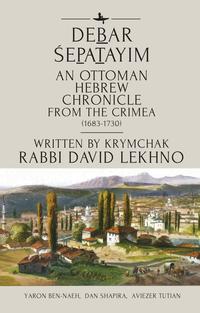
Debar Śepatayim: An Ottoman Hebrew Chronicle from the Crimea (1683-1730). Written by Krymchak Rabbi David Lekhno
Покупка
Издательство:
Academic Studies Press
Год издания: 2021
Кол-во страниц: 271
Дополнительно
Вид издания:
Монография
Уровень образования:
Дополнительное профессиональное образование
ISBN: 978-1-64469-618-7
Артикул: 872449.01.99
Доступ онлайн
1 800 ₽
В корзину
The fifty years between 1680-1730 were one of the most fascinating in the history of Europe and in Ottoman history. A period of coalitions and wars, climate changes, and natural disasters took place. This previously unpublished chronicle contains valuable information in various fields. It was written in Semi-Biblical Hebrew by a Jewish rabbi residing in the Crimean Peninsula, and includes insights on the political upheavals in the Crimean Khanate and the Ottoman capital; the wars between the Ottomans, Habsburgs, Venetians, Circassians, Sefevids, and the Russians, which he vividly describes; Persia and the Caucasus; the fate of Jewish communities; epidemics and weather; and weapons and customs. The book, a historical mine that reads like a sweeping thriller, is now available in English for the first time.
Скопировать запись
Фрагмент текстового слоя документа размещен для индексирующих роботов
DEBAR
ŚEPATAYIM
AN OTTOMAN
HEBREW
CHRONICLE
FROM THE CRIMEA
(1683-1730)
B O S T O N
2 0 2 1
YARON BEN-NAEH,  DAN SHAPIRA,  AVIEZER TUTIAN
DEBAR
ŚEPATAYIM
AN OTTOMAN
HEBREW
CHRONICLE
FROM THE CRIMEA
(1683-1730)
WRITTEN BY KRYMCHAK
 RABBI DAVID LEKHNO
Library of Congress Cataloging-in-Publication Data
Names: Lekhno, David son of Eliʻezer, -1735, author. | Ben-Naeh, Yaron,
   editor. | Shapira, Dan, editor. | Tutian, Aviezer, editor.
Title: Debar śepatayim : an Ottoman Hebrew chronicle from the Crimea (1683-1730)
written by
   Krymchak Rabbi David Lekhno ; Yaron Ben-Naeh, Dan Shapira, Aviezer Tutian
Other titles: Devar śefatayim. English
Description: Boston : Academic Studies Press, 2021. | Includes
   bibliographical references.
Identifiers: LCCN 2021010642 (print) | LCCN 2021010643 (ebook) | ISBN
   9781644696170 (hardback) | ISBN 9781644696187 (adobe pdf) | ISBN
   9781644696194 (epub)
Subjects: LCSH: Turkey--History--Ahmed III, 1703-1730. | Crimean
   Khanate--History. | Jews--History--17th century. | Jews--History--18th
   century.
Classification: LCC DR542 .L45 2021  (print) | LCC DR542  (ebook) | DDC
   956/.015--dc23
LC record available at https://lccn.loc.gov/2021010642
LC ebook record available at https://lccn.loc.gov/2021010643
Copyright © Academic Studies Press, 2021
ISBN 9781644696170 (hardback)
ISBN 9781644696187 (adobe pdf)
ISBN 9781644696194 (epub)
Book design by Lapiz Digital Services
Cover design by Ivan Grave
On the cover: “General view of Karasubazar,” by Carlo Bossoli, from his album “The
Landscapes and Attractions of the Crimea” (1842).
Published by Academic Studies Press
1577 Beacon Street
Brookline, MA 02446, USA
press@academicstudiespress.com
www.academicstudiespress.com
In Memoriam
Prof. Jacob L. Landau (1924–2020)
Prof. Michael Zand (1927–2018)
Mail and Plate Shirt, Northern Caucasus, Dr. Nasser Khalili Collection.
Contents
A Short Overview of the Chapters
45
The Translation of the Hebrew Chronicle
52
Bibliography
243
Index
253
Index of Quotations of Books other than Bible
262
The name of the historic Hebrew chronicle, which is presented to the reader
in this book in English translation, is Debar Śepatayim (pronounced Devar
Sefatáyim), “a word of lips,” or “a word of two lips.” It refers to the fact that
the most of the book’s contents was based on the information provided
by two high-ranking Muslim informants from the Crimean Khanate,1 and
that the chronicle is in fact an edited Hebrew translation of the transcript
of what had been told to the author in Ottoman-Turkish or in Ottomanized
Crimean-Tatar.
This is an annotated English translation of an eclectic edition of the
Debar Śepatayim chronicle, based on the four extant manuscripts (see
Aviezer Tutian, “Devar Sefatayim le-Rabbi David Lekhno, an Annotated
Edition” [MA thesis, Hebrew University, Jerusalem, 2012], vol. 1). We did
not elaborate on or mention the differences between the manuscripts, as
they are very minor, mostly regarding the spelling of names and terms.
In several cases, we based the translation on variant readings rejected in
Tutian’s 2012 edition.
The text was read using the microfilms kept in the Institute of
Microfilmed MSS at the National Library in Jerusalem, Israel.
1
One of them might be identified—very tentatively—as ‘Abdu-l-Ğaffār al-Qirimi, who
was an eyewitness to the Prouth Campaign and who began to write his own chronicle
in the year at which David Lekhno stopped, 1730. Cf. Barbara Kellner-Heinkele, “Who
was ‘Abdulghaffār el-Qirimī? Some Notes on an 18th Century Crimean Tatar Historian,”
Journal of Asian History 32, no. 2 (1998): 151. Another one might be Mustafa-Ağa, a
commander in the army of Devlet-Girāy Khan, cf. Ch 12.
MSS and Previous Publications and Reseach
The whereabouts of the original manuscript of Debar Śepatayim are
unknown. Today we know about four manuscripts which were probably
copied from the autograph, or perhaps a slightly later copy. The book was
first found and purchased by Abraham Firkowicz/Firkovitch, the renowned
manuscripts collector, in the 1830s, and the best MS contains his remarks.
The first MS is Russian National Library Evr. IV 104 [its code in Russian
is EBP. H.C. 104]; it contains fifty-six sheets, in an orderly nice legible handwriting, with partial vocalization, used for what was probably considered
by the copyist difficult words. The numbering of the pages in this MS, as in
the other three, was added much later, using Indian-European digits. This
is the only complete MS of Debar Śepatayim, and we used it as the base for
the text we translated and annotated.
The second MS is Russian National Library Evr. I 296 [EBP. I 296]; it
contains only eight sheets, in a very illegible and untidy handwriting. It is a
copy of chapters 32–38, and a part of chapter 52.
The third and fourth manuscripts are also kept in St. Petersburg, and
they complement each other. The late pagination reveals that the person who was working on them realized that they were two parts of one
manuscript, even though the second is written in a different hand. The St.
Petersburg Institute of Oriental Manuscripts of the Russian Academy B
435/1 contains twenty-eight sheets, covering chapters 1–26, in a nice and
clear handwriting, while the other manuscript in the same library (B 435/1)
contains eighteen sheets that cover the rest of the book, from chapter 26
onwards. As with the other manuscripts, we have no indication of their
date.
There must have existed a fifth MS, from which Firkowicz quoted
dates, as his dates are more correct than those found in the extant MSS.
The scholarly research of Debar Śepatayim began in in the late 1840s
when Firkowicz made known the existence of this chronicle and transferred
two MSS to the Odessa Historical Society. In 1850, Eliyahu Finkel of Odessa
published a Russian translation of five chapters (9, 10, 13, 17, and 27).
Interestingly, those chapters dealt with Muscovite-Russian victories over
the Ottomans and their Crimean associates. Soon after the first manuscript
of Debar Śepatayim was discovered, creating its academic translated edition became a research priority for Russian-Jewish intellectuals and scholars working on the earlier history of the Jews in the Russian Empire. Their
Похожие Показать весь список
Доступ онлайн
1 800 ₽
В корзину