
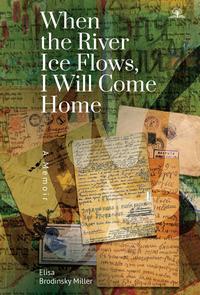
When the River Ice Flows, I Will Come Home: A Memoir
Покупка
Тематика:
Письма. Дневники. Воспоминания (мемуары)
Издательство:
Academic Studies Press
Автор:
Brodinsky Miller Elisa
Год издания: 2020
Кол-во страниц: 201
Дополнительно
Вид издания:
Художественная литература
Уровень образования:
Дополнительное профессиональное образование
ISBN: 978-1-64469-281-3
Артикул: 872409.01.99
Доступ онлайн
1 800 ₽
В корзину
Shortly after her father’s death, Elisa Brodinsky Miller uncovered a cache of letters among his belongings. Written in Russian and Yiddish, with datelines in Tsarist Russia, the letters detail eight long years (1914-1922) during which Elisa’s father, his five siblings, and their mother spend apart from Elisa’s grandfather who had left for America, believing their separation would be short. Miller, a Russian affairs specialist, learns bit by bit with each translation about the family she knew so little about, and the eight years of history they lived through, enabling her for the first time to connect her own experiences with those who came before her. This captivating memoir bridges the past with the present, as we learn about her grandparents’ struggles to escape Tsarist Russia, her parents’ hopes for their marriage in America, and her own reach for meaning and purpose: each a generation with dreams — first theirs, now hers.
Скопировать запись
Фрагмент текстового слоя документа размещен для индексирующих роботов
A Memoir
When the River Ice Flows,
I Will Come Home
A Memoir
Elisa Brodinsky Miller
Boston
2020
Library of Congress Cataloging-in-Publication Data
Names: Brodinsky Miller, Elisa, author.
Title: When the river ice flows, I will come home : a memoir / Elisa
   Brodinsky Miller.
Description: Boston : Cherry Orchard Books, 2020. | Includes
   bibliographical references.
Identifiers: LCCN 2019046140 (print) | LCCN 2019046141 (ebook) |
   ISBN 9781644692790 (hardcover) | ISBN 9781644692806 (paperback) |
   ISBN 9781644692813 (adobe pdf)
Subjects: LCSH: Brodinsky Miller, Elisa--Family. | Jewish women--United
   States--Biography.
Classification: LCC E184.37.M545 A3 2020  (print) | LCC E184.37.M545
   (ebook) | DDC 929.20947--dc23
LC record available at https://lccn.loc.gov/2019046140
LC ebook record available at https://lccn.loc.gov/2019046141
Copyright © 2020 Elisa Brodinsky Miller, text, illustrations, maps
All rights reserved.
ISBN 978-1-644692-79-0 (hardback)
ISBN 978-1-644692-80-6 (paperback)
ISBN 978-1-644692-81-3 (adobe pdf)
ISBN 978-1-644693-53-7 (ePub)
Book design by Tatiana Vernikov
Cover design by Joe Menth
Published by Cherry Orchard Books (imprint of Academic Studies Press)
1577 Beacon Street
Brookline, MA 02446, USA
press@academicstudiespress. com
www.academicstudiespress. com
To
Rachael and Amos
Tillie and Aditieh
Though for no other cause, yet for this,
that posterity may know we have not loosely
through silence permitted things to pass away
as in a dream.
—Richard Hooker,
Of the Laws of Ecclesiastical Polity
Con t e n ts
Foreword
1. A Cache of Letters
9
2. Gone to America
16
3. War Disrupts
24
4. Inflation Spirals
34
5. Scythe against Stone
43
6. Wrapping Tefillin
47
7. Eli Sends Money
52
8. Making Ends Meet
56
9. My Parents Separate, Reconcile, Divorce
61
10. Meer Joins the Red Army
66
11. My Marriage and My Divorce
76
12. Reindeer in the Arctic Circle
80
13. Taiga, Tundra, Gulag
88
14. Papa, Come Home!
97
15. Jewish Passion, Jewish Suffering
101
16. A Terrible Night
104
17. It Is My Turn Now to Try
115
18. The Soul Suffers
118
19. Ragamuffins, Barefoot, and Hungry
123
20. When the River Ice Flows
134
21. Waiting to Leave
145
22. The Moloch of Ambition
152
23. In Riga, at Last
157
24. Olga
171
25. Al Anon
177
26. A Plot in the Jewish Section
180
Afterword
Acknowledgments
185
About the Author
186
Sources
187
Appendix I. My Father’s Travel Notes
188
Appendix 2. Understanding the Russian Pale
196
Maps
Southwestern (Ukrainian) Provinces of the Russian Empire, 1914	 16
Kiev Province and the Pale of Jewish Settlement within
17
the Russian Empire, 1914
Gulag Territory (Yakutiia)
81
Working in the Tundra
92
Siziman Bay Gulag Camp
96
Civil War 1912-1921, with Railroad Lines
99
After the Pogrom of 1920, Manya’s Family Disperses
125
Amur and Ussuri Rivers Ice Breakup
139
Railroad Lines 1918
158
Getting to the Ship at Liepeija, Latvia
170
Foreword
I do not know this woman. . . .
I do not know her and yet I know her.
She was . . . not a person but a whole kind of person,
the ones who crossed the ocean,
who brought with us to America
the villages of Russia and Lithuania . . . .
Descendants of this immigrant woman,
you do not grow up in America,
you and your children and their children
with the goyische names,
you do not live in America, no such place exists.
Your clay is the clay of Litvak shtetl,
your air the air of the steppes.
Because she carried the old world
on her back across the ocean, in a boat,
and put down on Grand Concourse Avenue, or in Flatbush,
and she worked that earth into your bones,
and you pass it to your children, this ancient,
ancient culture and home. . . .
You can never make that crossing that she made,
for such Great Voyages in this world do not any more exist.
But every day of your lives the miles that voyage
between that place and this one you cross.
Every day. You understand me?
In you that journey is.
—Tony Kushner,
selections from Angels in America
1. A Cache of Letters
By
the rules of the retirement center in Bloomfield, Connecticut
where my father had lived, the family was allotted five working
days after his death to clear out the belongings from his cottage. My
brother and I had agreed: we wouldn’t save any furniture, just the china,
the stemware, the samovar, and the contents of his study. It all was
to go into a storage unit near his home in Wallingford, CT. Together,
later, we three siblings would sort through it all. Each of us would
take what we wanted and we’d toss the rest. We doubted there would
be any scraps between us; we three are much too different. Exactly
a year after our father’s death, I traveled from Seattle, my sister came
from Charlotte, to stay with my brother and his wife.
I knew the contents of many of those boxes marked “Books—from
study.” During my visits to my father I had often looked at his books,
on occasion he would gift me one or two. It was torment to stand in
the storage unit and watch both my brother and my sister tear through
these. Nothing seemed to matter to them. Especially the books. Even
before I got a chance to say I want it, my brother was ready to put
a book in the toss pile. Books that meant a lot to my father and books
I wanted to keep. Once, my brother who was trying to send an oversized
book into the toss bin, misjudged and instead of the toss bin the book
landed on the concrete floor flat open with its spine broken and pages
awry. Like kicking someone down the stairs and watching them
land sprawled out and hurt. Aggression. Like when the pogromschiks
entered a synagogue to tear it apart and hurled all the sacred books to
the sidewalk to be burnt.
Angry I was, and now nothing much left to do except to say I’ll take
all his books, his notes, papers and sort through them more leisurely
later. “But Annie doesn’t want any of this in her house. There might be
silverfish in the books or in the papers,” my sister Molly says. My sister
who took the name of my grandmother, Manya. “You can’t take all this
there, Annie and Mike don’t like clutter.”
Silverfish notwithstanding, the whole shebang was now under
my gaze in the basement of my brother’s house. There were scores
of postcards and letters. Amongst those letters was a small notebook
wrapped in pink tissue paper. Written on the pink paper was the word
“Ucraine.” I opened this small notebook of 68 numbered pages written
in Russian and noted the title page: Travel Notes. The pages were brittle
but the Russian handwriting was clear enough. I read the first sentence
of the entry, dated August 29, 1922. We left Kiev at 12:00 noon. I turned to
the last page 68 and read the last entry. We waited on the benches [of Ellis
Island] until our names were called . . . . My father, always the journalist,
had left me the perfect gift. I’d have him all to myself for quite a while.
I couldn’t wait to take everything back to Seattle.
Finding so many letters and postcards as well as my father’s travel
diary in Russian intensified my delight in the art of translation. I knew
I eventually would be able to master the various handwritings and
gain meaning and context from what I read. Translation was a tool
I used in my work: beginning with my dissertation research and also
my subsequent writings about contemporary Russia.
Once back at home, I was disciplined and patient. I had just sold
my business, a small company publishing commercial intelligence
on the Russian Far East. I would have the time. This was going to be
a big project and I would start carefully, methodically. The letters and
postcards addressed to Eli Brodinsky, my grandfather, in Wilmington
Eli leaves his wife and six children, 1914.
Похожие Показать весь список
Доступ онлайн
1 800 ₽
В корзину