
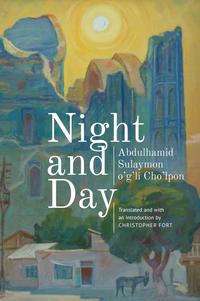
Night and Day
Покупка
Тематика:
Литература Европы первой половины XX в.
Издательство:
Academic Studies Press
Год издания: 2020
Кол-во страниц: 291
Дополнительно
Вид издания:
Художественная литература
Уровень образования:
Дополнительное профессиональное образование
ISBN: 978-1-64469-048-2
Артикул: 872397.01.99
Доступ онлайн
1 800 ₽
В корзину
Night (1934), the first novel of Abdulhamid Sulaymon o’g’li Cho’lpon’s unfinished dilogy of novels, Night and Day, gives readers a glimpse into the everyday struggles of men and women in Russian imperial Turkestan. More than just historical prose, Cho’lpon’s magnum opus reads as poetic elegy and turns on dramatic irony. Though it depicts the terrible fate of a young girl condemned to marry a sexual glutton, nothing is what it seems. Readers find themselves questioning the nature of women’s liberation, colonialism, resistance, and even the intentions of the author, whose life and sequel, Day, were lost to Stalinist terror.
Скопировать запись
Фрагмент текстового слоя документа размещен для индексирующих роботов
Central Asian Literatures in Translation
Series Editor: Rebecca Ruth Gould (University of Birmingham)
Editorial Board:
Erdağ Göknar (Duke University)
Jeanne-Marie Jackson (Johns Hopkins University)
Donald Rayfield, Professor Emeritus (Queen Mary University
of London)
Roman Utkin (Davidson College)
Abdulhamid Sulaymon o’g’li
Cho’lpon
Translated and with an Introduction by
Christopher Fort
Boston
2020
Library of Congress Cataloging-in-Publication Data
Names: Cho’lpon, 1893–1938, author. | Fort, Christopher, 1988-translator.
Title: Night and Day/Abdulhamid Sulaymon o’g’li Cho’lpon; translated by
Christopher Fort.
Other titles: Kecha va kunduz. English
Description: Boston : Academic Studies Press, 2019. | Series: Central
Asian literatures in translation
Identifiers: LCCN 2019009577 (print) | LCCN 2019013341 (ebook) |
ISBN 9781644690482 (ebook) | ISBN 9781644690468 (hardcover) |
ISBN 9781644690475 (pbk.)
Subjects: LCSH: Asia, Central--Fiction. | Imperialism--Fiction. | Marriage--
Fiction. | Man-woman relationships--Fiction.
Classification: LCC PL56.9.C47 (ebook) | LCC PL56.9.C47 K4313 2019
(print) | DDC 894/.325--dc23
LC record available at https://lccn.loc.gov/2019009577
Copyright © 2020 Academic Studies Press All rights reserved.
ISBN 978-1-64469-046-8 (hardback)
ISBN 978-1-64469-047-5 (paperback)
ISBN 978-1-64469-048-2 (ebook)
Book design by Phi Business Solutions.
Cover design by Ivan Grave.
On the cover: Nostalgia, by Grigory Ulko (1987). Reproduced by permission.
Published by Academic Studies Press.
1577 Beacon Street
Brookline, MA 02446, USA
press@academicstudiespress.com
www.academicstudiespress.com
Table of Contents
vii
xi
45
Translation and Transliteration
Acknowledgements
An Introduction to Cho’lpon and his Night and Day
Night and Day: Night, First Book
Glossary
273
Translation and
Transliteration
T
ransliterating from Uzbek, a language that contains much borrowing from
other tongues, into English, a language that similarly assimilates foreign
words without difficulty, is no easy task—the results are inevitably imperfect.
The system I have chosen attempts to create a consistent representation of the
many unique cultural concepts that appear in the novel, while also maintaining
accessibility for readers not familiar with Central Asia.
For words that have already been borrowed by English through other
contexts—namely, Arabic, Persian, and South Asian languages—I maintain
the commonly accepted English standard. For example, I write imam instead
of imom, pilaf instead of palov or osh, and tandoor instead of tandir. Likewise,
names that are known to English speakers through Arabic, Persian, and Turkish
contexts, such as Nizami Ganjavi, receive the commonly accepted transliterations minus any diacritics. The larger Central Asian city names also receive
their commonly accepted English transliterations. For the names of historical
persons and places that are not well known, I often provide internationally
accepted transliterations in the footnotes, while using their Uzbek transliteration in the text itself. For concepts specific to the sedentary Central Asian
peoples, I transliterate names and those words that I gloss via the Uzbek Latin
alphabet established in 1992 with some modifications.
I translate from the original 1936 edition of the text, which was printed
in the short-lived 1930s Uzbek Latin alphabet, and from transliterated reproductions of that text. When Cho’lpon’s novel was first republished in 1988 and
in subsequent editions, the editors transliterated the original into the Uzbek
Cyrillic alphabet, which was introduced in the 1940s. That transliteration erases
some of the vowel harmony that the 1930s Uzbek literary language still possessed. The 1992 Latin alphabet obscures nothing when transliterating from
viii
Translation and Transliteration
Uzbek Cyrillic because each letter possesses a one-to-one transliteration equivalent. The 1992 alphabet in which transliterations appear presents only a few
difficulties for the English reader: “o’” is read as an ordinary English “o”; “o” is
read as an open, almost full “a” sound; “x” is read as a devoiced “h” sound (often
transliterated from other languages as “kh”); “q” is a devoiced guttural velar;
and “g’” is the voiced pair of “q.” Instead of using a different translation system
for the several Russian names that appear here, I have decided to transliterate
them through the Uzbek alphabet, the only caveats being that “ы” becomes “y,”
and the soft sign (“ь”) becomes an apostrophe. I use common English equivalents for Russian names, such as Alexander for Aleksandr, only for the tsars and
other figures well known in English.
I have modified the 1992 alphabet somewhat to ensure that transliterations in the text will not look unfamiliar to Middle Eastern specialists. The
1992 alphabet prescribes a forward apostrophe to indicate a glottal stop (the
Arabic phoneme ʿayn). To distinguish them from the glottal stop, the Uzbek
phonemes o’ and g’ are rendered with a backward apostrophe as o’ and g’. That
backward apostrophe, however, looks similar to the turned comma ‘, which
Middle Eastern specialists generally use to transliterate ʿayn. To avoid that confusion and maintain consistency with the rest of this translation series, this text
uses the forward apostrophe for the Uzbek phonemes o’ and g’ and the turned
comma for the glottal stop or ʿayn.
When citing Russian and Uzbek sources in the footnotes of the text, I use
the Library of Congress transliteration system and the 1992 Uzbek Latin alphabet respectively. I do this to ease the burden for those who might look for these
sources in a US library.
The glossary that follows the text of the novel provides definitions of
lacunae found in the text. In the glossary I explain the terminology relating
to rank and cultural customs of sedentary Central Asians that is important
to understanding the social and cultural context of Cho’lpon’s time. The first
appearance of a glossed word in the text, with the exception of Sufi and Fitna,
which are used as monikers, is marked in italics to indicate that the reader refer
to the glossary. All subsequent uses of glossed words are unitalicized.
Regarding translation, I have tried to retain a feel of the original within
the English text. Sometimes this means translating Uzbek-language idioms,
of which Cho’lpon uses many, literally—rather than searching for rough
equivalents in English. Where idioms or cultural realia require further explanation than given in the text, I indicate their meaning in the footnotes and
glossary supplied at the end of the text. Likewise, I tried to maintain some of
ix
Translation and Transliteration
the syntax and word order that the author employs. That being said, clarity
and rhythm often required that I break up Cho’lpon’s frequent long sentences
into smaller units.
Additionally, punctuation posed something of a challenge. Cho’lpon
makes ample use of ellipses in the original text in ways that would confuse a contemporary English-language reader. He uses ellipses 1) to indicate a speaker is
trailing off; 2) to indicate that something has been left unsaid by either the narrator or the characters (this is often sexual innuendo or the act of sex itself); 3)
to indicate an impending contradiction, often at the end of chapters or sections,
creating suspense; 4) to simulate stream of consciousness when the narrator
enters the minds of characters; and 5) to denote the narrator’s incomplete sentences, which are often used when describing the layout of a new space or room.
I have retained ellipses in the first case and rarely in the cases of numbers two
and four.
Похожие Показать весь список
Доступ онлайн
1 800 ₽
В корзину