
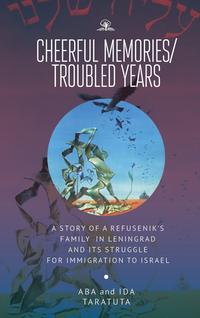
Cheerful Memories / Troubled Years. A Story of a Refusenik’s Family in Leningrad and its Struggle for Immigration to Israel
Покупка
Тематика:
Письма. Дневники. Воспоминания (мемуары)
Издательство:
Academic Studies Press
Год издания: 2019
Кол-во страниц: 160
Дополнительно
Вид издания:
Монография
Уровень образования:
Дополнительное профессиональное образование
ISBN: 978-1-64469-045-1
Артикул: 872396.01.99
Доступ онлайн
1 800 ₽
В корзину
This book captures the story of the Taratuta family and their struggle to flee the hardships of the USSR and repatriate to Israel in the late twentieth century. The narrative follows the lives of three family members, Aba, his wife Ida, and their son Misha, as they endure countless struggles throughout their journey to freedom. Tense moments ensue as the refuseniks print copies of forbidden Zionist literature and textbooks, publicly support those detained in prison and the Gulag, organize scientific and legal seminars in their apartment, receive Western visitors, and secretly partake in weekly Hebrew lessons. Well-recognized in the West as central players in the Soviet Jewish movement in Leningrad throughout the 1970s and 1980s, the Taratutas underwent constant surveillance by the KGB until they were finally able to repatriate to Israel. In spite of their hardships, the family attempted to live a life of normalcy and to cherish moments of happiness and togetherness.
Скопировать запись
Фрагмент текстового слоя документа размещен для индексирующих роботов
Aba, Misha and Ida Taratuta
New York, 2010
Cheerful Memories / Troubled Years
 Library of Congress Cataloging-in-Publication Data
Names: Taratuta, Aba, author. | Taratuta, Ida, author.
Title: Cheerful memories/troubled years : a story of a refusenik's family
   in Leningrad and its struggle for immigration to Israel / Aba and Ida Taratuta.
Description: Boston : Cherry Orchard Books, an imprint of Academic Studies
   Press, 2019. | Includes index.
Identifiers: LCCN 2019007840 (print) | LCCN 2019008826 (ebook) |
   ISBN 9781644690451  | ISBN 9781644690437 (hardcover) |
   ISBN 9781644690444 (pbk.)
Subjects: LCSH: Taratuta, Aba—Family. | Refuseniks. |
   Jews—Persecutions—Soviet Union. | Jews—Soviet Union—Migrations. |
   Soviet Union—Emigration and immigration—Government policy. | Soviet
   Union—Ethnic relations. | Israel—Emigration and immigration
Classification: LCC DS134.93.T37 (ebook) | LCC DS134.93.T37 A3 2019 (print) |
   DDC 323.1192/4047210922 [B] —dc23
LC record available at https://lccn.loc.gov/2019007840
Editors: Michael Beizer and Tamara Brill
This publication is supported by the Association “Remember and Save,” Israel
11 Haprahim St., Apt 69, Haifa, 3473306, Israel
Tel: 972-4-8256959 or 972-5444-82569
aba.taratuta@gmail.com
Soviet-jews-exodus.com
Copyright © 2019 Academic Studies Press
1577 Beacon Street
Brookline, MA 02446
P: (617) 782-6290
F: (857) 241-3149
press@academicstudiespress.com
www.academicstudiespress.com
On the cover: “Aliya shelanu” by Eugene Abeshaus, 1975.
Cover design by Ivan Grave.
Cheerful Memories /
Troubled Years
A Story of a Refusenik’s Family in Leningrad
and its Struggle for Immigration to Israel
Aba and Ida
Taratuta
Boston
2019
Our very special thanks are extended to:
Stefani Hoffman, Enid Wurtman, Israel,
for editing the book,
A special thank you to:
Lena Romanovsky, Israel,
for the Russian-English translation.
Edward Markov, Israel,
for development of photographic materials
and for valuable advice in preparing the book,
Igor Uspensky, Israel,
for valuable advice in editing the book.
Sincere gratitude to:
Alex Geller,
Leonid Lotvin,
Boris Ruchkan,
Nina Simanovsky,
Ilya Simovsky,
Pavel Tsimberov,
all USA,
for the Russian-English translation.
Special thanks to
Leonid Fridkin, Israel,
Edward Markov, Israel,
Yael Pushkin, Israel,
Natan Rodzin, USA,
Lena Yeroshina, Russia,
Tamara Kazakevich, USA,
for permission to use their material.
Dedicated to our grandchildren
Daniel Jacob and Benjamin Simon Taratuta
Contents
From the Editor
From the Authors
9
10
23
46
53
57
59
61
63
66
68
73
75
80
83
85
87
90
91
99
104
118
123
124
1. Grandmother Ida
2. Grandfather Aba
3. Father Michael (Misha)
4. Hebrew
5. Samizdat
6. Demonstrations, 1974
7. The Phone
8. Seminars
9. Unsanctioned exhibition
10. Pesach 1977
11. Warning
12. Visits to places of detention
13. The Search
14. An Investigation at the Public Prosecutor’s office
15. The Jewish Library
16. Interrogation at the KGB, 1982
17. Burglary
18. Our Contacts with the West
19. Three Demonstrations, 1987
20. Not by Zionism alone
21. Israel
Afterword
Appendix
From the Editor
This book was conceived as a family history written for the grandchildren.
Hence, the authors’ personal approach and the significance of their family
history. However, the text includes only a small part of the pedigree of the
family Taratuta, as written by an Israeli cousin, and should not outweigh the
primary author’s text. Ida Taratuta is listed as the co-author because she wrote
the first chapter, and because, together with her husband, she reconstructed the
events and facts of the entire experience.
In the process of working on the book, the authors, in addition to
depending on their memories, used a three-page diary with a list of the main
events of their life in refusal for 1973–88 (the reader will find a facsimile in
the attachments), and the record of Aba’s interrogation by the KGB in 1982,
which he wrote immediately upon returning home. Taratuta managed to get
these four pages out of the USSR. Dozens of unique, first published, carefully
attributed photos give this edition a special value.
Memories differ. Having known the author, my friend and senior colleague
in the struggle, for thirty-five years, and being familiar with the events described
both as a participant and as an historian, I can confidently say that we have in
him a credible witness who writes concisely with a clear mind and memory,
sometimes with humor, but without dramatizing the events or boasting. You
yourself will see this after reading the book.
Dr. Michael Beizer
The Hebrew University of Jerusalem
November 2015
From the Authors
Dear grandchildren, Dan and Ben,
You live in the United States, far from our Israel, and farther still from
Russia, the country where we were born and raised. When you become fathers
and grandfathers, you may want to learn more about the history of your
family and about how we lived; then you will need this book with its brief and
entertaining story about our experiences.
As you know, in the past, Russia, together with a number of other, now
independent countries, was called the Soviet Union, whose citizens were not
entitled to the rights and liberties common to Western countries. Particularly
lacking was the right to leave one’s own country. Soviet Jews who, in addition to
enduring the general lawlessness, also suffered from state antisemitism, sought
the right to immigrate to Israel. The state permitted some of them to emigrate,
but it did not permit others to leave. These people were called “refuseniks.”
“Refuseniks” faced a fateful choice: to wait submissively for the state to
have mercy and release them from its grasp or to enter into an active struggle for
repatriation and for the awakening of the Jewish identity of their compatriots.
This could lead to not obtaining exit visas or even to imprisonment. We, your
grandparents, chose the path of struggle for our rights and fought for them for
fifteen years. This fight was the most important experience and the “finest hour”
of our lives. In this book, we aim to tell you about our family history and about
our involvement in the fight for Soviet Jewry. We hope it will interest both of
you and anyone else who may be interested in Jewish activities in the 1970s and
1980s in the USSR.
Grandmother Ida and Grandfather Aba
Haifa, 2012
Grandmother Ida
My family
My grandparents on my mother’s side lived in Ukraine up to the 1917
Bolshevik Revolution, in the town of Krivoy Rog. Grandfather’s name was
Moses Nemirovsky and grandmother’s, Cecilia Vodovoz. Grandfather’s roots
were probably from the Ukrainian city of Nemirov, as names often reflected the
geography of the Pale of Settlement (and sometimes an individual’s occupation).
The family was not religious but observed Jewish traditions. Mother, who was
born in 1902, was the only child of the family. At that time, a single child family
was considered a rarity. The “official” rabbi registered her as Sonya. “Official
rabbi” means that he was appointed by town officials and not by the Jewish
community.
Grandfather owned a bakery where bread was baked for the miners who
made up the bulk of the population of the city. They lived quite happily and
owned a one-story stone house in the town. When the Bolsheviks came to
power, they took away both the bakery and the house. Many years later, when
we were in refusal, we went there with our friends, the Abeshauses. While
boating by canoe in Ukraine, we arrived in Krivoy Rog. We decided to find this
house, basing our search on mother’s description. It was a one-story house with
a high first floor and two entrances, but it did not look as big as mother had
described....
During the Civil War, when the Bolsheviks tried to impose their power
over the country, Krivoy Rog repeatedly passed from one opposing group
to another; each change of power was accompanied by pogroms against the
Jewish population. When the Bolsheviks finally established themselves in the
town, they abolished the Pale of Settlement. At that time, the family moved to
Moscow. Mother had turned twenty years old or so by the time of their move.
She enrolled in medical school but was expelled as a daughter of lishenets (in
the first years of Soviet power, “lishenets” referred to those who, before the
Revolution, had owned property and were therefore deprived of many civil
Похожие Показать весь список
Доступ онлайн
1 800 ₽
В корзину