
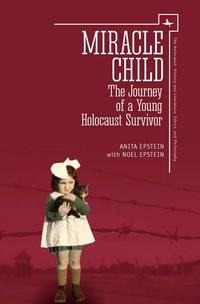
Miracle Child. The Journey of a Young Holocaust Survivor
Покупка
Тематика:
Письма. Дневники. Воспоминания (мемуары)
Издательство:
Academic Studies Press
Год издания: 2018
Кол-во страниц: 142
Дополнительно
Вид издания:
Монография
Уровень образования:
Дополнительное профессиональное образование
ISBN: 978-1-61811-860-8
Артикул: 872383.01.99
Доступ онлайн
1 800 ₽
В корзину
This memoir is about a Jewish baby born in the Krakow ghetto in November 1942, three years after Hitler conquered Poland, and, remarkably, escaping death — one of a mere one half of one percent of Jewish children in Poland who survived during the Nazi era. Her life was saved because her parents hid her with a Catholic family. Just as remarkably, her mother, still alive after suffering terribly through four of Hitler’s camps, traveled for weeks back to Poland and found her again. The book also depicts the author’s postwar challenges in Germany and America.
Скопировать запись
Фрагмент текстового слоя документа размещен для индексирующих роботов
Miracle Child
The Journey of  a Young Holocaust Survivor
The Holocaust:
History and Literature, Ethics, and Philosophy
Series Editor
Michael Berenbaum (American Jewish University)
Miracle Child
The Journey
of a Young Holocaust Survivor
Anita Epstein
With Noel Epstein
Boston
2018
Library of Congress Cataloging-in-Publication Data:
The bibliographic data for this title is available from the Library of Congress.
Copyright © 2018 Academic Studies Press
All rights reserved.
ISBN 978-1-61811-858-5 (hardback)
ISBN 978-1-61811-859-2 (paperback)
ISBN 978-1-61811-860-8 (electronic)
Cover  design by Ivan Grave.
Published by Academic Studies Press in 2018
28 Montfern Avenue
Brighton, MA 02135, USA
press@academicstudiespress.com
www.academicstudiespress.com
For our grandchildren,
Tessa, Jacob, Lilah, Max and Eli
Anyone who doesn’t believe in miracles
is not a realist.
—David Ben-Gurion
Contents
Acknowledgments
Foreword by Michael Berenbaum
10
Introduction: Before It’s Too Late
15
Part I: Origins
Chapter 1: In the Shadow of the Shoah
23
Chapter 2: Hotter Hells
34
Chapter 3: “Don’t Let Her Take Me!”
49
Part II: Closed Doors
Chapter 4: New People, Old Problems
61
Chapter 5: Living With the Enemy
68
Chapter 6: In Search of Home
79
Part III: New World
Chapter 7: Becoming an American
93
Chapter 8: Falling for a Litvak
105
Chapter 9: Debts
113
Chapter 10: New York City Crisis and Beyond
121
Afterword
134
Acknowledgments
As with almost all authors, I owe a great deal to others, but
I am of course solely responsible for any errors that may remain
in this book.
As I need scarcely say, in addition to all else that I owe my
mother and father, I incurred a large debt for the conversations
we had over the years about the period covered by this work. But
truth to tell my mother did not like to discuss specifics about the
Holocaust, and I was extremely reluctant to “interview” her about
everything that had happened.  As a result, I am also indebted to
the Shoah Foundation, housed today at the University of Southern
California, for the interview the foundation did with my mother.
Others’ knowledge and thoughts are also included in this work.
When my mother and I visited Zofia Sendler in 1985, she explained
what had happened while I was in hiding from the Nazis and when
my mother found me again after the war. Her daughter Danuta also
discussed these and other events with me. When we visited Lusia
Avnon in Israel, she described what she recalled about the arduous
post-war trip with my mother from Bergen-Belsen to Krakow, and
her self-published book on her life was helpful on this and other
scores. In New York, her sister Helga offered her thoughts as well,
particularly about life in Selb, Germany.
Among family members, my other largest debt is to my
husband, who has been keeping notes on my life for years and
whose research and writing skills have been critical, especially
since I began suffering several years ago from serious illnesses.
In addition, my late cousin Paul Rolnicki reviewed with me
the days when his father and mine were in the Soviet military,
my cousin Inka Hauser provided her insights as well, and my
sister-in-law Helene Kaminski gave me valuable advice.
I am also grateful to family members who critiqued the entire
manuscript at various stages, including my daughters Stephanie
and Pamela and my cousin Sally Koslow, a talented author who
introduced me to the New York Writer’s Workshop, where
I received an array of helpful comments.
In addition, Michael Berenbaum, Henry Waxman, Stuart
Eizenstat and Henryk Grynberg all read the entire manuscript
and offered varied thoughts, including those Prof. Berenbaum
generously penned in his forward and the kind assessments that
Messrs. Waxman, Eizenstat and Grynberg provided for the book’s
back cover.
Finally, I can never repay all the historians, attorneys, journalists,
documentarians, Holocaust victims and others whose writings and
films on the Holocaust and related issues inform this work. I hope
that I have done them justice, that the book does not fall too far
short in depicting the madness that was the Shoah.
Foreword
“Now it’s my turn.”
With these words Anita Epstein assumes her rightful role as
a child survivor of the Holocaust, one who knows that she and
other Jewish children who escaped death during the Shoah will be
the last survivors. After they go the way of all flesh, the Holocaust
will move from living history to historical memory; the content of
that memory will be different, as will its ethos.
Children of her generation—and of mine—were always taught
to wait their turn. Anita did so respectfully, understanding that
while her mother was alive her story was central, Anita’s but an
embellishment. Some child survivors were less respectful, and their
parents often belittled their children’s memories, saying, “What
could you know—you were only a child. What can you remember—
you were so young.” And because Anita was in hiding and not
in the camps, her unique testimony was negated even more. Her
suffering and her loss, real as they were for her, were secondary to
the terrible tragedies of the adults who had been in the ghettos and
camps. Thus, sometimes without thinking and certainly without
understanding the cruel effect of their statements, ghetto and camp
survivors were dismissive of the children and of others who lived
in hiding, whether by passing as non-Jews or living in clandestine
hiding places.
Yet now, more than three score and ten after the liberation
of Auschwitz, child survivors’ testimonies become all the more
Похожие Показать весь список
Доступ онлайн
1 800 ₽
В корзину