
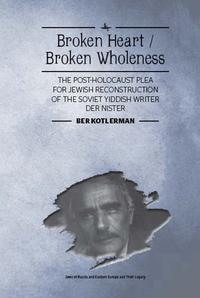
Broken heart / broken wholeness. The post-Holocaust plea for Jewish reconstruction of the Soviet Yiddish writer Der Nister
Покупка
Издательство:
Academic Studies Press
Автор:
Kotlerman Ber
Год издания: 2017
Кол-во страниц: 300
Дополнительно
Вид издания:
Монография
Уровень образования:
Дополнительное профессиональное образование
ISBN: 978-1-61811-531-7
Артикул: 872344.01.99
Доступ онлайн
1 800 ₽
В корзину
In the summer of 1947, three years before his death in a labor camp hospital, one of the most significant Soviet Yiddish writers Der Nister (Pinkhas Kahanovitsh, 1884-1950) made a trip from Moscow to Birobidzhan, the Jewish Autonomous Region in the Russian Far East. He traveled there on a special migrant train, together with a thousand Holocaust survivors. The present study examines this journey as an original protest against the conformism of the majority of Soviet Jewish activists. In his travel notes, Der Nister described the train as the "modern Noah’s ark,” heading "to put an end to the historical silliness.” This rhetoric paraphrasing Nietzsche’s "historical sickness,” challenged the Jewish history in the Diaspora, which "broke” the people's mythical "wholeness.” Der Nister formulated his vision of a post-Holocaust Jewish reconstruction more clearly in his previously unknown notes ("Birobidzhan Manifesto”), the last that have reached us from Der Nister’s creative legacy, which are being discussed for the first time in this book. Without their own territory, he wrote, the Jews were like "a soul without a body or a body without a soul, and in either case, always a cripple.” Records of the fabricated investigation case against the "anti-Soviet nationalist grouping in Birobidzhan” reveal details about Der Nister’s thoughts and real acts. Both the records and the manifesto are being published here for the first time.
Скопировать запись
Фрагмент текстового слоя документа размещен для индексирующих роботов
Broken Heart /
Broken Wholeness
THE POST-HOLOCAUST PLEA
FOR JEWISH RECONSTRUCTION
OF THE SOVIET YIDDISH WRITER
DER NISTER
Jews of Russia & Eastern Europe and Their Legacy
Series Editor
Maxim D. Shrayer (Boston College)
Editorial Board
Ilya Altman  (Russian Holocaust Center and Russian State University for the Humanities)
Karel Berkhoff (NIOD Institute for War, Holocaust and Genocide Studies)
Jeremy Hicks (Queen Mary University of London)
Brian Horowitz (Tulane University)
Luba Jurgenson (Universite ParisIV—Sorbonne)
Roman Katsman (Bar-Ilan University)
Dov-Ber Kerler (Indiana University)
Vladimir Khazan (Hebrew University of Jerusalem)
Mikhail Krutikov (University of Michigan)
Joanna Beata Michlic (Bristol University)
Alice Nakhimovsky (Colgate University)
Antony Polonsky (Brandeis University)
Jonathan D. Sarna (Brandeis University)
David Shneer (University of Colorado at Boulder)
Anna Shternshis (University of Toronto)
Leona Toker (Hebrew University of Jerusalem)
Mark Tolts (Hebrew University of Jerusalem)
Boston
Broken Heart /
Broken Wholeness
THE POST-HOLOCAUST PLEA
FOR JEWISH RECONSTRUCTION
OF THE SOVIET YIDDISH WRITER
DER NISTER
BER KOTLERMAN
Published with the assistance of
The Itzhak Akavyahu Fund
Department of Literature of the Jewish People
Bar Ilan University
and
The Şitnovitzer-Schmidt-Hecht Memorial Foundation
Tel Aviv
Library of Congress Cataloging-in-Publication Data: Names: Kotlerman,
Ber Boris, 1971- author.
Title: Broken heart / broken wholeness : the post-Holocaust plea for Jewish
reconstruction of the Soviet Yiddish writer Der Nister/ Ber Kotlerman.
Other titles: Jews of Russia & Eastern Europe and their legacy.
Description: Boston : Academic Studies Press, 2016. | Series: Jews of Russia
& Eastern Europe and their legacy
Identifiers: LCCN 2016037758 (print) | LCCN 2016041052 (ebook) |
ISBN 9781618115300 (hardcover) | ISBN 9781618115317 (e-book)
Subjects: LCSH: Nister, 1884-1950-Travel—Russia (Federation)—Birobidzhan. |
Nister, 1884-1950-Trials, litigation, etc. | Authors, Yiddish—Soviet Union—Biography.|
Jewish authors—Crimes against—Russia (Federation)—Birobidzhan. |
Jews-Persecutions—Soviet Union.
Classification: LCC PJ5129.K27 Z73 2016 (print) | LCC PJ5129.K27 (ebook) |
DDC 839/.0933 [B] -dc23
LC record available at https://lccn.loc.gov/2016037758
ISBN 978-1-61811-530-0 (hardback)
ISBN 978-1-61811-531-7 (electronic)
Copyright © 2017 Academic Studies Press
All rights reserved
Book design by Kryon Publishing
www.kryonpublishing.com
Published by Academic Studies Press in 2017
28 Montfern Avenue
Brighton, MA 02135, USA
press@academicstudiespress.com
www.academicstudiespress.com
Monstrum horrendum,
informe, ingens,
cui lumen
ademptum.
Virgil, Aeneid 3.658
And it shall come to pass
in that day, that a great
horn shall be blown; and
they shall come that
were lost in the land of
Assyria, and they that
were dispersed in the
land of Egypt; and they
shall worship the Lord in
the holy mountain at
Jerusalem.
Isaiah 27:13
Contents
Foreword by Zvi Gitelman...................................................... viii
Note on the Translation and Transliteration.................................x
Acronyms and Abbreviations.....................................................xi
Preface................................................................................. xiii
Part One: Der Nister’s Journey from Moscow to Birobidzhan ........ 1
A Wedding on a Migrant Train.............................................. 3
Der Nister’s Images and Impressions ...................................... 20
“With the Second Echelon” .............................................23
“With the New Settlers to Birobidzhan”............................ 35
A Man Dieth in a Tent ....................................................... 55
Russian-Jewish “Hybridization”............................................73
Comfort Ye My People.........................................................87
Real Action.......................................................................102
Part Two: Investigation Case No. 68........................................ 115
Der Nister Affair............................................................... 117
Accused in the Case ..........................................................136
Detention Order: BUZI MILLER, June 6, 1949, Birobidzhan  140
Interrogation Records........................................................ 145
Defendant HESHL RABINKOV, July 23, 1949, Khabarovsk .145
Defendant BUZI MILLER, August 5, 1949, Khabarovsk .... 151
Defendant BUZI MILLER, August 29, 1949, Khabarovsk ..169
Defendant BUZI MILLER, September 17, 1949, Khabarovsk .. 179
Defendant ITSIK FEFER, June 30, 1949, Moscow .............185
Defendant BUZI MILLER, October 1949, Khabarovsk ...... 189
Contents
vii
Defendant BUZI MILLER and Defendant HESHL
RABINKOV, October 28, 1949, Khabarovsk (Confrontation)....193

Khabarovsk ..................................................................207
Defendant SHIMEN SINIAVSKI-SINDELEVICH,
October 25, 1949, Khabarovsk......................................... 211
Defendant FAIVISH ARONES, November 1949,
Khabarovsk................................................................... 215
Defendant FAIVISH ARONES, November 21, 1949,
Khabarovsk ..................................................................217
Defendant FAIVISH ARONES and Witness
ALEKSANDR DRISIN, November 29, 1949,
Khabarovsk (Confrontation) ...........................................223
Resubmission of the Indictment: Defendant BUZI MILLER,
December 15, 1949, Khabarovsk ......................................... 231
Bill of Indictment: BUZI MILLER, HESHL RABINKOV,
ISROEL EMIOT, BER SLUTSKI, LUBA VASSERMAN,
SHIMEN SINIAVSKI-SINDELEVICH, and FAIVISH
ARONES, April 6, 1950, Khabarovsk (Excerpts)..................233
The Sentence: BUZI MILLER, May 31, 1950, Moscow
(Excerpt)..........................................................................241
The Early Release: BUZI MILLER, December 27, 1955,
Moscow (Excerpt)...................................................................242
Appendix: Der Nister’s “Birobidzhan Manifesto” (Yiddish) .........243
Bibliography ..............................................................................257
Index.........................................................................................273
Foreword
As might be expected by those familiar with the fashions of historiography, in recent decades scholars have turned from descriptions and
analyses of the dominant and mainstream in the study of Russia and the
Soviet Union to examining the marginal and deviant. In their zeal to
“correct” the “errors” of their predecessors, revisionists sometimes do
not just challenge previously accepted truths but reject them reflexively
and uncritically. However, as Hegel might have predicted, a third wave
of analysis sometimes comes along and navigates a middle course between
the old and new orthodoxies. This judicious book is a case in point.
In some circles, the radical, rejectionist, and militantly communist
Yiddish literature produced in the Soviet Union in the two decades
before World War II was welcomed as a breath of fresh air. But following
the war, it was mostly dismissed as hack work written for political
reasons and without artistic merit. In recent years, a reassessment of
this literature has been undertaken in an attempt to separate the wheat
from the chaff and the lasting from the evanescent. In such a reassessment, the work of Pinkhas Kahanovitsh (“Der Nister”) looms large.
Der Nister was indeed “hidden” from the wrath of Soviet
conformism and survived the scrutiny of ideological vigilantes longer
than many of his contemporaries. He was the most un-Soviet of the
Soviet Yiddish literary establishment. Deeply influenced by his traditional religious upbringing and explorations of Jewish mysticism, Der
Nister’s prerevolutionary writings, delving into the fantastic and
symbolic, were very far from what became the Soviet official aesthetic
of “socialist realism.” Even after returning to Russia in 1925, Der Nister
continued to write fantastic stories. When he moved toward a more
Soviet thematic and style, he stood out from genuinely enthusiastic
Stalinists, such as Itsik Fefer, by his focus on historical themes. Though
Foreword
ix
he was a member of the Jewish Anti-Fascist Committee during the war,
after the war he seemed still aloof from the mainstream of Yiddish
writing. Der Nister’s trip to Birobidzhan, vividly portrayed and
analyzed in this book, appeared to be firmly in line with the prevailing
Soviet orthodoxy, but it may well have been, as Mishe Lev and Ber
Kotlerman surmise, Der Nister’s grasping for some last hope that
Yiddish culture and the Soviet Jewish would survive the catastrophe
that had befallen them during the war. Of course, within a year and a
half, that hope was dashed with Der Nister’s arrest and the liquidation
of Soviet Yiddish culture and its leading lights.
This unusual book combines a description of Der Nister’s journey
to Birobidzhan, his own writings about it, and a transcript of the
subsequent trial of the Birobidzhan “conspirators,” who were supposedly and incongruously organized by Der Nister. It provides several
unusual angles of vision by which we can view the complexities of the
immediate postwar situation of Soviet Jewry. Based on new archival
research and personal interviews, this book brings the reader as close
as possible to the realities of postwar Soviet Jewish life as it was lived
by different kinds of people. In turn, that can point to further developments, culminating in the massive Soviet Jewish emigration in the
decades following 1971.
Der Nister’s personal fate encapsulates the larger tragedy of Soviet
Jewry. They were forced to live constantly with tensions between the
tug of a rich religio-cultural tradition and a revolutionary new secular
culture, between personal fulfillment and political obligation, and
between dreams of new beginnings and crushing disappointments. This
was compounded by the inability to express these tensions publicly and
the hypocrisy forced upon people by a demanding, vigilant regime. The
people emigrated and the regime collapsed, but not before it had
claimed its victims.
 Zvi Gitelman
Note on the Translation and
Transliteration
All the sources cited in the bibliographical references in this book are
spelled out in the original language and orthography. Yiddish words,
and Jewish names in the Yiddish sources, are given using the system of
Latin transliteration of the YIVO Institute. Russian and Ukrainian
titles are transliterated using the Library of Congress transliteration
system, and Hebrew titles are given in a simplified Latin transcription.
In order to make recognition simpler, capital letters in titles and
personal names absent in Yiddish and Hebrew are entered in the transliteration. The names of literary works in Yiddish, Russian, and other
languages are cited in English translation and in their original in Latin
transcription upon their first appearance. The names of Russian,
Yiddish, Hebrew, and other periodicals are given in the original in
Latin transcription.
Похожие Показать весь список
Доступ онлайн
1 800 ₽
В корзину