
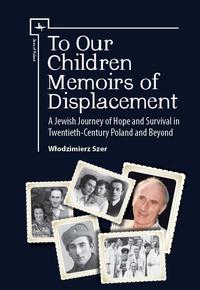
To Our Children: Memoirs of Displacement. A Jewish Journey of Hope and Survival in Twentieth-Century Poland and Beyond
Покупка
Издательство:
Academic Studies Press
Автор:
Szer Włodzimierz
Год издания: 2016
Кол-во страниц: 235
Дополнительно
Вид издания:
Монография
Уровень образования:
Дополнительное профессиональное образование
ISBN: 978-1-61811-479-2
Артикул: 694239.02.99
Доступ онлайн
1 800 ₽
В корзину
This book takes the reader through Dr. Włodzimierz Szer’s childhood in Yiddish prewar Warsaw, adolescence and imprisonment in wartime Russia, to the brutal reality of immediate postwar Poland, and the years of the socialist regime. Although largely autobiographical, the book provides a historically and intellectually compelling analysis of the social and political situation in Poland and Soviet Russia from the early 1930s to 1967.
Скопировать запись
Фрагмент текстового слоя документа размещен для индексирующих роботов
To Our
Children:
Memoirs of
Displacement
A Jewish Journey of Hope and Survival in
Twentieth-Century Poland and Beyond
Jews of Poland
Series Editor
Antony Polonsky (Brandeis University)
To Our
Children:
Memoirs of
Displacement
A Jewish Journey of Hope and Survival in
Twentieth-Century Poland and Beyond
Boston
2016
Włodzimierz Szer
Translated from the Polish by Bronisława Karst
Library of Congress Cataloging-in-Publication Data:
A catalog record for this book is available from the Library of Congress.
Copyright © 2016 Academic Studies Press
All rights reserved
ISBN 978-1-61811-478-5 (hardback)
ISBN 978-1-61811-479-2 (electronic)
Book design by Kryon Publishing
http://www.kryonpublishing.com/
Published by Academic Studies Press in 2016
28 Montfern Avenue
Brighton, MA 02135, USA
press@academicstudiespress.com
www.academicstudiespress.com
In memory of Felusia
—Włodek
Part I:
Part II:
Part III:
Contents
Before the War
1
The War
57
After the War
129
Afterword
209
Index
213
Acknowledgments
viii
Foreword
ix
Acknowledgments
We owe a great deal of gratitude to our life-long friend, Bronia Karst, who translated this memoir with love and care. She interpreted our dad’s book keeping his
voice alive and stayed true to his own words. He would have been thrilled with
this English version of his writing. We also want to thank Fred Rothzeid for his
help in the editing of the final manuscript and Meghan Vicks for her guidance
during this process. We are indebted to Drs. Halina Sierakowska and Kazimierz
Wierzchowski for their beautiful tribute to our father.
Foreword
For a very long time our father had been a man without a past. When we were
growing up he almost never spoke about his childhood, his relatives, or how he
had survived the war. We were aware of some facts: that he grew up in Warsaw,
that his mother was a seamstress and his father worked as an accountant. We
knew about his maternal grandmother and that his grandfather had once lived
somewhere in the US. That was all. There were no details, no stories. Our parents’ wonderful and loving friends became our surrogate uncles, aunts, and
grandmother. We knew our paternal grandfather lived somewhere in a remote
village in a Siberian forest against his will. He would eventually come to live
with us for a brief time in Warsaw in 1956. What we did not know was that
our father’s silence and his refusal to speak about the past was typical of many
Holocaust survivors. We did not fully appreciate that recalling his personal history and speaking of his mother, whom he loved so much, would bring to mind
her terrible death in the Treblinka death camp. He felt great appreciation toward
her for forcing him at a young age to join his father in the Soviet Union shortly
after the war broke out, thus saving him from an almost certain death. In his
book he declares that she gave him life for the second time. But he also felt guilt
for leaving her behind, although he would certainly not have been able to protect her. He was equally unable to share stories about his grandmother and other
relatives because the fate they had suffered was so terrible.
But Dad’s past came alive in his memoir. He began writing it in 2006 in his
beloved Polish and continued over a period of several years, referencing letters
and notes on postcards and photographs he had kept meticulously for decades.
Mostly he wrote from memory, using his profound intellect to bring to life the
people and places of his youth. As we read his memoir we were moved to find
answers to the many questions we had concerning those years. Initially he did
not intend to have this memoir published; he simply wanted to share his life
x
Foreword
with us, his daughters, before he passed away because he had found it so difficult
to tell us about it. But as family members and friends and especially our mother
read excerpts, we encouraged him to publish it, to tell the story of a world that
no longer exists and about which virtually no eyewitnesses remain. He did not
live to see his book published as a historical document by the Jewish Historical
Institute in Warsaw in November of 2013, but he was involved in every aspect
of the process, including selection of the book cover and photos, many of which
we had never before seen. Despite a number of controversial issues, the memoir
was well received. He died three months before its publication.
The book opened a new vista for us. We had always known that our
father was a polymath with outstanding accomplishments as a scientist and
teacher. Yet we knew next to nothing of his childhood and his education, first
in a Bund-run school where he developed a love affair with Yiddish literature
and music, and later in a Polish high school, which gave him a life-long passion for learning. Here we learned the story of his escape from Nazi-occupied
Warsaw, details of his life in Siberia, and how he came back to Poland as an
officer of the Polish regiment of the Russian army, getting badly wounded
along the way. The first two chapters of the book were a true revelation for
us. They not only revealed our father as a young man, but they allowed us to
understand the man he had become and grasp the reasons for his reluctance
to share this part of his life with us. Through his words we were also able
to “meet” our relatives: our grandparents, and our many aunts, uncles, and
cousins, and catch a glimpse into their lives. We learned a great deal about the
Bund’s influence on our father’s political views and about the rich Jewish life
in pre-war Poland. The third chapter provided us with previously unknown
details of our parents’ life immediately after the war. It described how other
Holocaust survivors tried, with greater or lesser success, to rebuild their shattered lives after years of horror and death. The many interludes that a family’s
history is made of were now in our grasp, for us and for our children and their
children to build upon, continue the legacy, and never forget.
Dad concluded his memoirs with our family’s immigration to the United
States in 1967. It was a relatively peaceful and happy time in his life, no longer
defined by struggle and adversity, but it was far from ordinary. In New York
he continued his work at the Biochemistry Department of the NYU School
of Medicine. Within six years he became a full professor and acting chairman of the Department of Biochemistry, securing NIH1 funding for his work,
1	 Tr: National Institutes of Health (NIH).
Похожие Показать весь список
Доступ онлайн
1 800 ₽
В корзину