
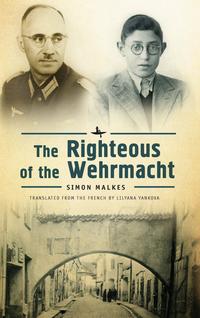
The Righteous of the Wehrmacht
Покупка
Тематика:
История военного дела
Издательство:
Academic Studies Press
Автор:
Malkes Simon
Год издания: 2015
Кол-во страниц: 115
Дополнительно
Вид издания:
Монография
Уровень образования:
Дополнительное профессиональное образование
ISBN: 978-1-61811-450-1
Артикул: 694136.02.99
Доступ онлайн
1 800 ₽
В корзину
The Righteous of the Wehrmachtz describes the life of the author’s family in Vilnius before and during WWII and under the Nazi occupation, depicting their miraculous survival thanks to the German officer Karl Plagge. Plagge played a vital role in the survival of more than one hundred Jews, and for this is known as "the Schindler from Darmstadt.” After liberation by the Red Army, the author’s family moved first to Poland and then to France, forging their lives as refugees with gratitude and courage.
Скопировать запись
Фрагмент текстового слоя документа размещен для индексирующих роботов
• The Righteous of the Wehrmacht •
Boston • 2015
The Righteous
of the Wehrmacht
Simon Malkes
Translated from the French
by Lilyana Yankova
Library of Congress Cataloging-in-Publication Data:
A catalog record for this book as available from the Library of Congress.
Copyright © 2015 Academic Studies Press
All rights reserved.
ISBN 978-1-61811-449-5 (paperback)
ISBN 978-1-61811-450-1 (electronic)
Cover  design by Ivan Grave
Published by Academic Studies Press in 2015
28 Montfern Avenue
Brighton, MA 02135, USA
press@academicstudiespress.com
www.academicstudiespress.com
I dedicate this book
to my daughter, Nathalie,
her husband, Jean-Michel,
and their children, Jeremy and Clara.
Contents
Introduction
8
Serge Klarsfeld
Preface
12
Names Concordance
13
1
My Childhood in Wilno and Holszany
14
(1930-1939)
2
The War: The Soviet Occupation
29
(1939-1941)
3
The War: The German Occupation
34
(1941-1944)
4
The HKP
47
(1943-1944)
5
Liberation, Vilnius, and Lodz
56
(1944-1949)
6
University Years in Munich
60
(1949-1952)
7
Paris
66
(1952-1961)
8
Work, Family, and Homeland
71
(1961-2012)
9
Major Karl Plagge
84
(1897-1957)
Appendix
99
Acknowledgements
107
Index
108
Simon Malkes’s account is first and foremost the
story of a family in the bloody Holocaust nightmare in Vilna (Vilnius), where, thanks to a senior
Wehrmacht officer’s surprisingly positive attitude
toward Jews, Simon's family and some hundred
other Jews survived.
Simon was fourteen years old in 1941. He
waited for a long time after his retirement to
undertake a thorough investigation and all the
steps necessary to pay the tribute that his German
savior, Karl Plagge, deserved. Perhaps it is the
success of Simon’s personal and professional life
that gave rise to this belated recognition in the
form of solemn posthumous awarding of the
Righteous Medal to Karl Plagge in Jerusalem in
2005. When Karl Plagge died in 1957, it was still
too early for survivors to look for him and thank
him. Europe after the war bristled with borders
that were difficult to cross. Holocaust survivors
tried to rebuild their lives in Europe, Israel, the
United States, or elsewhere. Time was necessary
for a group of survivors to realize that their lives
had been saved by the German officer and that he
had done so unselfishly, out of pure humanism.
Although he had been a member of the Nazi
party since 1931 and indeed had voted for Hitler,
Introduction
• Introduction •
he had not voted for the Holocaust. Under the Third Reich, there
were Nazis who were not vicious, and executioners who were not
members of the Party. Karl Plagge chose to remain human.
Following Germany’s invasion of the Soviet Union and the Baltic
states, Plagge was appointed commander of a workshop for repairing military vehicles in Vilnius, Lithuania. He was a 44-year-old mechanical engineer who had fought in World War One. He employed
not only Germans, but also about 500 Jews who were amazed to
find themselves and their families safe in Plagge’s workshop, where
they received decent amounts of food and Germans’ attitude contrasted with the outburst of violence that had poured down upon
Vilna Jews, almost all of whom were taken to Ponary forest and its
mass graves. The Vilna Jewish community was erased. The Jerusalem of the North was a community that had stood out with its
intellectual and spiritual resistance as well as with its heroes, such
as Yitzhak Wittenberg, who surrendered to the SS in order to avoid
repressions and committed suicide with cyanide; Abba Kowner, his
successor, the poet Avrom Suzkewer, and Yitzhak Arad, who later
became an Israeli general, then president of Yad Vashem.
Plagge insisted upon the indispensability of the accomplished
work and his Jewish workers’ competence, which allowed him
skillfully to keep them with him despite the SS’s willingness to get
rid of all Jews, regardless of their utility to the war economy.
Plagge’s great merit further consists in having personally
taken Simon’s mother to the hospital where she could remain
safe for several months until Vilna’s liberation. The rescuer’s deed
persuaded Yad Vashem to award the Righteous Medal to a German
officer and member of the Nazi party, a Vilna Schindler of sorts.
Shortly before liberation, when Plagge warned his protégés that
the army was about to retreat and that they would have to face the
SS and their Lithuanian accomplices, Simon, his father, and a few
friends’ families took refuge in a hideout prepared in anticipation
of the event. They crowded in together, but the conditions soon
• Introduction •
became so unbearable that they had to kill with their bare hands
and in front of their children a man and his wife who panicked and
lost their minds, putting them all in danger of death.
In July 1944, the Soviets seized Vilna. A new life began, which
is still going on for Simon in 2014. Here lies one of this Holocaust
account’s major strengths: it does not end when freedom comes to
replace tyranny, but rather goes on to tell us what the seventeenyear-old boy did with his life. He was one of the rare survivors to
have been saved (along with his parents) thanks to Karl Plagge. Did
not such a happy ending require a special commitment on behalf
of the survivor to justify the miracle? Simon’s contemporaries have
apparently set their minds and energy on a very simple cause:
“I survived for a reason and I will do everything possible to become
a man.”
I shall not refer to others since Simon’s case suffices. He grew
up in the 1930s in a well-to-do environment and spoke Yiddish,
Hebrew, and Polish as a child. He then learned German during the
three years of occupation. Simon began his studies in engineering
in Lodz (1947-1949) and completed them in Munich (1949-1952).
A most dutiful son, he then joined his parents, who had moved
to Paris, and learned French. Later, after he had become a highly
qualified electrical engineer and traveled abroad regularly, English
became his working language. Simon never ceased studying,
advancing, and innovating. Once retired, he volunteered to work
for ORT, an educational institution that teaches a number of
technical professions and which has done so much for poor Jews
worldwide.
As soon as he retired, Simon had the chance to think about the
Odyssey that his life has been and to realize that what he owes to
the German major should be shared with the world. People should
know about Plagge and his example should shine as a beacon of light
through the dark window of the Vilna Holocaust. The adolescents
who once worked at the workshop and repaired German military
Похожие Показать весь список
Доступ онлайн
1 800 ₽
В корзину