
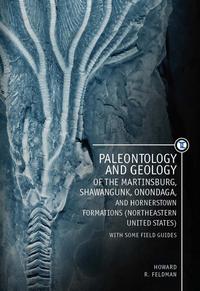
Paleontology and Geology of the Martinsburg, Shawangunk, Onondaga, and Hornerstown Formations (Northeastern United States) with Some Field Guides
Покупка
Тематика:
Палеонтология
Издательство:
Academic Studies Press
Автор:
Feldman Howard B.
Год издания: 2015
Кол-во страниц: 505
Дополнительно
Вид издания:
Монография
Уровень образования:
Дополнительное профессиональное образование
ISBN: 978-1-61811-417-4
Артикул: 694098.02.99
Доступ онлайн
1 800 ₽
В корзину
The chapters in this book will cover the paleontology and geology of some important rock formations (Paleozoic and Paleogene) in the northeastern United States. The emphasis will be on brachiopod paleontology, specifically taxonomy, but will also include comments on morphologic variation and community analysis. The Martinsburg formation in the lower mid-Hudson Valley has been studied for many years but recently yielded numerous marine fossils that shed new light on the community ecology of the formation in the region. The Middle Silurian Shawangunk Formation near New Paltz, New York, is an important ridge-maker that extends toward the southwest into Pennsylvania. Recently discovered rare trace fossils in the Shawangunk will be discussed along with the depositional environment of the conglomerate. The Onondaga Limestone is a well-known formation that crops out from Port Jervis, northeast toward Albany and the westward to Buffalo. The brachiopods and community structure of the formation will be covered in some detail. The paleoecology of the Paleogene Hornerstown Formation of New Jersey will also be discussed, including a biostrome of large terebratulid brachiopods.
Скопировать запись
Фрагмент текстового слоя документа размещен для индексирующих роботов
PALEONTOLOGY
AND GEOLOGY
OF THE MARTINSBURG,
SHAWANGUNK, ONONDAGA
AND HORNERSTOWN FORMATIONS
 (NORTHEASTERN UNITED STATES)
W I T H  S O M E  F I E L D  G U I D E S
“Innocent unbiased observation is a myth.”
Peter Medawar
Induction and Intuition in Scientific Thought, Chapter 11, Section 2, p. 28,
American Philosophical Society, Philadelphia, PA (1969).
“Quite recently the human descent theory has been stigmatized as the ‘gorilla
theory of human ancestry.’ All this despite the fact that Darwin himself, in the
days when not a single bit of evidence regarding the fossil ancestors of man
was recognized, distinctly stated that none of the known anthropoid apes,
much less any of the known monkeys, should be considered in any way as
ancestral to the human stock.”
Henry Fairfield Osborn
“Osborn States the Case for Evolution,” New York Times (12 Jul 1925), XX1.
Written at the time of the Scopes Monkey Trial, in rebuttal of the antievolution position publicized by William Jennings Bryan.
“Why are the bones of great fishes, and oysters and corals and various other
shells and sea-snails, found on the high tops of mountains that border the sea,
in the same way in which they are found in the depths of the sea?”
Leonardo da Vinci
“Physical Geography,” in The Notebooks of Leonardo da Vinci, trans.
E. MacCurdy (1938), Vol. 1, 361.
PALEONTOLOGY
AND GEOLOGY
OF THE MARTINSBURG,
SHAWANGUNK, ONONDAGA
AND HORNERSTOWN FORMATIONS
 (NORTHEASTERN UNITED STATES)
W I T H  S O M E  F I E L D  G U I D E S
HOWARD
R. FELDMAN
Library of Congress Cataloging-in-Publication Data:
A catalog record for this book is available
from the Library of Congress.
ISBN 978-1-61811-416-7 (hardback)
ISBN 978-1-61811-417-4 (electronic)
©Touro College Press, 2015
Published by Touro College Press and Academic Studies Press.
Typeset, printed and distributed by Academic Studies Press.
Cover design by Ivan Grave
Touro College Press
Michael A. Shmidman and Simcha Fishbane, Editors
27 West 23rd Street
New York, NY 10010, USA
touropress.admin@touro.edu
Academic Studies Press
28 Montfern Avenue
Brighton, MA 02135, USA
press@academicstudiespress.com
www.academicstudiespress.com
Touro College  Press
This book is dedicated to my children, Debra and
Brian Belowich, Brian and Baylene Feldman, and my
grandchildren, Alexa and Talia Belowich.
CONTENTS
Introduction..............................................................................................................................................vii
Acknowledgments................................................................................................................................xiv
Chapter One. Notes on the Geology of the Shawangunk Ridge
on the Mohonk Preserve and Environs...........................................................................................1
Chapter Two. Level-bottom Brachiopod Communities in the
Middle Devonian of New York..........................................................................................................12
Chapter Three. Brachiopods of the Onondaga Limestone in Central and
Southeastern New York.......................................................................................................................51
Chapter Four. Chonetacean Brachiopods of the “Pink Hallinetes”
Zone, Onondaga Limestone (Devonian, Eifelian), Central New York............................178
Chapter Five. Brachiopods of the Onondaga Formation, Moorehouse
Member (Devonian, Eifelian), in the Genesee Valley, Western New York...................201
Chapter Six. Paleoecology and Morphologic Variation of a Paleocene
Terebratulid Brachiopod (Oleneothyris harlani) from the Hornerstown
Formation of New Jersey..................................................................................................................297
Chapter Seven. Notes on and Description of Oleneothyris fragilis
(Morton) 1828 (Brachiopoda, Terebratulidae) .....................................................................334
Chapter Eight. Oleneothyris subfragilis (d’Orbigny, 1850), a
Replacement Name for the Brachiopod Oleneothyris fragilis (Morton, 1828)..........351
Chapter Nine. The Shawangunk and Martinsburg Formations
Revisited: Sedimentology, Stratigraphy, Mineralogy, Geochemistry,
Structure, and Paleontology...........................................................................................................353
Chapter Ten. Paleocommunities of the Onondaga Limestone
(Middle Devonian) in Central New York State........................................................................374
Chapter Eleven. Fossils and Facies of the Onondaga Limestone in
Central New York.................................................................................................................................388
Chapter Twelve. Paleogeography and Brachiopod Paleoecology of the
Onondaga Limestone in Eastern New York..............................................................................412
Chapter Thirteen. Understanding the East Central Onondaga Formation
(Middle Devonian): An Examination of the Facies and Brachiopod Communities
of the Cherry Valley Section, and Mt. Tom, a Small Pinnacle Reef..................................445
Appendix.................................................................................................................................................471
Index.........................................................................................................................................................473
INTRODUCTION
The papers herein not only provide a database for taxonomists, biostratigraphers, sedimentologists, and paleobiogeographers but also enhance
our knowledge of marine communities and depositional environments,
especially in the Paleozoic. They also increase our ability to correlate Paleozoic formations in the northeastern United States. The Ordovician Martinsburg Formation can be traced into Pennsylvania as can the Silurian
Shawangunk Formation, the correlatives of which can be found as far south
as Virginia. The Devonian Onondaga Limestone provides insight into formations such as the Anderdon Limestone, Lucas Dolomite, Amhertsburg Dolomite, and Sylvania Sandstone of the Detroit River Group in the Michigan
Basin.
The brachiopods from the Paleocene Hornerstown Formation of New
Jersey that occur in a biostrome on the New Jersey Coastal Plain help elucidate topoclines, chronoclines, and morphologic variation in the genus
Oleneothyris. In addition, paleoecological information provides us with
information about how these brachiopods lived and under what environmental conditions.
Ordovician-Silurian
The Martinsburg Formation was formed due to Ordovician plate
convergence that involved a collision between proto-North America and a
Taconic Island Arc as the Iapetus Ocean closed. As the collision progressed,
a deep basin formed, into which was deposited a thick sequence of muds
and dirty sands that were subsequently consolidated into what we now
recognize as the Martinsburg Formation (Feldman et al., 2012). The Martinsburg is generally considered to be representative of a synorogenic basin that
deepened as a result of Taconic tectonism (Epstein, 1986). Epstein and
Lyttle (1987) consider the Martinsburg Formation in the Wallkill Valley as
parautochthonous and Middle to Upper Ordovician in age. However, they
believe that the parautochthonous sequence west and southwest of Albany
viii
Introduction
is not contiguous with the rocks of the Wallkill Valley and thus the Shale
Bank at Mohonk from which a moderately diverse fauna was collected.
The Martinsburg Formation in the lower mid-Hudson Valley has yielded
a Sowerbyella-Onniella brachiopod community with the following faunal
constituents:
Sowerbyella
Onniella
Dalmanella
Ectenocrinus
Deceptrix
Cryptolithus
Isotelus
Conularia sp.
Trocholites
Corals
Ostracodes
In addition, numerous sedimentary structures were found: oscillation
and interference ripple marks, gutter casts, cross-stratification, and linear
to sinusoidal burrows. Based on the fauna and sedimentology, the depositional environment appears to have been relatively shallow water. McBride
(1962) suggested that the Martinsburg Formation in the Great Valley was
probably deposited at a depth of less than 2,000 m.
The Middle Silurian Shawangunk Formation lies unconformably above
the Ordovician shales and graywackes of the Martinsburg. It crops out from
near Rosendale, south through Wurtsboro, New York, High Point State Park
and the Delaware Water Gap in New Jersey, and at Lehigh Gap, Pennsylvania, after which it continues into Maryland and Virginia (Feldman et al.,
2014). The depositional environment of the Shawangunk was one of braided
streams with deposition on a coastal plain of alluviation, a linear source
toward the southeast, and a marine basin toward the northwest (Epstein
et al., 1987; Feldman et al., 2014). Arthrophycus, found on the Shawangunk
Ridge at Mohonk, near New Paltz, New York, is normally found on the
bottom of beds; however, these specimens occur on the top of a bed. The
trace maker may have been terrigenous but it is likely that it was formed in
a marine environment, possibly estuarine since the basin was just to the
northwest. Rises in sea level or tidal ebbs and flows would have enabled
marine burrowers to form traces in the conglomerate, a fact supported by
the occurrence of (euryhaline) eurypterids in the formation that lived in a
wide range of salinities.
ix
Introduction
Devonian
The first serious attempt to study the fossils of the Onondaga Limestone (Eifelian) in New York was made by Eaton (1832) in which he
mentioned twelve Onondagan species. In 1836 Governor Marcy established
the Geological Survey of New York shortly after which detailed studies of
the Devonian in the state began. In Vanuxem’s Fourth Annual Report (1840),
he referred to the “Corniferous Rock” of Eaton in which he noted the occurrence of Cyrtoceras from the Nedrow Member. In 1842, he published the
first significant description of the Onondaga Limestone in which he included
the outcrop belt in New York State’s Third Geological District. In general the
faunal constituents of the Onondaga, especially the brachiopods, were not
very well known by workers in the nineteenth century. Hall (1840), in a
discussion of the Fourth District, stated that his faunal list represents only a
few of the most common and characteristic fossils and that the list will be
greatly increased when we have succeeded in ascertaining the names of
species.
The papers herein provide a thorough taxonomic treatment of Onondagan brachiopods from central New York through the lower mid-Hudson
Valley.
Stratigraphy
Stratigraphically, the Onondaga consists of four members within the
study area: Edgecliff, Nedrow, Moorehouse, and Seneca. In the mid-Hudson
Valley, the Edgecliff Member can be recognized by abundant light-weathering
chert seams with occasional crinoid stems present. It is finer-grained than
in central New York and more than twice as thick in the eastern part of the
state. Large crinoid stems are typical of the Edgecliff in the Syracuse area.
The Nedrow Member in central New York is very shaly resulting in ledges on
which brachiopods weather out. In the east, however, the Nedrow becomes
thicker-bedded, less argillaceous and coarser-grained (Feldman, 1985).
The Moorehouse Member in the Hudson Valley can be recognized by its
dark-weathering chert seams and greater thickness. In central New York the
Moorehouse is lighter in color with lighter chert. Silicified fossils are found
in the east but not the central part of the state. The Seneca Member is an
x
Introduction
argillaceous limestone with few fossils except for the chonetids found in the
pink “Chonetes” (Hallinetes) Zone 10 ft above the base in central New York
(Feldman, 1985). The Tioga Bentonite separates the Moorehouse from the
Seneca in the Syracuse area. The Seneca Member does not crop out east of
Cherry Valley, New York.
Community Ecology
The Onondaga Limestone was deposited in a low-energy environment
(Feldman, 1980). The hard-shell component of the Onondaga (brachiopod)
communities are closely representative of the living communities. There
was little post-mortem transport and no significant destruction of the shells
due to biopredation of diagenesis. Here I define community as a recurrent
association of taxa that were presumably controlled by a set of environmental factors such as: temperature, pressure, current and/or wave action,
light penetration, nutrients, water chemistry, dissolved oxygen, and miscellaneous factors (biotic relationships such as symbiosis; mechanical wear,
etc.) (Feldman, 1980). It should be noted that there are many varying views
on exactly what defines a community. MacArthur (1971), as cited in Boucot
(1981), summarized the community definition question well by an appropriate quote from Lewis Carroll: “Humpty Dumpty told Alice, ‘when I use a
word, it means just what I choose it to mean—neither more nor less’ (pp.
189-190).”
The communities described herein are named after the dominant
brachiopod taxa. Nine brachiopod communities are recognized in the Onondaga Limestone:
Atrypa-Coelospira-Nucleospira
Atrypa-Megakozlowskiella
Atrypa
Leptaena-Megakozlowskiella
Pacificacoelia
Levenea Community I
Levenea Community II
Amphigenia?
“Chonetes” (now Hallinetes)
The communities named above belong to Benthic Assemblage 3. A
Benthic Assemblage is a group of communities that occur repeatedly in parts
of a region in the same position relative to shoreline (Boucot, 1975). Boucot
(1975) noted that Benthic Assemblages are probably temperature controlled
Похожие Показать весь список
Доступ онлайн
1 800 ₽
В корзину