
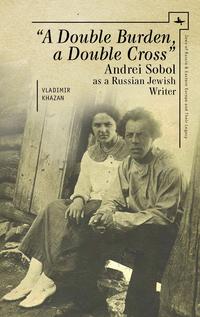
"A Double Burden, a Double Cross”. Andrei Sobol as a Russian-Jewish Writer
Покупка
Тематика:
Литературоведение. Фольклористика
Издательство:
Academic Studies Press
Автор:
Khazan Vladimir
Год издания: 2017
Кол-во страниц: 181
Дополнительно
Вид издания:
Монография
Уровень образования:
Дополнительное профессиональное образование
ISBN: 978-1-61811-712-0
Артикул: 694406.02.99
Доступ онлайн
1 800 ₽
В корзину
If a history of Russian-Jewish literature in the twentieth century (or, at least, a history of its authors and texts) were ever to be written, it would reveal a number of puzzling lacunae. One such lacuna is Andrei Sobol, a truly significant writer who, paradoxically, has not received due scholarly attention. This can easily be demonstrated by the fact that Sobol’s name goes virtually unmentioned in some of the most representative and authoritative studies dealing with the Russian-Jewish literary discourse. It is this scholarly gap that has prompted Vladimir Khazan to write this volume, a comprehensive and exhaustive account of Sobol’s public, literary, and artistic activities as a purely Russian-Jewish phenomenon. Khazan analyzes his biographical subject within the framework of cultural studies.
Тематика:
ББК:
УДК:
ОКСО:
- ВО - Бакалавриат
- 45.03.01: Филология
- ВО - Магистратура
- 45.04.01: Филология
ГРНТИ:
Скопировать запись
Фрагмент текстового слоя документа размещен для индексирующих роботов
“A Double Burden, a Double Cross”
Jews of Russia & Eastern Europe and Their Legac y
Series Editor
Maxim D. Shrayer—Boston College
Editorial Board
Karel Berkhoff—NIOD Institute for War, Holocaust and Genocide Studies
Jeremy Hicks—Queen Mary University of London
Brian Horowitz—Tulane University
Luba Jurgenson—Universite ParisIV—Sorbonne
Roman Katsman—Bar-Ilan University
Dov-Ber Kerler—Indiana University
Vladimir Khazan—Hebrew University of Jerusalem
Alice Nakhimovsky—Colgate University
Antony Polonsky—Brandeis University
Jonathan D. Sarna—Brandeis University
David Shneer—University of Colorado at Boulder
Anna Shternshis—University of Toronto
Leona Toker—Hebrew University of Jerusalem
Mark Tolts—Hebrew University of Jerusalem
“A Double Burden,
a Double Cross”
Andrei Sobol
as a Russian-Jewish
Writer
Vladimir
Khazan
Boston
2017
Library of Congress Cataloging-in-Publication Data
Names: Khazan, Vladimir, author.
Title: "A double burden, a double cross" : Andrei Sobol as a Russian-Jewish
   writer / Vladimir Khazan.
Description: Boston, MA : Academic Studies Press, 2017. | Series: Jews of
   Russia & Eastern Europe and their legacy | Includes bibliographical
   references.
Identifiers: LCCN 2017043780 (print) | LCCN 2017046557 (ebook) |
   ISBN 9781618117120 (ebook) | ISBN 9781618117113 (hardback)
Subjects: LCSH: Sobol', Andrei, 1888-1926--Criticism and interpretation. |
   Russian literature--Jewish authors--20th century--History and criticism. |
   Jews in literature.
Classification: LCC PG3476.S577 (ebook) | LCC PG3476.S577 Z69 2017 (print) |
   DDC 891.73/42--dc23
LC record available at https://lccn.loc.gov/2017043780
© Academic Studies Press, 2017
All rights reserved.
ISBN 978-1-61811-711-3 (hardcover)
ISBN 978-1-61811-712-0 (electronic)
Cover design by Ivan Grave.
Published by Academic Studies Press in 2017
28 Montfern Avenue
Brighton, MA 02135, USA
P: (617)782-6290
F: (857)241-3149
press@academicstudiespress.com
www.academicstudiespress.com
C o n t e n t s
List of Illustrations
6
Preface
7
List of Abbreviations
22
Part I. “…And, Apparently, a Very Good Jew”:
Sobol as a Russian-Jewish Literary Critic
and Journalist
I.1 Baal-Makhshoves  and Andrei Sobol:
24
Two Views on the Purpose and Objectives
of Russian-Jewish Literature
I.2 The Context and Subtext of Sobol’s
31
Open Letter to D. Merezhkovsky
I.3 A Battle that Never Happened
46
(Sobol’s Unpublished Open Letter to Ivan Bunin)
Part II. Andrei Sobol and Evreiskii Mir
54
Part III. Overcoming the Myth: Jewish Themes, Motifs,
   and Images in Sobol’s Works
III.1. Between Literature and Politics:
69
Sobol’s Novel Pyl’
III.2. Jewish Themes, Motifs, and Images
85
in Sobol’s Short Stories
III.3. The Fate of Sobol’s Book Evrei
109
Part IV. Sobol’s Translation of Wandering Stars
114
Part V. Andrei Sobol and the Jewish Theater
135
Conclusion
143
Notes
147
Bibliography
164
Index
174
L i s t  o f  I l l u s t r a t i o n s
Figure 1. Andrei Sobol in 1911
8
Figure 2. Andrei Sobol’s parents:
14
father Moisei-Yitzhak (1870) and mother Mina (1891)
Figure 3. Andrei Sobol’s parents:
15
father Moisei-Yitzhak (1885) and mother Mina (1915)
Figure 4. Andrei Sobol  and his brothers
16
Figure 5. Andrei Sobol in Cavi di Lavagne
17
Figure 6. Rakhil Bakhmutskaia (Dvinsk,
18
left—1911, right—1908)
Figure 7. Rakhil Bakhmutskaia with Mark Sobol
19
on her hands (March 1918)
Figure 8. Andrei Sobol—commissar
20
of the Provisional Government (August 1917)
Figure 9. Andrei Sobol in 1925
21
Figure 10. Andrei Sobol’s grave
21
at the Novodevich’e cemetery
Figure 11. Lower row: Leib Iaffe and Pinkhas Rutenberg;
105
upper row: unidentified person and Andrei Sobol
(village Taininskaia, near Moscow,  summer of 1918
P r e f a c e
If a history of Russian-Jewish literature in the twentieth century (or,
at least, a history of its authors and texts) were ever to be written,
it would reveal a number of puzzling lacunae. One such lacuna is
Andrei Sobol, a truly significant writer who, paradoxically, has not
received due scholarly attention. This can easily be demonstrated
by the fact that Sobol’s name goes virtually unmentioned in some of
the most representative and authoritative studies dealing with the
Russian-Jewish literary discourse (see, for instance, Nakhimovsky,
1992; Kornblatt, 1992; Sicher, 1995; Katz, 2008; Murav, 2011, et al.);
even the seemingly most comprehensive recent work—a fourvolume collective monograph titled Yehudei Rusya ba-Mea ha-Esrim
[Russian Jews in the Twentieth Century], which was published in
Hebrew in 2014—passes over him in silence.
This is not to say that Sobol, as a Russian-Jewish writer, has
been completely forgotten; in fact, several authors have touched
on this subject. These range from the well-known contemporary
critic Vasily L’vov-Rogachevskii, who discussed him briefly in his
book Russko-evreiskaia literatura [Russian-Jewish literature] (L’vovRogachevskii, 1922: 160–61), to several modern scholars: Rytman,
1993; Prat, 1996; Prat, 2000; Gantseva, 2001; Geizer, 2001; Hetényi,
2006; Hetényi, 2008 (according to the index, pp. 196–200; 279–81
in particular); in addition to those, see our own works: Khazan,
2005a; Khazan, 2008a; Khazan, 2014; Khazan, 2015. Nevertheless,
we still lack a comprehensive and exhaustive account of Sobol’s
public, literary, and artistic activities as a purely Russian-Jewish
phenomenon—either in the form of a biographical description or
as an analysis within the framework of cultural studies. It is this
scholarly gap that has prompted me to write this book.
In reality, the problem lies not
in the lack of a complete study
of the Russian-Jewish element of
Sobol’s literary legacy, so much
as in the failure, rather startling in
itself, to identify this element on
the part of many of his would-be
interpreters. Sobol, in his literary
works, touched on some of the
sorest spots in Russian-Jewish
relations, was braver than most
in entering the “danger zones”
of
this
relationship,
showed
a keen interest in the numerous
manifestations of the Jewish spirit
in Russian culture, worked as
a translator and editor of Jewish
authors, engaged with Jewish
theater in his capacity as a critic,
and, finally, made an important contribution to the gallery of Jewish
fictional “types,” thereby significantly enriching the Russian-Jewish
literary stock—and yet, despite all this, it seems that neither his
dauntless and unflinching civic stance nor the ideas and images that
are expressed in his writing have yet been adequately perceived
and analyzed by critics and scholars.
Sobol’s impact on the Russian-Jewish press is both broad
and diverse. Before the Revolution of 1917, his articles appeared
in most of the key Russian-Jewish periodicals: Khronika Evreiskoi
Zhizni [The Chronicle of Jewish Life], Evreiskaia Zhizn’ [Jewish Life],
Novyi Put’ [New Way], Novyi Voskhod [New Sunrise], and Evreiskaia
Nedelia [The Jewish Week]; after the Revolution, he wrote for the
single-issue newspaper Evreistvo i Palestina [The Jews and Palestine]
(Moscow, 1918), and for the Safrut collections (1918, 1922; edited by
Leib Iaffe, a well-known Jewish poet, journalist, and public figure).
He also edited an anthology entitled Evreiskii Mir [The Jewish
World] (1918; originally, at least six issues were projected, but the
Bolsheviks banned it after the first issue). During the Civil War, he
Figure 1. Andrei Sobol in 1911
Preface
wrote for the Odessa-based anti-Bolshevik newspaper Evreiskaia
Mysl’ [Jewish Thought]. All in all, Sobol’s numerous contributions—
to Russian-Jewish literature; to the social, intellectual, and spiritual
life of Russian Jews in the 1910s and the first half of the 20s; and,
more broadly, to the national-cultural identity of Russian Jewry—
are varied and highly significant. And yet, when one reads certain
studies dealing with the history of Russian-Jewish literature in
the twentieth century, one gets the distinct impression that such
a writer was never a part of this literature.
The response to Sobol’s oeuvre in general, and to the “RussianJewish” component thereof in particular, tends to be characterized
by a peculiar sloppiness, an unwillingness not only to go into
details, but even to attain even a cursory understanding of some
of the most basic aspects of these works. This negligent attitude
is typical of even the most authoritative critics. Here is just one
illustrative example. In the collection Evreiskii mir [Jewish World],
which was compiled by the Union of Russian Jews during World
War II, Mark Slonim, who authored the article on Jews in Soviet
literature, unequivocally relegated Sobol to the category of authors
whose works “despite … the obvious assimilation into the Russian
environment, are characterized by occasional infusions of Jewish
themes and motifs” (Slonim, 2001 (1944): 156). Slonim also wrote:
In his nervous, frantic works, one could sense that painful ambivalence, that mental imbalance of a dreamer and a visionary,
which was commonly attributed to those consumptive Jewish
youths who used to be the favorite protagonists of many
a writer. Although Sobol wrote almost exclusively about the
Russian intellectuals with their troubled conscience and about
the “superfluous men” of the bohemian intelligentsia (the novel
Pyl’ [Dust]), there are occasional passages that, both in terms of
subject matter and in terms of interpretation, attest to his Jewish
origins (ibid.).
Almost all the claims made in this quote are factually wrong, and
they arouse a sharp feeling of protest that borders on bewilderment:
by no means all of Sobol’s works can be characterized as the
writings of a “consumptive Jewish youth”; the Jewish theme is
far from marginal in his oeuvre, and the novel Pyl’ (1915), which
depicts revolutionary terrorists and deals unflinchingly with the
question of anti-Semitism in the revolutionary milieu, cannot in any
way be described as a novel about the “bohemian intelligentsia”—if
Slonim had actually bothered to read it, he would never have made
such a claim.
This entry is all the more puzzling in light of the fact that Sobol,
both as a human being and as a writer, was much more closely
connected to Jewry, had a far deeper and more nuanced view of
the actual dramas, needs, and problems facing the Jews, than those
latter-day critics who would presume to judge him with varying
degrees of severity. Suffice it to say that, at different times in his
life, he was interested in Zionism, and this was no mere “passing
youthful fad”: he really shared his people’s millennial yearning to
return to their ancestral homeland, and this conviction stayed with
him in later years. In an article published in the single-issue Zionist
newspaper Evreistvo i Palestina, appropriately titled Son tysiacheletii
[The Dream of Millennia], he addressed this subject clearly and
unambiguously:
We sleep uneasily. The nightmares are ever at our bedside, both
by night and by day; we often wake to the light of a candle stub;
just as often, we wake to utter darkness; our life is harsh, and all
our paths and roads are arduous. And yet, there are also healing
dreams, wonderful dreams—and, if they come to us, I know one
such golden dream.
The dream of a millennium, the dream of yesterday, the dream of
tomorrow—it is unchanging, eternal, and captivating.
It is within the soul of the people, it is with me. Ask me not
whether I believe in dreams—I see it with my own eyes.
Oh, how poor—yet how rich—we are! (Sobol, 1918).
If we are to comprehensively analyze the subject of “Sobol
and Jewry,” we must take account of a whole range of facts that
are not merely understudied, but completely unknown. Thus,
we know virtually nothing about Sobol’s activities in the Crimea
during the Civil War, where he, together with Osip Mandelstam
and the Yiddish-language poet and pamphleteer Elisha (Abram
Похожие Показать весь список
Доступ онлайн
1 800 ₽
В корзину