
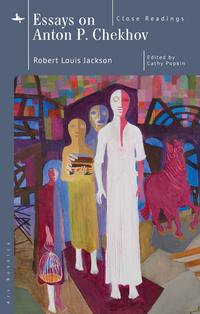
Essays on Anton P. Chekhov: Close Readings
Покупка
Тематика:
Литературоведение. Фольклористика
Издательство:
Academic Studies Press
Автор:
Jackson Robert Louis
Под ред.:
Popkin Cathy
Год издания: 2023
Кол-во страниц: 272
Дополнительно
Вид издания:
Монография
Уровень образования:
Дополнительное профессиональное образование
ISBN: 979-8-88719-093-8
Артикул: 871879.01.99
Доступ онлайн
1 800 ₽
В корзину
This long awaited collection brings together in one volume the definitive essays on Anton Chekhov by renowned Chekhov scholar Robert Louis Jackson, including work that has never appeared in English as well as brand new essays published here for the first time. The volume offers a series of "slow” readings that yield insight after exquisite insight. They also model fruitful ways of discerning the rich complexity of Chekhov’s deceptively simple work. The volume’s introduction by Robin Feuer Miller captures beautifully what Jackson undertakes in his careful scrutiny of Chekhov’s text. The editor’s afterword by Cathy Popkin includes passages from the editorial correspondence in which Jackson reflects on his work and articulates his aspirations; the authorial voice thus resounds in the section Jackson expected to write himself. The editor also outlines the arguments and insights of Jackson’s remarkable unfinished essays. Finally, an appendix provides the full text of his virtually complete but still open-ended treatment of "On Official Business,” the story Jackson returned to repeatedly for decades, the previously unpublished culmination of his life’s work on Chekhov. Essays on Anton P. Chekhov: Close Readings is fully accessible to readers without knowledge of Russian while also providing complete documentation for scholars in the field.
Скопировать запись
Фрагмент текстового слоя документа размещен для индексирующих роботов
Essays on
Anton P. Chekhov
C l o s e  R e a d i n g s
Ars Rossica
Series Editor:
David Bethea (University of Wisconsin, Madison)
B O S T O N
2 0 2 3
Essays on
Anton P. Chekhov
C l o s e  R e a d i n g s
Robert Louis Jackson
E d i t e d  b y
C a t h y Po p k i n
Library of Congress Cataloging-in-Publication Data
Names: Jackson, Robert Louis, author. | Popkin, Cathy, 1954- editor.
Title: Essays on Anton P. Chekhov : close readings / Robert Louis Jackson;
   edited by Cathy Popkin.
Other titles: Ars Rossica.
Description: Boston : Academic Studies Press, 2023. | Series: Ars rossica |
   Includes bibliographical references and index.
Identifiers: LCCN 2022050073 (print) | LCCN 2022050074 (ebook) |
   ISBN 9798887190921 (hardback) | ISBN 9798887190938 (adobe pdf) |
   ISBN 9798887190945 (epub)
Subjects: LCSH: Chekhov, Anton Pavlovich, 1860-1904—Criticism and
   interpretation. | LCGFT: Literary criticism. | Essays.
Classification: LCC PG3458.Z8 J33 2023  (print) | LCC PG3458.Z8  (ebook) |
   DDC 891.72/3—dc23/eng/20221017
LC record available at https://lccn.loc.gov/2022050073
LC ebook record available at https://lccn.loc.gov/2022050074
Copyright © 2023 Academic Studies Press
All rights reserved
ISBN 9798887190921 (hardback)
ISBN 9798887190938 (Adobe PDF)
ISBN 9798887190945 (ePub)
Book design by Tatiana Vernikov
Cover design by Ivan Grave
On the cover: “Self-Portrait Construisant Une Ville—after Degas,
Sémiramis” (detail), by Leslie Jackson, 1975. Reproduced by permission.
Published by Academic Studies Press.
1577 Beacon Street
Brookline, MA 02446, USA
press@academicstudiespress.com
www.academicstudiespress.com
Contents
Editor’s Note by Cathy Popkin
vi
Introduction by Robin Feuer Miller
ix
Essays on Anton P. Chekhov. Close Readings by Robert Louis Jackson
On Chekhov’s Art
3
Chekhov’s Seagull: The Empty Well, the Dry Lake, and the Cold Cave
14
“If I Forget Thee, O Jerusalem”:
27
An Essay on Chekhov’s “Rothschild’s Fiddle”
Dostoevsky in Chekhov’s Garden of Eden: “Because of Little Apples”
44
“The Betrothed”: Chekhov’s Last Testament
64
Chekhov and Proust: A Posing of the Problem
78
“The Steppe”: Space and the Journey. A Metaphor for All Times
90
“The Enemies”: A Story at War with Itself?
102
Chekhov’s “The Student”
114
The Ethics of Vision:
122
The Punishment of the Tramp Prokhorov in The Island of Sakhalin
Dantesque and Dostoevskian Elements in Chekhov’s “In Exile”
129
Biblical and Literary Allusions in Chekhov’s “Gusev”
142
Russian Man at the Rendezvous:
151
The Narrator of Chekhov’s “A Little Joke”
“Small Fry”: A Nice Little Easter Story
159
Chekhov’s “Rothschild’s Fiddle”:
173
“By the Rivers of Babylon” in Eastern Orthodox Liturgy
Three Deaths: A Boy, A Goose, and an Infant
180
A Fragment from the Aggregate:
195
Sinai and Sakhalin in Chekhov’s Letters to Suvorin
“Grief”: Once Again about the Ending of the Story
200
Dogs: Text and Subtext in “Lady with a Pet Dog”
213
Matthew Arnold’s “Dover Beach” and Gurov’s Oreanda Meditations
221
in Chekhov’s “Lady with a Pet Dog”
Afterword by Cathy Popkin
227
Appendix: Robert Louis Jackson on “Po delam sluzhby”
236
[“On Official Business”] (unfinished)
Index
254
Еditor’s Note
All scholarship on Chekhov’s work must address two technical difficulties,
one in the mechanics of quotation and the other in the identification of
sources.
The first entails distinguishing typographically between editorial omissions and Chekhov’s own liberal use of suspension points—three dots at the
end of sentences, clauses, phrases, and even between words to indicate pauses, to capture an incomplete thought or the trailing off of speech, or to create
silences amidst the sounds. Given their functionality, Chekhov’s suspension
points are included in all quoted passages, indicated by three closely spaced
dots...
In order to distinguish Chekhov’s punctuation from Robert Jackson’s ellipses, the essays use three dots enclosed in square brackets to indicate where
anything has been omitted from a quoted passage […].
The second practice adopted here is prompted by the organization of
the Academy of Sciences edition of Chekhov’s work: A. P. Chekhov, Polnoe
sobranie sochinenii i pisem v tridtsati tomakh [Complete works and letters in
30 volumes] (Moscow: Izdatel′stvo “Nauka,” 1974–1983). Unless otherwise
indicated, all references to Chekhov’s work are to this edition. Because the
edition’s thirty volumes are divided into two separate numerical sequences
(Works [Sochineniia], vols. 1–18, and Letters [Pis′ma], vols. 1–12), the conventional abbreviation for a Russian author’s complete works [PSS] is expanded here to PssS for Works [Sochineniia] and PssP for Letters [Pis′ma],
followed by the relevant volume and page number.
Analogously, references to the works of Ivan Turgenev are to the following edition: I. S. Turgenev, Polnoe sobranie sochinenii i pisem v dvadtsati
vos′mi tomakh (Moscow and Leningrad: Izdatel′stvo Akademii nauk SSSR,
1960–1968). Because the edition’s twenty-eight volumes are numbered as
two independent sequences—Works [Sochineniia], vols. 1–15, and Letters
[Pis′ma], vols. 1–13—references to this edition, too, specify PssS for Works
[Sochineniia] and PssP for Letters [Pis′ma], followed by the relevant volume
and page number.
The collected works of Dostoevsky and Tolstoy cited here number their
volumes in one continuous sequence: F. M. Dostoevskii, Polnoe sobranie
vii
Е d i t o r ’s  N o t e
vii
sochinenii v tridtsati [30] tomakh (Leningrad: Izdatel′stvo “Nauka,” 1972–
1990); and L. N. Tolstoi, Polnoe sobranie sochinenii v devianosta [90] tomakh
(Moscow: Gosizdat, 1928–1958). References to these editions thus appear
as Dostoevskii, PSS and Tolstoi, PSS, respectively, followed by the relevant
volume and page number.
Please note as well that, while in the text of the essays Russian names
are given in their familiar Anglicized forms (Fyodor [rather than Fedor],
Yakov [rather than Iakov], Gorky [rather than Gor′kii], Tolstoy [rather than
Tolstoi]), all bibliographic references and transliterated passages are rendered in accordance with the modified Library of Congress system of transliteration.
Finally, my sincere thanks to Ekaterina Yanduganova of Academic
Studies Press for her editorial acuity and her unfailing support—as well as for
devising the graphic means to express all of the above distinctions.

cp
"Red Sofa"
(Portrait of Robert Louis Jackson at age 18)
by Ella F. Jackson, 1941.
Reproduced by permission of owner.
Introduction
Robert Louis Jackson’s death at the age of ninety-eight in May 2022 came
as a shock to his family, his colleagues, and friends. His vibrant physical presence seemed permanent, whether in the classroom or at his hospitable kitchen tables in Truro, Massachusetts, or Guilford, Connecticut. Now he joins the
writers and characters about whom he has written and who will, no doubt,
welcome him to their circle. He emanated in old age the kind of joyousness,
sparkle, curiosity, and clarity that we associate with the final days of the Elder
Zosima in The Brothers Karamazov.
Among Jackson’s books are three collections of his essays; they offer
us, because each volume contains work carefully selected by Jackson at the
time of compilation, three snapshots of his critical thinking over some thirty
years—a time when both the world and the modes of critical engagement
have been undergoing significant change. The present volume, Essays on
Anton P. Chekhov: Close Readings, is the third, and it was preceded by Close
Encounters: Essays on Russian Literature (Academic Studies Press, 2013) and
Dialogues with Dostoevsky: The Overwhelming Questions (Stanford University
Press, 1993). The title of each of these collections reflects Jackson’s steady
preoccupation with the reader’s activity in time: he is reading, he is having
close encounters, he is engaging in dialogue and asking questions.
Among the various striking aspects of Jackson’s writing is its fluidity, its
openness to change, to listening to others, to engaging in close communications—all without the straitjacket of ideology or even theories about such
engagement. His critical work is the thing itself. Jackson puts authors—
Chekhov, Turgenev, Tolstoy, Dostoevsky, Gorky, Goethe, and others—into
dialogue with each other and does not hesitate to insert himself into the conversation as well. Thus, his work is perennially alive, undogmatic, and subject
to change or rethinking, provisional. As with Chekhov and Dostoevsky, for
Jackson the process, the act, outweighs the significance of any static meaning
or result. The present volume reflects the value of revisiting important works
over time, acknowledging, accommodating, and reflecting upon one’s own
changing understanding of them.
As I read Essays on Anton P. Chekhov, it seemed that an appropriate subtitle for it would have been An Essay in the Old Criticism, but of course that
x
was already used over sixty years ago by George Steiner in 1959—a reminder
of how quickly the new becomes old and perhaps the old is new again. And,
curiously, in the 1993 collection of his essays, some thirty years ago, Jackson
had the same impulse, telling his readers in his “Introduction” that he “should
have been glad to subtitle [his] book ‘Essays in the Old Criticism’ if Steiner
had not, some thirty-five years earlier, already “preempted that subtitle.”
Jackson’s perennial themes, moreover, are “the intractable problems
that preoccupy both literature and criticism.” The present volume represents
those themes and problems with compelling originality and humanity. A preoccupation with the overarching themes of Fate, Freedom, Responsibility,
Beauty, Ugliness, Parting, and Death suffuses all three volumes, but Essays
on Anton P. Chekhov adds to that collection of themes a practice of frequent
illuminating excursions into the Russian language and the way in which
Chekhov and other Russian writers have used particular words. These analyses are of significant value both to readers of Russian and to those who know
nothing about the language.
Criticism abounds with theories of reading. In the opening sentence of
the book, Jackson contributes, with almost off-hand modesty, a theory of his
own, derived of all places from an old grammar textbook whose author he
no longer remembers: “Wisdom and platitude sometimes coincide. ‘Read
slowly and deeply, looking forwards and backwards’—I once read in an old
grammar. I have always read cautiously and, in learning Russian, developed
a habit of examining words closely.” Jackson’s book offers up not a paradigm of
a hermeneutic journey from part to whole, nor a chronological one (whether
at the level of the sentence, the work at hand, the oeuvre, or the epoch as
a whole) that traces the writer’s development and evolution as an artist to
some endpoint. Instead, Jackson reads Chekhov slowly, deeply, while looking and reading forwards and backwards. There is no part that stands for the
whole; there is no destination, but there are piercing moments of insight,
moments of significant, if temporary or fragile, arrival. With the exception of
the opening piece (“On Chekhov’s Art”), Jackson ordered the essays for the
volume chronologically, yet it is fascinating to see that, taken as a whole, they
reflect the backwards and forwards motion of Jackson’s thinking about Chekhov and about his description of the act of reading generally. Neither Jackson nor his editors shied away from seeming repetitions or returns to certain
stories or themes. The result is an exquisite structure that mirrors a process of
reading over time. To revise Stein’s bleak entropic command in Conrad’s Lord
Jim into a life-affirming one: “In the artistic element immerse.”
Похожие Показать весь список
Доступ онлайн
1 800 ₽
В корзину