
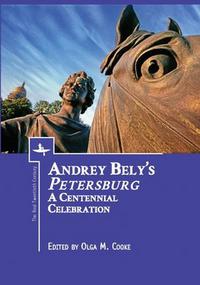
Andrey Bely’s Petersburg: A Centennial Celebration
Покупка
Тематика:
Теория литературы
Издательство:
Academic Studies Press
Автор:
Cooke Olga M.
Год издания: 2017
Кол-во страниц: 275
Дополнительно
Вид издания:
Сборник
Уровень образования:
Дополнительное профессиональное образование
ISBN: 978-1-61811-576-8
Артикул: 871815.01.99
Доступ онлайн
1 800 ₽
В корзину
Celebrating the one-hundredth anniversary of Andrey Bely’s Petersburg, this volume offers a cross-section of essays that address the most pertinent aspects of his 1916 masterpiece. The plot is relatively a simple one: Nikolai Apollonovich is ordered by a group of terrorists to assassinate his father, the prominent senator, Apollon Apollonovich Ableukhov. Nevertheless, Bely’s polyphonic, experimental prose invokes such diverse themes as: Greek mythology, the apocalypse, family dynamics, psychology, Russian history, theosophy, revolution, and European literary influences. Considered by Vladimir Nabokov to be one of the twentieth century’s four greatest masterpieces, Petersburg is the first novel in which the city is the hero. Frequently compared to Joyce’s Ulysses, no novel did more to help launch modernism in turn-of-the century Russia.
Скопировать запись
Фрагмент текстового слоя документа размещен для индексирующих роботов
ANDREY BELY’S PETERSBURG
A Centennial Celebration
The Real Twentieth Century
Series Editor
Thomas Seifrid (University of Southern California, Los Angeles)
Editorial Board
Stephen Blackwell (University of Tennessee, Knoxville)
Nancy Condee (Pittsburgh University, Pittsburgh)
Caryl Emerson (Princeton University, Princeton)
Mikhail Iampolskii (New York University, New York)
Galin Tihanov (Manchester University, Manchester)
BOSTON
ANDREY BELY’S PETERSBURG
A Centennial Celebration
Edited by OLGA M. COOKE
Library of Congress Cataloging-in-Publication Data
Names: Cooke, Olga Muller, editor.
Title: Andrey Bely’s Petersburg : a centennial celebration / edited by Olga M. Cooke.
Other titles: Real twentieth century.
Description: Boston : Academic Studies Press, 2017. | Series: Real twentieth century |
Includes bibliographical references and index.
Identifiers: LCCN 2016052721 (print) | LCCN 2016056173 (e-book) |
ISBN  9781618115751 (hardback) | ISBN 9781618115768 (e-book)
Subjects: LCSH: Bely, Andrey, 1880-1934. Peterburg. | Bely, Andrey,  1880-1934—
Criticism and interpretation. | Russian prose literature—20th century—History and
criticism.
Classification: LCC PG3453.B84 P5316 2017 (print) | LCC PG3453.B84 (ebook) |
DDC 891.73/3—dc23
LC record available at https://lccn.loc.gov/2016052721
Copyright © 2017 Academic Studies Press
All rights reserved
ISBN 978-1-61811-575-1 (hardback)
ISBN 978-1-61811-576-8 (electronic)
Book design by Kryon Publishing, www.kryonpublishing.com
Cover design by Jen Stacey
Cover photo by Alexander Petrosyan, reproduced by the author’s permission
http://aleksandrpetrosyan.com/
https://www.instagram.com/petrosphotos/
Published by Academic Studies Press in 2017
28 Montfern Avenue
Brighton, MA 02135, USA
press@academicstudiespress.com
www.academicstudiespress.com
Dedicated to the memory of Georgette Donchin
Contents
Foreword by Thomas R. Beyer Jr.
vii
Acknowledgments
viii
Vladimir Nabokov, “On Petersburg”
x
Introduction by Olga M. Cooke
1
Carol Anschuetz, “Bely’s Petersburg and the End of the Russian Novel”
19
Maria Carlson, “Andrey Bely’s Astral Novel: A Theosophical Reading of Petersburg”	 46
Charlene Castellano, “Synesthesia as Apocalypse in Andrey Bely’s Petersburg”
63
Jacob Emery, “Kinship and Figure in Andrey Bely’s Petersburg”
73
Roger Keys, “Metafiction in Andrey Bely’s Novel Petersburg”
94
Timothy Langen, “Petersburg as a Historical Novel”
102
Aleksandr V. Lavrov, “Andrey Bely between Conrad and Chesterton”
116
Magnus Ljunggren, “The Bomb, the Baby, the Book”
134
Anna Ponomareva, “‘Know Thyself’: From the Temple of Apollo at Delphi to
the Pages of Petersburg”
147
Ada Steinberg, “Fragmentary ‘Prototypes’ in Andrey Bely’s Novel Petersburg”
163
Adam Weiner, “The Enchanted Point of Petersburg”
187
Judith Wermuth-Atkinson, “Reality and Appearance in Petersburg and
the Viennese Secession”
227
Contributors
251
Index
254
Foreword
This revolutionary novel, explosive and innovative, is still little known, less
understood, and inadequately appreciated in the West. The unique marriage
of sound and sense in the original Russian has stymied translators into
English. Were it not for Vladimir Nabokov’s claim that Petersburg was one
of the “masterpieces of twentieth-century prose,” the novel might have been
largely overlooked in the English-speaking world. Even in his homeland, Bely
was met largely by silence for almost fifty years, although he was held in high
esteem among Russian émigré scholars.
Bely and his Petersburg have been likened to James Joyce’s Ulysses. Both
require slow, meticulous reading (best aloud) and the scholarly commentary
that peels back the layers for the inquisitive mind. The myriad influences on
Bely’s own voracious and encyclopedic consciousness are still being unraveled.
In the latter decades of the twentieth century, a small cadre of Russian literary
scholars abroad, primarily in the United States and in Europe, gradually
helped restore the novel to its rightful place as one of the most stylistically and
philosophically complex and demanding prose works of Western literature. In
the past twenty-five years, Bely has been rediscovered by his native Russian
audience, helped by brilliant and bold scholars, and aided by the contributions
of those in the West who kept alive the memory of the life and works of this
eccentric genius.
A century after its publication, the novel finds in this volume tributes
from across the globe by many of those who are directly responsible for the
new appreciation and comprehension of this jewel of Western culture. Bely
had hoped that future generations would yield some who could make him
accessible to others. This collection of authors more than fulfills his wish.
Thomas R. Beyer Jr.
C. V. Starr Professor of Russian
and East European Studies
Middlebury College
Acknowledgments
In the spirit of celebrating a centennial year, I would like to express my
gratitude first to the many Bely scholars who are no longer with us. To those
who have passed away, among them people like Leonid Dolgopolov, Georgette
Donchin, Ronald Peterson, and Vladimir Piskunov, we owe a great debt of
gratitude for their lasting impact in Bely studies. Perhaps more than any other
scholar, it was Dolgopolov, who courageously and almost single-handedly
kept alive the spirit of Andrey Bely in the Soviet Union, when the author’s
great masterpiece was neglected. No scholar can be without Dolgopolov’s
monograph on the novel, Andrei Belyi i ego roman “Peterburg” (Leningrad:
Sovetskii pisatel’, 1988).
I would also like to acknowledge the following scholars, who deserve
special mention for laying the groundwork for Bely studies in the 1970s and
1980s in both the United States and Europe but whose works we could not
include in this volume: Vladimir Alexandrov, Peter Barta, Gerald Janecek, John
Malmstad, Georges Nivat, Lena Szilard, and Alexander Woronzoff. Naturally,
this volume includes pioneers of Bely studies, such as Carol Anschuetz,
Thomas R. Beyer Jr., Maria Carlson, Charlene Castellano, John Elsworth,
Roger Keys, Magnus Ljunggren, Aleksandr Lavrov, and Ada Steinberg. Our
other contributors, namely, Jacob Emery, Timothy Langen, Anna Ponomareva,
Adam Weiner, and Judith Wermuth-Atkinson, represent a younger generation
of scholars. Since “Bely returned to his motherland,” there is one scholar,
who has been especially instrumental in keeping the Bely flame alive, Monika
Spivak, director of the Andrey Bely Museum in Moscow and organizer of
three international conferences devoted to “Bely in a Changing World.”
Dr. Spivak’s publications, especially Andrei Belyi: Mistik i sovetskii pisatel’
(Moscow: RGGU, 2006), editions, conferences, and collections continue to
inspire Bely studies by bringing together hundreds of scholars from around the
world and help celebrate the importance of this great writer. Countless other
scholars have contributed immensely to Bely studies, in their monographs and
essays as well as their continued interest in all of Bely’s works.
ix
Acknowledgments
Without the help of Faith Wilson Stein and Lauren Hill of Academic
Studies Press, this project would not have been possible. I feel blessed to
have benefitted from their meticulous editing and generous advice. Special
gratitude goes to those who read early drafts of this collection, including
Brett Cooke and Charlene Castellano, and to Maria Carlson, who translated
Alexander Lavrov’s contribution. Finally, I would like to express once again
my profound appreciation to all the contributors to this collection.
Carol Anschuetz’s article, “Bely’s Petersburg and the End of the Russian
Novel,” was originally published in The Russian Novel from Pushkin to
Pasternak, ed. John Garrard (New Haven: Yale University Press, 1983), 125–53,
and is reprinted here with the permission of Prof. John Garrard.
 An earlier version of Maria Carlson’s article, “Andrei Belyi’s Astral
Novel: A Theosophical Reading of Petersburg,” was published as “Theosophy
and History in Andrei Belyi’s Peterburg: Life in the Astral City,” in Russian
Literature 58, nos. 1–2 (2005): 29–45, and is reprinted with permission.
Jacob Emery’s “Kinship and Figure in Andrey Bely’s Petersburg” originally
appeared in PMLA, Volume 123, No. 1, January 2008, 76–91, published by
the Modern Language Association of America.
Ada Steinberg’s “Fragmentary ‘Prototypes in Andrey Bely’s Novel
Petersburg” was originally published in Slavonic and East European Review 56,
no. 4 (October 1978): 522–45, and is reprinted with permission.
Adam Weiner’s “The Enchanted Point of Petersburg” was originally
published in the author’s By Authors Possessed: The Demonic Novel in Russia
(Evanston: Northwestern University Press, 1998). Copyright (c) 1998 by
Northwestern University Press. All rights reserved.
On Petersburg
VLADIMIR NABOKOV
[Bely’s] greatest book, Petersburg, was written during the early years of this
century. It is difficult to sum it up in a few words, because, as is the case with
a truly great work of art, it itself represents the shortest possible exposition
of all that the writer wanted to convey of it. Its manner and tackling of the
subject, again as is the case with every truly great work of art, is unique and to
be properly understood has to be experienced by reading.
And summing up such a book, as I am now about to do, is a thing I
hate doing, for it amounts to a crippling of both the writer’s intention and
its realization. So now to get it over with as quickly as possible: the story
proper is that of a young man, son of an important official/a senator, who,
partly seduced by the temptations of terrorism, partly desperate because of
a hopeless infatuation with a pretty but brainless woman and because of the
silly things he has done in his desperation, agrees to introduce a time-bomb
into his father’s house. (The Father absentmindedly had removed it to the
study.)1 The bomb explodes with minor damage, and the young man, cured
of his dangerous fancies, is seen living his mature years in Egypt, away from
his family and from the place of his homicidal attempt. But the point of
the book is not in this subject, however intricate and weird psychologically.
The true hero of the book is the city by whose name it is called: Petersburg,

Unpublished lecture on Bely from the Berg Collection by Vladimir Nabokov. Copyright ©
2015 by Vladimir Nabokov, courtesy of the Vladimir Nabokov Archive at the Berg Collection,
New York Public Library, used by permission of The Wylie Agency LLC. This excerpt from
an essay on Soviet literature was typed in English, with a title penciled in Russian, “Posle
Bloka” (After Blok), by which it is catalogued. Unsigned, it has the appearance of a rough
draft. This is also indicated by uncharacteristic repetitions in Nabokov’s prose, which,
however, convey his evident enthusiasm. Minor corrections in spelling, grammar, and style
have been introduced. This excerpt elucidates Nabokov’s often-cited statement that Petersburg
is one of the four greatest novels of the twentieth century.
  1	 Last word crossed out.
Похожие Показать весь список
Доступ онлайн
1 800 ₽
В корзину