
Three Metaphors for Life: Derzhavin’s Late Poetry
Покупка
Тематика:
История литературы
Издательство:
Academic Studies Press
Автор:
Smoliarova Tatiana
Год издания: 2018
Кол-во страниц: 320
Дополнительно
Вид издания:
Монография
Уровень образования:
Дополнительное профессиональное образование
ISBN: 978-1-61811-574-4
Артикул: 871814.01.99
Доступ онлайн
1 800 ₽
В корзину
The poetry of Gavrila Derzhavin is a monument to that which could be read, heard, and, most important, seen in the two centuries in which he lived. The Palladian villa he occupied, the British service placed on the table before him, the English spinning machine put to use on his estate, and even the optical devices, such as the telescope, magic lantern, and camera obscura, which populated his home: Tatiana Smoliarova restores Derzhavin’s visual environment through minute textual clues, inviting the reader to consider how such impressions informed and shaped his thinking and writing, countering the conservative, Russophile ideology he shared in his later years. In examining the poetics, aesthetics, and politics of Derzhavin’s poems written in the early nineteenth century, Three Metaphors for Life makes us see this period as a chapter in the contradictory development of Russian modernity — at once regressive and progressive, resistant to social reform, insistent on a distinctly Russian historical destiny, yet enthusiastically embracing technological and industrial innovations and exploring new ways of thinking, seeing, and feeling.
Скопировать запись
Фрагмент текстового слоя документа размещен для индексирующих роботов
Three Metaphors for Life
Derzhavin’s Late Poetry
L i b e r  P r i m u s
Series Editor David Bethea
E d i t o r i a l  B o a r d
Caryl Emerson (Princeton University, Princeton)
Svetlana Evdokimova (Brown University, Providence)
John MacKay (Yale University, New Haven)
Irina Reyfman (Columbia University, New York)
Justin Weir (Harvard University, Cambridge)
Three Metaphors for Life
Derzhavin’s Late Poetry
Tatiana Smoliarova
Translated by Ronald Meyer
with Nancy Workman and Tatiana Smoliarova
Edited by Nancy Workman
Boston  2018
Library of Congress Cataloging-in-Publication Data
Names: Smolìarova, Tat’ìana, author. | Meyer, Ronald, 1952- translator. |
Workman, Nancy, 1962- translator, editor.
Title: Three metaphors for life : Derzhavin’s late poetry / Tatiana
Smoliarova ; translated by Ronald Meyer ; translated and edited Nancy
Workman.
Other titles: Zrimaìa lirika. English | 3 metaphors for life | Liber Primus
(Series)
Description: Brighton, MA : Published by Academic Studies Press, 2017. |
Series: Liber primus | Extensive revision of the “Zrimaìa lirika”. |
Includes bibliographical references and index.
Identifiers: LCCN 2017002163 (print) | LCCN 2017002851 (ebook) |
ISBN 9781618115737 (hardcover) | ISBN 9781618115744 (e-book)
Subjects: LCSH: Derzhavin, Gavriil Romanovich, 1743-1816—Criticism and
interpretation. | Russian literature 19th century—History and criticism.
| Metaphor in literature. | Symbolism in literature. | Derzhavin, Gavriil
Romanovich, 1743-1816. Fonar’. | Derzhavin, Gavriil Romanovich, 1743-1816.
Zhizn’ Zvanskaìa. | Derzhavin, Gavriil Romanovich, 1743-1816. Raduga.
Classification: LCC PG3312.Z5 S6613 2017 (print) | LCC PG3312.Z5 (ebook) |
DDC 891.71/2--dc23
LC record available at https://lccn.loc.gov/2017002163
Copyright © Novoe Literaturnoe Obozrenie, Moscow, 2011
Copyright © 2018 Academic Studies Press
All rights reserved.
ISBN 9781618115737 (hardcover)
ISBN 9781618115744 (electronic)
Cover by Alexander Brodsky.
Published by Academic Studies Press in 2018
28 Montfern Avenue
Brighton, MA 02135, USA
press@academicstudiespress.com
www.academicstudiespress.com
C o n t e n t s
Introduction to the English Edition
10
Part I. Magic Lantern (Projection)
Chapter 1. A Text in Performance
30
Shadows Only
41
“Pregnant Moments”
45
An Attempt in the Dramatic Field
48
Chapter 2. Lanterns and Lanternists
55
Laterna Magica
55
Citizen Robertson
60
The Fantasmagoria
62
Part II. Rainbow (Refraction)
Chapter 1. Unweaving the Rainbow
76
The Meteorological Cycle
76
From Allegory to . . . Allegory
79
Magic Made Simple, or Do-It-Yourself
84
Chapter 2. The Limits of Imitation
94
The Artist
94
The Dark Heart, or the Camera Obscura
95
The Child of Thaumas
103
Part III. Garden of Memory (Reflection)
Chapter 1. The Keys to Zvanka
108
“Beatus, My Brother”
108
Essay on Man
111
The Art of Memory
122
A Peculiar Vision: Approaches to the Text
126
Chapter 2. Nine Views
128
Pleasures of Imagination
128
Choral Vision
160
Fifteen Stanzas of Solitude
197
Chapter 3. The Poet’s House
217
The Bard Lived There...
218
Zvanka’s Echo
223
Pindar, Derzhavin, and the Twenties: In Place of a Conclusion
232
Notes
253
References
292
Index
307
Introduction to the English Edition
I put the finishing touches on this book in New York City in July 2016,
precisely two hundred years after Gavrila Romanovich Derzhavin passed
away at Zvanka, his beloved estate in the Novgorod region of Russia. If
the widely commemorated centennial of the poet’s death—in the middle of
World War I, on the eve of the Revolution—brought Derzhavin back from
a period of relative obscurity, the bicentennial passed almost unnoticed.
And yet, this chronological “rhyme,” two hundred years separating the
moment when Derzhavin scribbled his last words on the slate on his
deathbed and the moment when I finished editing my conclusion on the
computer and headed to the maternity ward to deliver my third child, was
extremely meaningful to me.
Derzhavin wrote his late poetry in the first decade and a half of the
nineteenth century; I worked on my book about him in the early years of
the twenty-first. As it turned out, these two periods had more in common
than one might suppose: not merely their difficult parting with the previous
century but also the rise of state-sponsored jingoism and the attendant
anti-Western sentiments not infrequently held by quite educated people yet
fundamentally at variance with the very essence of a culture built on Western
models. In Derzhavin’s time, such sentiments were explained and to some
extent justified by Russia’s war with Napoleon; their rampant blossoming in
Russia in our own century has been a sadder spectacle. In my book, I trace
one example of the struggle between official ideology and the internal logic
of a culture’s development.  I wanted to show how, even when that struggle
takes place within a single person, as happened with Derzhavin, cultural
momentum prevails over dogma. Looking at the early nineteenth century
as a chapter in the contradictory development of Russian modernity, at
once “progressive” and “regressive,” helped me better understand my own
time. It was important to share this sense of the ultimate predominance of
culture over ideology with my non-Slavist friends, colleagues, and students.
This, at least in part, is why I decided to publish my book in English.
Introduction to the English Edition
Another reason was my humble hope to contribute to an important
series of publications that began in 1998 with David Bethea’s Realizing
Metaphors: Alexander Pushkin and the Life of the Poet, the first book in
English to show so explicitly that neither Pushkin nor the rest of nineteenthcentury Russian literature can be read without glancing back at Derzhavin.
Four further titles from the first decades of the new millennium have
been particularly helpful in making the poet accessible to English readers.
Derzhavin's Poetic Works: A Bilingual Album (2001), by Alexander Levitsky
and Martha Kitchen, was the first comprehensive English-language version
of Derzhavin’s poetry—a remarkable achievement, given how difficult
his vocabulary, syntax, and imagery can be. The very title of Anna Lisa
Crone’s study The Daring of Derzhavin, also from 2001, showed the right
perspective to take on his art. Angela Brintlinger’s excellent translation of
Vladislav Khodasevich’s Derzhavin: A Biography (2007), prefaced with her
profound and subtle essay on the author of the biography and its subject,
played a crucial role in introducing Derzhavin’s personality, refracted
through another poet’s eye, to an English-speaking readership. Last but
not least, Luba Golburt’s The First Epoch: The Eighteenth Century and the
Russian Cultural Imagination (2014) did a wonderful job of contextualizing
“Derzhavin’s moment” in the history of Russian culture. My work was
informed and inspired by all of the abovementioned books and their
authors.
The main difference between this translation and the Russian edition is
that the English version is half as long. With an English-language audience
in mind, I took out many of the Russian version’s numerous “excursions”
explaining various names and concepts from the European Enlightenment,
which followed the eighteenth century’s own ramified modes of thinking
yet risked distracting the reader. In the course of its abridgment, the book
naturally reshaped itself, each of its three parts coalescing around one of
the key metaphors Derzhavin “lived by” in his later years, and the book as
a whole around the use of metaphor, “the shorthand of the spirit,” as Boris
Pasternak once defined it. This reshaping and rethinking provided new
titles for parts and chapters of the book, as well as a new title for the whole.
This is also why the concept of metaphor, its treatment by Derzhavin,
and its reception and understanding by the Russian culture of the 1920s
became the focus of the concluding chapter, the only substantial addition
to the book and the only part originally written in English. I have included
this discussion of the parallels between Derzhavin’s poetry and Russian
modernism to help readers better contextualize my subject, placing him
within the larger map of Russian culture.
It is impossible to name all the colleagues and friends who have helped
me in the long process of preparing the Russian and English versions of this
book. I would like to mention three people who are no longer living, but
who played a crucial role in my formation as a scholar. Alexey Mikhailovich
Peskov, with whom I studied at Moscow State University, kindled my
interest in the eighteenth century and the Russian ode. My mentor Mikhail
Leonovich Gasparov taught me how to read poetry (and so much more).
Lastly, reading and conversing with Ilya Zakharovich Serman, with whom
I’ve never had a chance to study, helped me to understand and appreciate
Derzhavin, especially his late works. I would also like to thank Andreas
Schönle, Andrey Zorin, and Bill Todd for their steady collegial help and
friendly support over the years. I am deeply grateful to my colleagues
and students from the three universities where I have worked, Harvard,
Columbia, and the University of Toronto. The translation and publication
of this book wouldn’t have been possible without generous grants from the
Harriman Institute and Columbia University Schoff Publication Fund.
My very special thanks go to Ronald Meyer of Columbia University,
who was the first to believe in this project and fearlessly took on the task
of translating the book, and to Nancy Workman, also of Columbia, who
joined us later, but whose participation in translating and editing the text
has been invaluable. I will never forget the hours we spent together on
the interlinear translations of Derzhavin’s intricate, subtle, and, at times,
bone-rattling verse, which I now understand better even in Russian due
to Nancy’s translator’s gift and poetic sensitivity. This book would never
have seen the light of day without the incredible patience and support of
David Bethea, Kira and Igor Nemirovsky of Academic Studies Press, and
their wonderful, thoughtful and devoted editors Meghan Wicks and Faith
Wilson Stein.
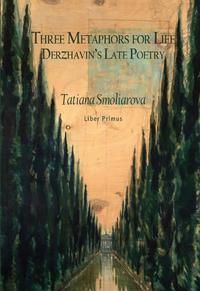
I would also like to thank my friend the eminent Russian architect
Alexander Brodsky for offering me his painting for the cover. This
painting, inspired by the architecture of Andrea Palladio, fulfills the main
requirement of an ideal illustration as formulated by Derzhavin’s friends
Nikolai Lvov and Alexei Olenin, who claimed that the image should never
repeat, but rather complement the text, “fleshing out with the artist’s
Introduction to the English Edition
pencil” something that was implied, but never explicitly stated. Brodsky’s
image of a cypress alley leading, at the vanishing point, to a tiny, almost
invisible Palladian villa gives an immediate evocative sense of Derzhavin’s
self-awareness in his later years, which the three hundred pages of my book
attempt to explicate.
I dedicated the Russian version of my book to my son. Since then,
my two daughters have joined the family, but it doesn’t feel quite right to
dedicate an adaptation, new only in part, to such wholly new and original
creatures. Needless to say, however, my work would never have been
possible without the love and support of those closest to me – my husband,
our three kids, my father, and, first and foremost, my mother, who read me
my first poems and taught me my first English, who was happy to see the
Russian version of my book published and who passed away shortly after.
The chain of births and deaths that marked my own life while I worked on
this book affected the way I saw Derzhavin’s late poetry, and vice versa.
 P r e f a c e
In Search of a Metaphor
In Place of an Introduction
By far the greatest thing is to use metaphors.
—Aristotle, Poetics, 1459ab
I
The turn of the nineteenth century in Russian history was Russia’s first turn
of a century in the literal sense of the expression, at least as it was understood
in Europe. While it somehow seems right that Shakespeare’s Hamlet first
appeared on the stage in the momentous year of 1601—the first year of
a new century, the coeval memorable events in Russia derived no extra
significance from their place in the calendar: in pre-Petrine chronology
Europe’s 1601 was Russia’s 7109 (usually reduced to simply 109 in all the
documents of the time). If 1701 marked an absolute beginning dictated by
legislative and mythological considerations, a move “from nothingness
into being” (iz nebytiia v bytie), to use the expression formulated by Peter
the Great’s chancellor Gavrila Golovkin, then 1801 became the first pivotal
moment in Russia’s history that was recognized as such by contemporaries.
This did not take place right away: the idea of a chronologically defined
marker and the experiences that went with it, not to mention the rhetorical
appeal to celebrate this designation, were imported from Europe and took
root on Russian soil only gradually, during the course of the first decades
of the new century.
In the life of Gavrila Romanovich Derzhavin this “boundary between
the two centuries” fell during the winter of 1803–4, one of the saddest
winters in his life. On October 8, 1803, Derzhavin was forced to resign his
ministerial post in the government of Alexander I, “the beloved son of the
sweet heavens,” in the poet’s own words, whose birth he had hailed a quarter
century earlier and on whose happy rule so many hopes had been pinned
Похожие Показать весь список
Доступ онлайн
1 800 ₽
В корзину