
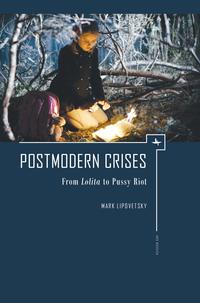
Postmodern Crises. From Lolita to Pussy Riot
Покупка
Тематика:
Культура России
Издательство:
Academic Studies Press
Автор:
Lipovetsky Mark
Год издания: 2017
Кол-во страниц: 277
Дополнительно
Вид издания:
Сборник
Уровень образования:
Профессиональное образование
ISBN: 978-1-61811-559-1
Артикул: 694358.02.99
Доступ онлайн
1 800 ₽
В корзину
Postmodern Crises collects previously published and yet unpublished Mark Lipovetsky’s articles on Russian literature and film. Written in different years, they focus on cultural and aesthetic crises that, taken together, constitute the postmodern condition of Russian culture. The reader will find here articles about classical subversive texts (such as Nabokov’s Lolita), performances (Pussy Riot), and recent, but also subversive, films. Other articles discuss such authors as Vladimir Sorokin, such sociocultural discourses as the discourse of scientific intelligentsia; post-Soviet adaptations of Socialist Realism, and contemporary trends of "complex” literature, as well as literary characters turned into cultural tropes (the Strugatsky’s progressors). The book will be interesting for teachers and scholars of contemporary Russian literature and culture; it can be used both in undergraduate and graduate courses.
Скопировать запись
Фрагмент текстового слоя документа размещен для индексирующих роботов
P o s t m o d e r n  C r i s e s
From Lolita to Pussy Riot
Ars Rossica
Series Editor
David Bethea (University of Wisconsin–Madison)
Boston  /  2017
Postmodern Crises
From Lolita to Pussy Riot
Mark Lipovetsky
Library of Congress Cataloging-in-Publication Data:
A bibliographic record for this title is available
from the Library of Congress.
Names: Lipovetskii, M. N. (Mark Naumovich), author.
Title: Postmodern crises : from Lolita to Pussy Riot / Mark Lipovetsky.
Other titles: Ars Rossika.
Description: Brighton, MA : Published by Academic Studies Press, 2017. |
Series: Ars Rossica
Identifiers: LCCN 2016042029 (print) | LCCN 2016045161 (ebook) | ISBN
9781618115584 (hardcover) | ISBN 9781618115591 (e-book)
Subjects: LCSH: Postmodernism (Literature)—Russia (Federation) | Russian
literature—20th century—History and criticism. | Russian
literature—21st century—History and criticism. | Postmodernism—Russia
(Federation) | Motion pictures—Russia (Federation)—History and
criticism.
Classification: LCC PG3027.5.P67 L56 2017 (print) | LCC PG3027.5.P67 (ebook)
| DDC 891.709/0044—dc23
LC record available at https://lccn.loc.gov/2016042029
Copyright © 2017 Academic Studies Press
All rights reserved.
ISBN 9781618115584 (hardcover)
ISBN 9781618115591 (electronic)
Cover design by Tatiana Vernikov.
On the cover: film-still from Short Stories, dir. Mikhail Segal, 2012.
Published by Academic Studies Press in 2017
28 Montfern Avenue
Brighton, MA 02135, USA
press@academicstudiespress.com
www.academicstudiespress.co
To Tanya,
my favorite coauthor and critic,
who has read it all already anyway
C o n t e n t s
Preface
LITERATURE
The War of Discourses:
Lolita and the Failure of a Transcendental Project
13
The Poetics of the ITR Discourse:
In the 1960s and Today
33
The Progressor between the Imperial and the Colonial
53
Cycles and Continuities
in Contemporary Russian Literature
87
Flеshing/Flashing the Discourse:
Sorokin’s Master Trope
109
Pussy Riot as the Trickstar
130
The Formal Is Political
145
FILM
Post-Soc: Transformations of Socialist Realism
in the Popular Culture of the Late 1990s–Early 2000s
169
War as the Family Value:
My Stepbrother Frankenstein by Valery Todorovsky
195
A Road of Violence: My Joy by Sergei Loznitsa
219
In Denial: The Geographer Drank His Globe Away
by Aleksandr Veledinsky
230
Lost in Translation: Short Stories by Mikhail Segal
240
Works Cited
248
Index
262
P r e f a c e
Among the articles collected under this cover, the earliest was
written in 1996 and the latest, a couple of months ago, in 2016.
Consistency is not what one would expect from such a long stretch.
I did not select articles according to a certain plan—just ones
available in English and ones I was not exceedingly ashamed of,
from today’s perspective. Many of these texts were triggered by the
desire to react to the most recent cultural irritants, and although
English tends to quench most flammable emotions, these articles
can hardly pretend to offer an objective history of the given (and
worse, contemporary) period in Russian culture.
Nevertheless, I was surprised to detect at least two themes
that seem to thread through this motley assemblage. One of
them is the cultural crisis that we, for lack of a better word, call
postmodernism. This is why I included in this collection an
article about Lolita—a seminal novel that, in my opinion, marked
the crisis of the transcendental cultural paradigm. Next to it
I placed two articles discussing the culture of the Soviet scientific
intelligentsia of the 1960s, which, as I try to argue, signified the
crisis of the posttotalitarian Enlightenment project. Articles about
Vladimir Sorokin and Pussy Riot, as well as about the “misuses” of
postmodernism in post-Soviet popular culture, naturally belong to
the same analytic thread. Nowadays, Fredric Jameson, the foremost
theorist of postmodernism, says that “it would have been much
clearer had I distinguished postmodernity as a historical period
from postmodernism as a style” (Jameson 2016, 144; emphasis in the
original). I also accept this distinction. Postmodern crises do not
necessarily require postmodernist poetics for their manifestation—
for example, all the films that I address here can hardly qualify
as postmodernist by their aesthetics; yet they are undoubtedly
postmodern, as they all display discursive discordances resulting
P r e f a c e
from multiple breakdowns of cultural communication and
the collapse of stable binaries. These are the characteristics
of postmodernity, but they are also central to postmodernist
aesthetics (which also necessarily includes deconstruction of
binaries).
Any attempt to reflect on recent cultural phenomena cannot
help relating—directly or not—to the political context surrounding
the works under analysis. The articles in this collection are not
about politics (obviously not my field), and yet inevitably they
are. I didn’t plan it this way, but the twenty years between 1996
and 2016 include at least three distinct periods in contemporary
Russia’s history—the anarchic 1990s, the “stabilized” 2000s, and the
repressive 2010s. Recently, I can’t help writing about the cultural
reasons behind the failure of the perestroika aspirations for a new,
liberal Russia and the recent turn toward a new yet old (or vice
versa) nationalist, imperialist, conservative, and isolationist Russia.
There is also the question of the liberal intelligentsia’s responsibility
for today’s state of affairs. Another painful question concerns the
relationship between postmodern crises and today’s crisis of Russian
society, with its notorious 86 percent of the public supporting
Putin’s political course and the marginalization and repression
of everything subversive, critical, and countercultural. Strangely
enough, I believe that this “signified” can be detected not only in
texts written after the failure of the anti-Putin protests but also prior
to these events. This is certainly an aberration in perception, but
I prefer to stick with it.
Such a collection also offers the wonderful chance to thank from
the bottom of my heart all the friends and colleagues who tirelessly
improved my ungainly English by editing, proofreading, and
sometimes (re)translating my texts. My gratitude goes to Helena
Goscilo, Birgit Beumers, Eliot Borenstein, Vladimir Makarov, Dirk
Uffelmann, Tine Roesen, Klavdia Smola, Irene Masing-Delic, Helen
Halva, Yana Hashamova, Lacey Smith, Julia Gerhard, and, of course,
my oldest, strictest, and most sarcastic editor—Daniil Leiderman.
Ben Peterson has done a lot of work to smooth the stylistic differences
between disparate texts in this collection, for which I am very grateful
to him.
Po s t m o de r n  C r i s e s :  Fr o m  L o li t a  t o  P u s s y  R i ot
I am also profoundly grateful to Birgit Beumers, Natascha
Drubek, Ingunn Lunde, Helen Halva, Irene Masing-Delic, Williams
Stephen Matthew, Marina Mogilner and Ilya Gerasimov, and
Benjamin Kloss for their permission to reprint articles that first
appeared in the following publications:
“The War of Discourses: Lolita and the Failure of the
Transcendental Project.” In Набоков/Nabokov: Un’eredita
letteraria, edited by Alide Cagidemetrio and Daniela Rizzi,
49–66. Venice: Universitá Ca’Foscari Venezia, 2006.
“The Poetics of ITR Discourse: In the 1960s and Today.”
Ab Imperio 1 (2013): 109–31.
“The Progressor between the Imperial and the Colonial.” In
Postcolonial Slavic Literatures after Communism, edited by
Klavdia Smola and Dirk Uffelmann, 29–58. Postcolonial
Perspectives on Eastern Europe, vol. 4. Frankfurt am Main:
Peter Lang, 2016.
“Cycles, Continuity and Change in Contemporary Russian
Culture.” In Russia’s New Fin de Siècle, edited by Birgit
Beumers, 29–45. Bristol: Intellect, 2013.
“Fleshing/Flashing Discourse: Sorokin’s Master-Trope.” In
Vladimir Sorokin’s Languages, edited by Tine Roesen and Dirk
Uffelmann, 25–47. Slavica Bergensia, vol. 11. Bergen: Bergen
University Press, 2013.
“Pussy Riot as the Trickstar.” Apparatus 1 (2015):
http://www.apparatusjournal.net/index.php/apparatus/
article/view/5.
“The Formal Is Political.” Slavic and East European Journal, vol. 60,
2 (2016): 185-204.
“Post-Soc: Transformations of Socialist Realism in the Popular
Culture of the Recent Period.” In “Innovation through
Iteration: Russian Popular Culture Today,” special forum
issue, Slavic and East European Journal 48, no. 3 (Fall 2004):
356–77.
“War as the Family Value: Failing Fathers and Monstrous Sons in
My Stepbrother Frankenstein.” In Cinepaternity: Fathers and Sons
in Soviet and Post-Soviet Film, edited by Helena Goscilo and
Похожие Показать весь список
Доступ онлайн
1 800 ₽
В корзину