
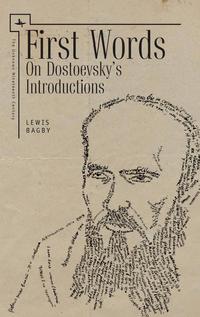
First Words. On Dostoevsky's Introductions
Покупка
Тематика:
Теория литературы
Издательство:
Academic Studies Press
Автор:
Lewis Bagby
Год издания: 2016
Кол-во страниц: 221
Дополнительно
Вид издания:
Монография
Уровень образования:
Дополнительное профессиональное образование
ISBN: 978-1-61811-483-9
Артикул: 871811.01.99
Доступ онлайн
1 800 ₽
В корзину
Dostoevsky attached introductions to his most challenging narratives, including Notes from the House of the Dead, Notes from Underground, The Devils, The Brothers Karamazov, and "A Gentle Creature.” Despite his clever attempts to call his readers’ attention to these introductions, they have been neglected as an object of study for over 150 years. That oversight is rectified in First Words, the first systematic study of Dostoevsky’s introductions. Using Genette’s typology of prefaces and Bakhtin’s notion of multiple voices, Lewis Bagby reveals just how important Dostoevsky’s first words are to his fiction. Dostoevsky’s ruses, verbal winks, and backward glances indicate a lively and imaginative author at earnest play in the field of literary discourse.
Скопировать запись
Фрагмент текстового слоя документа размещен для индексирующих роботов
On Dostoevsky’s
Introductions
First Words
The Unknown Nineteenth Century
Series Editor
Joe Peschio (University of Wisconsin, Milwaukee)
Editorial Board
Angela Brintlinger (Ohio State University, Columbus)
Alyssa Gillespie (University of Notre Dame, South Bend, Indiana)
David Powelstock (Brandeis University, Waltham, Massachusetts)
Ilya Vinitsky (University of Pennsylvania, Philadelphia)
On Dostoevsky’s
Introductions
Boston
L E W I S
B A G B Y
First Words
Library of Congress Cataloging-in-Publication Data:
A catalog record for this book as available from the Library of Congress.
Copyright © 2016 Academic Studies Press
All rights reserved
ISBN 978-1-61811-482-2 (hardback)
ISBN 978-1-61811-483-9 (electronic)
Cover design by Ivan Grave
Published by Academic Studies Press in 2016
28 Montfern Avenue
Brighton, MA 02135, USA
press@academicstudiespress.com
www.academicstudiespress.com
This study is dedicated to
Donna Peters Bagby
In Memory of
Grover C. Bagby
(1916–2010)
and
Dorothy Waters Bagby
(1917–2010)
They could not wait for this book
One feels an urge to smoke
Dostoevsky out with the question,
“Who’s talking?”
—John Jones, Dostoevsky
On this occasion I shall include
“The Notes of a Certain Person.”
That person is not I,
but someone else entirely.
I think no further foreword is needed.
—Dostoevsky, “Bobok”
chapter 6
chapter 4
Table of Contents
Model Prefaces from Russian Literature
1
Dostoevsky’s Initial Post-Siberian Work
28
Playing with Authorial Identities
61
Monsters Roam the Text
91
Re-Contextualizing Introductions
119
Anxious to the End
144
Conclusion
164
Bibliography
171
Index
193
Note on Transliteration
viii
Acknowledgments
ix
Introduction
xi
Note on Transliteration
Russian names in the text are spelled either in the form most familiar
to readers who know no Russian or in such a way as to facilitate pronunciation. For all other Russian words I have followed the Library of
Congress transliteration system.
Acknowledgments
A work of this many years in the making inevitably involves a large
collection of people and institutions. I would like to express my gratitude for support and assistance to my colleagues, Elizabeth Cheresh
Allen, who challenged me in this and other work on Dostoevsky to
not only use my mind but to trust my intuition in attempting to get to
the heart of the matter; and Gene Fitzgerald, a friend and colleague of
over forty years, for his astute commentary on the figure of the narrator and the constitution of the subject in Dostoevsky. Their insights
have proven most helpful to me. To my friend and colleague of over
thirty years at the University of Wyoming, Pavel Sigalov, I also extend
my gratitude for assistance. His advice about the Russian language
has proven both broadly educational and useful specifically in my
work on this project. Irina Paperno, William Mills Todd, III, and Boris
Gasparov were very supportive in my initial efforts to get this study
off the ground, and their recommendations for research holdings,
publishing outlets, and critical literature have kept me on the straight
and narrow at every step of the way. Victor Brombert holds a special
place in my grateful heart for his seeing the potential of my initial
discoveries on Dostoevsky’s introductions. He assisted me in locating
the first outlet for my work, The Modern Language Review, to whose
editors I express my gratitude for the opportunity to present my ideas
about Notes from the House of the Dead’s first paragraph, but also
for allowing portions of that first publication to appear in this study.
And to Gerald Janecek, former editor of The Slavic and East European
Journal, I also express my appreciation for permission to print portions of an article on the preface to The Brothers Karamazov.
The library at Stanford University, the Hoover Institute of War
and Peace, the University of California at Berkeley, as well as the
x
Acknowledgments
New York Public Library have opened their doors to me and provided original manuscripts and journals. Without those materials,
I would have been lost. The University of Wyoming Interlibrary
Loan division and its friendly and persistent staff have always been
ready to secure a ton of tomes for my research. I am forever in their
debt. I express my appreciation, too, to Maggie Farrell, former dean
of the University of Wyoming Libraries, for creating and sustaining
such a wonderful, open institution on campus.
The acquisitions editors at Academic Studies Press, Sharona Vedol
and Meghan Vicks, have been most helpful and encouraging in all our
dealings, and the copyeditor, Elizabeth F. Geballe, has made this study
better with her keen eye and sensitive ear. It has been a distinct pleasure to work long distance with her on this study. Joe Peschio, editor
for the Academic Studies Press series on “The Unknown Nineteenth
Century,” has been kind enough to inaugurate the series with my study
of Dostoevsky’s introductions. I am grateful to him, and not only for his
generosity, but for his friendship and enthusiastic support of this project. It goes without saying (as I say it nonetheless), that I am responsible
for the final product. Please read it; pray not weep.
Behind every researcher there are the deepest of friends who over
the years have supported my tilting at windmills no matter how big
or small. I thank them all for sticking with me. And then there are the
generations of a greatly supportive and rather large extended family
down to fourth cousins. My thankfulness flies to them along with an
invitation, à la Nikolai Gogol’s Rudy Panko, to feast at the cabin and
listen to yarns on the high plains. At its pine-scented center lives a great
heart. To her I have dedicated this book. Each day’s first words are to
her and for her. The final ones, too.
Похожие Показать весь список
Доступ онлайн
1 800 ₽
В корзину