
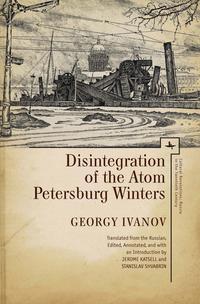
Disintegration of the Atom. Petersburg Winters
Покупка
Тематика:
Литература русского зарубежья
Издательство:
Academic Studies Press
Автор:
Ivanov Georgy
Год издания: 2016
Кол-во страниц: 303
Дополнительно
Вид издания:
Монография
Уровень образования:
Дополнительное профессиональное образование
ISBN: 978-1-61811-455-6
Артикул: 694150.02.99
Доступ онлайн
1 800 ₽
В корзину
This book presents translations of two celebrated works by Georgy Ivanov. Disintegration of the Atom (1938) is a prose poem depicting Russian émigré despair on the eve of WWII—a cri de coeur that challenges prevailing concepts of time and space, ending in erotically charged wretchedness. Petersburg Winters (1928/1952) is a portrait of Petersburg swept up in the artistic ferment of late Imperial and Revolutionary Russia. The spirit of the city is conveyed through a series of vignettes of Ivanov’s contemporaries, including Blok, Akhmatova, Esenin, and Mandelstam.
Скопировать запись
Фрагмент текстового слоя документа размещен для индексирующих роботов
Disintegration of the Atom
Cultural Revolutions: Russia in the Twentieth Century
Series Editor
Boris Wolfson—Amherst College
Editorial Board
Anthony Anemone—The New School
Robert Bird—The University of Chicago
Eliot Borenstein—New York University
Angela Brintlinger—The Ohio State University
Karen Evans-Romaine—Ohio University
Jochen Hellbeck—Rutgers University
Lilya Kaganovsky—University of Illinois, Urbana-Champaign
Christina Kiaer—Northwestern University
Alaina Lemon—University of Michigan
Simon Morrison—Princeton University
Eric Naiman—University of California, Berkeley
Joan Neuberger—University of Texas, Austin
Ludmila Parts—McGill University
Ethan Pollock—Brown University
Cathy Popkin—Columbia University
Stephanie Sandler—Harvard University
Boston
Disintegration
of the Atom
Petersburg Winters
GEORGY IVANOV
Translated from the Russian,
Edited, Annotated, and with
an Introduction by
JEROME KATSELL and
STANISLAV SHVABRIN
Sections of the initial superseded draft of
Petersburg Winters were prepared with the assistance of
OKSANA WILLIS
This publication is supported by


Translation of this publication and the creation of its layout were carried out with
the financial support of the Federal Agency for Press and Mass Communication
under the federal target program “Culture of Russia (2012-2018).”
© 2016 Jerome Katsell, Stanislav Shvabrin, all rights reserved
ISBN 978-1-61811-454-9 (hardback)
ISBN 978-1-61811-455-6 (electronic)
Cover design by Ivan Grave
On the front cover: Excavator, by Mstislav Dobuzhinsky
(from the album “Petrograd in 1921,” 1922).
On the back cover: Portrait of Georgy Ivanov by Yuri Annenkov, 1921.
Published by Academic Studies Press in 2016
28 Montfern Avenue
Brighton, MA 02135, USA
press@academicstudiespress.com
www.academicstudiespress.com
in memoriam
Vladimir Markov
(1920–2013)
Acknowledgments
vii
On Transliteration, Sources, and Annotation
ix
“. . . Struck by all the horrors of human disillusionment . . .”:
Miseries and Splendors of Georgy Ivanov’s “Citational” Prose
xii
DISINTEGRATION OF THE ATOM
01
PETERSBURG WINTERS
27
Notes
222
Table of Contents
vii
One must be thankful for the growing richness of scholarship that has
recently been directed to the life and work of Georgy Vladimirovich
Ivanov. Our task as his translators, editors, and interpreters has been
greatly enhanced by contemporary scholarship, including but not limited
to the analyses and research by Andrey Arieff, Nikolay Bogomolov, Anna
Lisa Crone (1946–2009), Jennifer Jean Day (1973–2009), Justin Doherty,
Sergey Fedyakin, Roman Gul’ (1896–1986), Vadim Kreyd, Alexei Lalo,
Francesca Lazzarin, Nikolai Melnikov, Georgy Moseshvili (1955–2008),
Kirill Pomerantsev (1906–1991), Andrei Ranchin, Peter Rossbacher (1928–
2007), Svetlana Semenova, and Tatjana Senn. Michael A. Green, Professor
Emeritus (Program in Russian, University of California, Irvine) assiduously read the first draft of Petersburg Winters. We are thankful for his
many helpful and precise suggestions. Valuable assistance came from
Kirill Tolpygo, Slavic and East European Studies Librarian at The University
of North Carolina at Chapel Hill.
One scholar, teacher, mentor, and dearly departed friend we must
single out for special praise for his fundamental contribution to the study of
Georgy Ivanov. It is Vladimir Markov (Vladimir Fedorovich Markov, 1920–
2013, Professor Emeritus with the Department of Slavic Languages and
Literatures of the University of California, Los Angeles). Not only did he
establish a personal contact with the notoriously difficult and cantankerous
Ivanov, but in a serious of groundbreaking publications Markov laid the
foundation for an impartial conceptual understanding of this poet and writer’s significance for Russian letters and culture. In addition to that Markov
should be credited with establishing the subfield of Ivanov studies. He
accomplished all this at a time when only a few people were persuaded that
Ivanov merited such attention; it should be noted that his contribution to
Ivanov studies comprises a mere fraction of his wide-ranging achievement.
Acknowledgments
viii
Acknowledgments
Jerome Katsell and Stanislav Shvabrin gratefully dedicate this volume
to the memory of Vladimir Markov.
A number of years ago Jerome Katsell and Oksana Willis, with advice
and encouragement from Stanislav Shvabrin, set out to redress the dearth
of Georgy Ivanov’s prose in English. Petersburg Winters was translated
first in draft. Of its total eighteen chapters, Oksana Willis did first drafts of
eight of the first sixteen; Jerome Katsell did likewise, and on his own
Chapters XVII and XVIII, which Ivanov added for the final 1952 edition.
The initial notes for Petersburg Winters, which have now been superseded,
were formulated by Katsell and Willis. Unfortunately, Oksana Willis was
unable to continue her work on this project. The first draft of and the
notes to Disintegration of the Atom were the sole work of Jerome Katsell.
Stanislav Shvabrin joined the project in 2014. Since that time the initial
drafts have been thoroughly revised,  and a new introduction written,
while the notes have been culled and expanded where needed.
While we are most grateful for all the assistance directly or indirectly
proffered by the scholars enumerated here and others, final responsibility
for the text remains of course with the translators, editors, and annotators.
ix
On Transliteration, Sources, and Annotation
We have chosen to use a two-tier system of transliteration of Russian
names and toponyms. The “service” sections of this volume, such as this
preamble, the introduction, and the notes, adhere to a simplified US
Library of Congress transliteration system that matches each Russian
(Cyrillic) character with its customary English (Latin) counterpart, yet
avoids diacritical signs. In the texts of our translations of Disintegration of
the Atom and Petersburg Winters, we have opted for still greater simplicity
with the aim of meeting the needs of English speakers who may wish to
sound out or pronounce Russian names they encounter in this book. To
that end, we signal the presence of the “y” sound found at the beginning of
such English words as “young” and “yonder” when it appears before and
between Russian vowels: hence the surnames that could be and have been
rendered in English as “Esenin,” “Evreinov,” and “Chebotarevskaia” have
invariably been spelled as “Yesenin,” “Yevreinov,” and “Chebotarevskaya.”
In those cases where the presence of the accented “o” sound would be
obscured by the deceptive correspondence between visually identical
Cyrillic and Latin characters, we have used the “yo” combination, hence
the spelling of “Fyodor” (not “Fedor”) for the first name and “Gumilyov”
(not “Gumilev”) for the surname.
Whenever supported by precedents in English usage, in the body of
our translated texts Russian first names and surnames of foreign origin
retain their English or Western spelling (hence “Alexander,” not “Aleksandr”; “Hippius,” not “Gippius”; and “Wilhelm,” not “Vilgelm”). We depart
from this practice in those instances where the author deliberately chooses
to employ patronymics along with first names: it is for this reason that the
reader will find “Alexander Blok” and “Aleksandr Aleksandrovich Blok” for
the poet and “Alexandra” and “Aleksandra Fyodorovna” for the empress,
for example. Along with those of many first names and surnames (“Dmitry,”
x
On Transliteration, Sources, and Annotation
and not “Dmitrii,” “Gorodetsky,” and not “Gorodetskii”), the different
grammatical endings of Russian toponyms have all been standardized to
look identical regardless of the gender of the nouns they modify in the
original: hence “Vasilyevsky” and not “Vasil’evskii,” “Shpalerny” and not
“Shpalernaia.” It is useful to recall that much like alphabets, all transliteration systems are mere approximations of the sounds and sound
combinations they correspond to in actual speech, and as such they are
subject to various spelling conventions and may not altogether eschew
occasional incongruities and inconsistencies.
After falling into obscurity, Georgy Ivanov’s literary legacy was rediscovered and reevaluated, first in the West and subsequently in the Soviet
Union and Russia. His poetry, prose, and critical writings have been
republished multiple times, and annotated scholarly editions have long
superseded small-run original publications and their reprints. Our translations of Disintegration of the Atom and Petersburg Winters are based on
the versions of these texts established in the three-volume annotated
collection of Ivanov’s writings compiled by Evgenii Vitkovskii and Vadim
Kreyd (see Georgii Ivanov, Sobranie sochinenii v trekh tomakh [Moscow:
Soglasie, 1994]). Whereas Ivanov did not revise the text of Disintegration
of the Atom after its publication in 1938, he amended that of Petersburg
Winters when he republished the memoir in 1952 in such a way that it
differed considerably from its initial publication of 1928. Among the most
important emendations are the removal of the poem-epigraph from Ivanov’s friend-foe Georgy Adamovich, deletion of a number of sections
pertaining to Anna Akhmatova (Chapter VI) and the poet and novelist
Aleksei Skaldin (Chapter VIII), along with the addition of Chapters XVII
and XVIII. Certain fugitive fragments published by Ivanov under the
“Petersburg Winters” heading in various émigré outlets were not included
in either version of the memoir when it was published as a book in 1928
and 1952 and have not been incorporated in our version of the text.
Ivanov’s references to “DPs,” or “displaced persons” (here citizens of the
Soviet Union who found themselves in the American, British, and
French-controlled sections of Western Europe in the aftermath of World
War II, as was the destiny of this book’s dedicatee Vladimir Markov) in
Chapter XVIII expand the narrative span of the book from the early 1900s
Похожие Показать весь список
Доступ онлайн
1 800 ₽
В корзину