
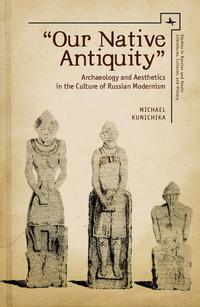
"Our Native Antiquity". Archaeology and Aesthetics in the Culture of Russian Modernism
Покупка
Тематика:
Искусствоведение
Издательство:
Academic Studies Press
Автор:
Kunichika Michael
Год издания: 2015
Кол-во страниц: 349
Дополнительно
Вид издания:
Монография
Уровень образования:
Дополнительное профессиональное образование
ISBN: 978-1-61811-442-6
Артикул: 694115.02.99
Доступ онлайн
1 800 ₽
В корзину
For Russian modernists in search of a past, there were many antiquities of different provenances and varying degrees of prestige from which to choose: Greece or Rome; Byzantium or Egypt. The modernists central to "Our Native Antiquity" located their antiquity in the Eurasian steppes, where they found objects and sites long denigrated as archaeological curiosities. The book follows the exemplary careers of two objects—the so-called "Stone Women” and the kurgan, or burial mound — and the attention paid to them by Russian and Soviet archaeologists, writers, artists, and filmmakers, for whom these artifacts served as resources for modernist art and letters and as arenas for a contest between vying conceptions of Russian art, culture, and history.
Скопировать запись
Фрагмент текстового слоя документа размещен для индексирующих роботов
“Our Native Antiquity”
A r c h a e o l o g y  a n d  A e s t h e t i c s
in the Culture of Russian Modernism
Studies in Russian and Slavic Literatures, Cultures, and History
Series Editor
Lazar fleishman (Stanford University, Palo Alto, California)
“Our Native Antiquity”
A r c h a e o l o g y  a n d  A e s t h e t i c s
in the Culture of Russian Modernism
M i c h a e l   K u n i c h i k a
Boston  /  2015
Library of Congress Cataloging-in-Publication Data:
A bibliographic record for this title is available
from the Library of Congress.
Copyright © 2015 Academic Studies Press
All rights reserved.
ISBN (cloth) 978-1-61811-441-9
ISBN (electronic) 978-1-61811-442-6
Cover design by Ivan Grave
On the cover: Detail of A. S. Uvarov, “Svedeniia o kamennykh babakh,”
Trudy pervogo akheologicheskogo s’’ezda v Moskve
(Moscow: V Sinodal’noi tipografii, 1871), 501-20.
Title page: Vignette from A. P. Bogdanov, ed., Antropologicheskaia vystavka
(Moscow: Tipografiia M. N. Lavrova, 1878-), 4:2:54.
Published by Academic Studies Press in 2015
28 Montfern Avenue
Brighton, MA 02135, USA
press@academicstudiespress.com
www.academicstudiespress.com
This book is dedicated to my teachers,
my parents first among them.
   T a b l e  o f  C o n t e n t s
Acknowledgments
Note on Translation and Transliteration
11
Introduction
12
i. Archaic Mirrors
15
ii. Elective Antiquities
19
Chapter One
27
The Archaeology of the Stone Babas
and the Modernist Inheritance
i. “Rough Hewn Statues”
34
ii. Idols Destroyed, Idols Displaced,
49
and the Steppe Denuded
iii. The Modernist Peregrinations of the Stone Babas
57
Chapter Two
62
A Cultural Poetics of the Kurgan
i. How to Excavate a Kurgan
62
ii. Gnedich, Iliada
69
iii. Vantage Points, ca. 1850
80
iv. 1876—The Grave Becomes a Cradle:
90
Zabelin contra Chaadaev
v. Archaeological Defamiliarization
96
vi. Steppe Archaism and the Stratification of Time
100
Chapter Three
107
Ancient Statues, Ancient Terrors
i. Archaic Simplicity
110
ii. Primitive Rudeness
120
iii. “No Ordinary Stone Woman”
128
Chapter Four
139
How a Modernist Artifact Is Made:
The “Native Antiquity” of the Stone Babas
and the Indigenization of Cubism
i. The Stone Baba and the Bronze Horseman
147
ii. Indigenous Cubism
162
Chapter Five
Velimir Khlebnikov, Poet of the Stone Babas
i. “The Stone Woman” (1919): Modernist Metamorphosis	178
ii. The Steppes of Time: “A Night in a Trench”
190
iii. The Grave of Khlebnikov
201
Chapter Six
204
The Landmarks of Time: Burial Mounds,
Eurasian Necropolises, and Modernist Form
in Boris Pil’niak’s The Naked Year
i. Volga “Pompeiis”
211
ii. Scythianism, 1918
217
iii. Modernist Stratigraphy: Uvek, Site of Time
222
iv.  Modernist Topography: “Loop Station Mar”
and the Poetics of Adjacency
234
Chapter Seven
243
Areas of Deformation
Part One: Dziga Vertov and the Scythian
243
i. Areas of Deformation
247
ii. The Shooting Log
261
iii. The Archaeology of the Superimpositions
271
iv. Archaeology with a Hammer
275
Part Two: Boris Pil’niak’s The Volga Falls
280
 to the Caspian Sea and the Courage of Farewell
i. All That Was Solid Did Not Melt into Air:
287
Persisting Things
ii. The Fluids of History:
291
Archaeology and Antiquarianism
iii. The Courage of Farewell:
297
The Return of the Stone Women
iv. Coda
307
Bibliography
312
Index
326
A c k n o w l e d g m e n t s
I did not know upon entering the Russian Department at Reed
College and, later, the Slavic Department at the University
of California, Berkeley, how fortunate I would be, then and
thankfully still now, in my teachers there. Justin Weir and Elena
Bogdanovich at Reed College encouraged the first steps. So, too,
did Lena Lencek, mentor and friend, who gave me a language
to think about literature, and certainly about life, and she has
watched over everything since with grace. And then at Berkeley,
Robert Hughes, Liza Knapp, Lisa Little, Olga Matich, Hugh
McLean, Anna Muza, Eric Naiman, Anne Nesbet, Irina Paperno,
Harsha Ram, Alan Timberlake, the late Viktor Zhivov, and the
visitors with whom I was also lucky to study while there—
Katerina Clark, Gregory Freidin, and Andrew Kahn—scholarteachers all, I hope these pages reflect—Eric would probably say
“pervert”—what they continue to teach me.
At Berkeley, it seemed that everyone helped with the
dissertation from which this book partially draws, but I thank
especially Harsha, Eric, Anne, and Yuri Slezkine for advising it.
With Harsha, I poured over every sentence and idea of the
dissertation; with Anne, who taught me how to watch silent
Soviet film, I saw Dziga Vertov’s “Scythian” in a theater in Sacile
and the idea for the dissertation was born; with Yuri, at Ned’s,
I realized the dissertation was actually about the steppe. And it
was at the Neues Museum with Irina and Joachim Klein where
I saw the kamennye baby for the first time and was encouraged that
the book could actually become a book.
Without Irina this book would never have found a home.
I thank her and especially Lazar Fleishman for his editing and
support, and for accepting it into his series. Penelope Burt and
Jane Friedman edited the manuscript and improved it in every
way. Irene Masing-Delic, the manuscript’s “anonymous” reader,
reviewed it with remarkable care and expert counsel. I thank
Kira Nemirovsky, Sharona Vedol, and Meghan Vicks, the editors
at Academic Studies Press, for their meticulous oversight of the
entire publication process.
Many friends and colleagues commented on early versions
of these chapters, and I thank them for their tremendous help
and suggestions: Richard Anderson, Polina Barskova, Evgenii
Bershtein, Molly Brunson, Catherine Ciepiela, Anne Dwyer,
Devin Fore, Victoria Frede, Toral Gajarwala, Sergey Glebov, Luba
Golburt, Lilya Kaganovsky, Edward Kasinec, John MacKay—
whose help with the chapter on Vertov was an extraordinary act
of scholarly generosity—Boris Maslov, Miriam Neirick, Tatiana
Nikitina, Dale Peterson, Jennifer Presto, Stanley Rabinowitz, Tom
Roberts, Gabriella Safran, Jane Sharp—whose work on Natal’ia
Goncharova and the kamennye baby helped me to realize what
the literary side of the story could involve—Irina Shevelenko, Jon
Stone, Jane Taubman, and Jane Tylus. Serguei Oushakine, Marina
Mogilner, and Ilya Kukulin commented on an early version of
chapter six that transformed and sharpened the claims of that
chapter. And throughout, Robert Hughes and Olga Matich read,
reread, and improved many of these chapters.
My colleagues in the Department of Russian and Slavic
Studies at New York University deserve a special word of thanks.
The department has been a great place to teach these past seven
years, and I thank Eliot Borenstein, Jane Burbank, Yanni Kotsonis,
and, in particular, Anne Lounsbery, for her encouragement on an
early version of the manuscript, and Ilya Kliger, the best office
neighbor and interlocutor on deep time, among much else.
All the mistakes that remain are mine.
I am grateful to Jane Tylus and the Humanities Initiative,
NYU (2008-09), for a year spent in the urban pastoral Jane creates
there every year, during which I reconceived the book. And to
Terry Martin and Stephanie Sandler, co-directors of the Seminar
on Eurasian Subjectivities (2013-14), I am especially indebted for
a Senior Fellowship at the Davis Center for Russian and Eurasian
Studies, Harvard University, which allowed me to complete the
revisions of the manuscript. I thank Joy Connolly, Dean for the
Humanities at NYU, for supporting that leave.
Portions of the book have benefitted from audiences at various
institutions. I thank for their invitations and their comments the
departments and audiences at: Amherst College; the Davis Center
for Russian and Eurasian Studies; the Five College Slavic Seminar;
the New Scholars Series at Reed College; the NEH Seminar on
Russian Modernism at the New York Public Library; the NYU
Slavic Colloquium; the Poetics Workshop and Slavic Department
of the University of Chicago; the Slavic Colloquium at Stanford
University; the Slavic Seminar and the Slavic Department of
Columbia University; and the Slavic departments at the University
of California, Berkeley, the University of Wisconsin-Madison,
the University of Oregon, Eugene, and Yale University.
Along with these many debts, I thank friends and family
who’ve provided support and distraction in tandem and in equal
measure these past several years: Michael Allan; David Alsdorf;
Kaveh Askari; Sylvan Brackett; Caroline Byfield; Bryan Cook;
Judy Goldstein; Sarah Hamill; Louise Hornby; Joost Keizer;
John Kunichika; Chris Lakey; Amnon Lev; Heather Lord; Anne
Lorraine-Bujon; Grant, Lexi, and Jasper Mainland; Jeremy
Melius; Kelly Miyata; Ricardo Montez; Maya Portner; Paull
Randt; Sally and Moxie Rudoy; Sam Schaeffer; Eva Schuss;
Mariko Silver; Lizbet Simmons; Meghan Sutherland; Lisa
Wakamiya; Amanda Walling; Jenny Wapner; Patrick Weil; and
Boris and Benjamin Wolfson.
Then, again, there’s Boris Maslov and Devin Fore to thank
for their many acts of friendship and faith. And, lastly, I thank
my parents, Kenneth and Janice Kunichika, whose support has
sustained me throughout the writing of this book.
Похожие Показать весь список
Доступ онлайн
1 800 ₽
В корзину