
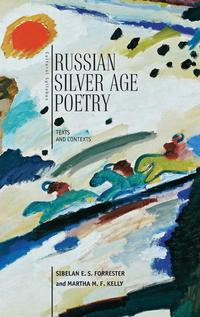
Russian Silver Age Poetry. Texts and Contexts
Покупка
Тематика:
История литературы
Издательство:
Academic Studies Press
Год издания: 2015
Кол-во страниц: 619
Дополнительно
Вид издания:
Монография
Уровень образования:
Дополнительное профессиональное образование
ISBN: 978-1-61811-363-4
Артикул: 694071.02.99
Доступ онлайн
1 800 ₽
В корзину
Russian Silver Age writers were full participants in European literary debates and movements. Today some of these poets, such as Akhmatova, Mandelstam, Mayakovsky, Pasternak, and Tsvetaeva, are known around the world. This volume introduces Silver Age poetry with its cultural ferment, the manifestos and the philosophical, religious, and aesthetic debates, the occult references and sexual experimentation, and the emergence of women, Jews, gay and lesbian poets, and peasants as part of a brilliant and varied poetic environment. After a thorough introduction, the volume offers brief biographies of the poets and selections of their work in translation—many of them translated especially for this volume — as well as critical and fictional texts (some by the poets themselves) that help establish the context and outline the lively discourse of the era and its indelible moral and artistic aftermath.
Скопировать запись
Фрагмент текстового слоя документа размещен для индексирующих роботов
Russian
Silver Age
Poetry
TEXTS AND CONTEXTS
Cultural Syllabus
Series Editor – Mark Lipovetsky (University of Colorado, Boulder)
Russian
Silver Age
Poetry
TEXTS AND CONTEXTS
Edited and introduced by
Sibelan E. S. Forrester
and
Martha M. F. Kelly
BOSTON  /  2015
A catalog record for this book as available from the Library of Congress.
Copyright © 2015 Academic Studies Press
All rights reserved
ISBN 978-1-61811-352-8 (hardback)
ISBN 978-1-61811-363-4 (electronic)
Book design by Ivan Grave
On the cover:
“Romantic Landscape,” by Wassily Kandinsky (2011), a fragment.
Published by Academic Studies Press in 2015
28 Montfern Avenue
Brighton, MA 02135, USA
press@academicstudiespress.com
www.academicstudiespress.com
Preface
x
How To Use This Book
xi
Some Issues in Translating Russian Poetry into English
xv
Several Different Versions of the Same Russian Poem
xx
Acknowledgments
xxviii
Sources and Permissions
xxx
Introduction: Poetry of the Russian Silver Age
xxxviii

Sibelan Forrester and Martha Kelly
SECTION I: THE POETS
Biographies and Poetry
3
Anna Akhmatova
5
Innokenty Annensky
22
Nikolai Aseev
28
Konstantin Balmont
32
Andrei Bely
38
Alexander Blok
44
Valery Bryusov
58
Sergei Esenin
64
Zinaida Gippius
68
Nikolai Gumilyov
74
Vyacheslav Ivanov
80
Velimir Khlebnikov
83
Contents
vi
Contents
Vladislav Khodasevich
Nikolai Klyuev
101
Alexei Kruchonykh
107
Mikhail Kuzmin
110
Mirra Lokhvitskaya
120
Osip Mandelstam
126
Vladimir Mayakovsky
147
Dmitri Merezhkovsky
166
Sofia Parnok
171
Boris Pasternak
176
Igor Severyanin
190
Maria Shkapskaya
193
Fyodor Sologub
198
Vladimir Solovyov
204
Marina Tsvetaeva
210
Maximilian Voloshin
237
Selected Bibliography of Poetry Translations
240
SECTION II: BEYOND POETRY
Essays
247
From Poetry as Enchantment (1915)
248

Konstantin Balmont
Symbolism and Contemporary Russian Art (1908)
251

Andrei Bely
Keys to the Mysteries (1904)
269

Valery Bryusov
vii
Contents
A Holy Sacrifice (1905)

Valery Bryusov
Symbolism’s Legacy and Acmeism (1913)
290

Nikolai Gumilyov
Nietzsche and Dionysus (1904)
294

Vyacheslav Ivanov
The Precepts of Symbolism (1910)
304

Vyacheslav Ivanov
Thoughts on Symbolism (1912)
321

Vyacheslav Ivanov
The Morning of Acmeism (1913)
329

Osip Mandelstam
The Word and Culture (1921)
334

Osip Mandelstam
From The Apocalypse of Our Times (1917)
340

Vasily Rozanov
Poets’ Demons (1907)
343

Fyodor Sologub
Criticism
349
Innokenty Annensky (1963)
350

Anna Akhmatova
From “On Contemporary Lyrism” (1909)
353

Innokenty Annensky
In Memory of Vrubel (1916)
366

Alexander Blok
Chertova kukla (The Devil’s Doll): A Novel by Z. N. Gippius (1911)
370

Kornei Chukovsky
Reviews of Works by Blok, Klyuev, Balmont, and Others (1912)
382

Nikolai Gumilyov
viii
Contents
Review of Akhmatova’s Beads (1914)

Nikolai Gumilyov
Foreword to Evening by Anna Akhmatova (1912)
395

Mikhail Kuzmin
Review of Igor Severyanin’s The Thunder-Seething Goblet (1913)
398

Osip Mandelstam
On Contemporary Poetry: Almanac of the Muses (1916)
399

Osip Mandelstam
V. V. Khlebnikov (1922)
402

Vladimir Mayakovsky
In Quest of a Path for Art (1913)
409

Sofia Parnok
On Symbolists and Decadents (1901)
415

Vasily Rozanov
Reviews of Russian Symbolists (1894)
430

Vladimir Solovyov
Downpour of Light: Poetry of Eternal Courage (1922)
443

Marina Tsvetaeva
The Horoscope of Cherubina de Gabriak (1909)
464

Maximilian Voloshin
Memoirs
472
Reminiscences of Alexander Blok (1955)
473

Anna Akhmatova
From “Osip Mandelstam” (1964)
477
  Anna Akhmatova
Bryusov (1925)
483

Zinaida Gippius
ix
Contents
The End of Renata (1928)

Vladislav Khodasevich
From The One and a Half-Eyed Archer (1933)
497

Benedikt Livshitz
From On the Banks of the Neva (1967)
499

Irina Odoevtseva
On Vladimir Mayakovsky (1931)
508

Boris Pasternak
From a review of Kuzmin’s Alexandrian Songs (1906)
521

Maximilian Voloshin
Other Prose Works
523
Letter to Alexander Blok (1907)
524

Innokenty Annensky
Letter to Maximilian Voloshin (1909)
525

Innokenty Annensky
Futurist Manifestos (1912, 1913)
527
Letters to Vyacheslav Ivanov (1909)
531

Osip Mandelstam
Quote about the Stray Dog cabaret (no date)
535

Viktor Shklovsky
The Demonic Woman (1913)
536

Nadezhda Tèffi
Thematic Index
541
Index of Poem Titles and First Lines (Russian)
546
Index of Poem Titles and First Lines (English)
551
Preface
W
hy do we want to draw your attention to the poetry of the Russian Silver
Age? For us, it is the most fascinating period in Russian culture: an era
of brilliant poets, vivid personalities who had important intellectual as well as
aesthetic gifts, and who plunged into creative life with all their energy—to
produce what is simply some of the sexiest, most gripping writing to come
from any time or place in the world. Poetry is only one of the era’s many
cultural achievements, but it is one of the most exciting—and the Silver Age
produced the first body of poetry that grabbed and kept the attention of
readers, not just scholars and specialists, outside Russia. This attention points
to its quality, its high status in both the East and the West during the Soviet
period, and its provocative dialogues with various non-Russian literatures
and cultures. Russian Silver Age poetry engages with Classical Antiquity and
Western European writings, of course, but also with Africa, the Far East, and
the Americas. The Silver Age witnessed an unprecedented degree of collaboration of writers with visual artists, musicians, dancers, and other creative
individuals. Many of the poets included here also wrote plays, memoirs,
fiction, literary criticism, and publicistic articles. The personal idiosyncrasies,
friendships, and entanglements of the poets themselves can be quite interesting, and they offer some insight into the poems—as well, perhaps, as some
warning about the possible side effects of such an all-consuming artistic
program on the lives of real human beings.
Похожие Показать весь список
Доступ онлайн
1 800 ₽
В корзину