
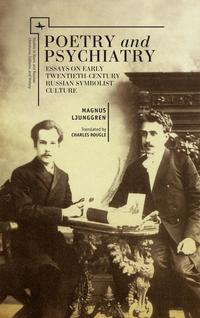
Poetry and Psychiatry. Essays on Early Twentieth-Century Russian Symbolist Culture
Покупка
Тематика:
История литературы
Издательство:
Academic Studies Press
Автор:
Ljunggren Magnus
Год издания: 2014
Кол-во страниц: 157
Дополнительно
Вид издания:
Монография
Уровень образования:
Дополнительное профессиональное образование
ISBN: 978-1-61811-361-0
Артикул: 694079.02.99
Доступ онлайн
1 800 ₽
В корзину
A century ago the Symbolists in Moscow and St. Petersburg dreamed of a fundamental transformation of life in Russia. From their reading of signs in the heavens, these poets, philosophers, and mystics sensed that tsardom was on the threshold of an apocalyptic upheaval. They were influenced by Vladimir Solovyov and Friedrich Nietzsche, but under the impact of the 1905 Revolution they later also subscribed to current radical political ideas. The eventual collision between these dreams and tsarist reality generated enormous intellectual turbulence and the need for substitutes. Not least psychoanalysis came to the rescue of these stranded dreamers. The present collection of essays is intended for readers interested in Russian literature or the early history of Eastern European offshoots of psychoanalysis.
Скопировать запись
Фрагмент текстового слоя документа размещен для индексирующих роботов
POETRY AND PSYCHIATRY
Essays on Early Twentieth-Century
Russian Symbolist Culture
Studies in Slavic and Russian Literatures, Cultures, and History
Series Editor:
Lazar Fleishman (Stanford University)
Boston  /  2014
POETRY a n d
PSYCHIATRY
Magnus  Ljunggren
Translated
by Charles Rougle
Essays
on Early Twentieth-Century
Russian Symbolist Culture
Library of Congress Cataloging-in-Publication Data:
A bibliographic record for this title is available
from the Library of Congress.
Copyright © 2014 Academic Studies Press
All rights reserved.
ISBN 978-1-61811-350-4 (cloth)
ISBN 978-1-61811-361-0 (electronic)
ISBN 978-1-61811-369-6 (paper)
Book design by Ivan Grave
On the cover: Sergey Solovyov and Andrey Bely, 1904.
Published by Academic Studies Press in 2014
28 Montfern Avenue
Brighton, MA 02135, USA
press@academicstudiespress.com
www.academicstudiespress.com
Ta ble of Contents
List of Illustrations
Introduction
8
Andrey Bely and the Philosopher’s Nephew
10
Bely and Aleksandr Blok
18
The Symbolist with Two Careers
26
Symbolism’s Charlatan
35
Oracle or Quack?
43
Janko Lavrin—Pan-Slavist across the Spectrum
54
The “Swede” in the Late Nineteenth-
61
and Early Twentieth-Century Russian Culture—
and His Daughter
Blok and Strindberg’s Face
68
The Early Breakthrough of Psychoanalysis in Russia
88
Anthroposophy’s Decade in Russia
98
Bely’s Encounter with Rudolf Steiner
107
Freud’s Unknown Russian Patient
115
Emilii Medtner and Carl Gustav Jung
124
Boris Pasternak and Goethe
134
Marietta Shaginyan and Verner von Heidenstam
138
Literature
144
Index of Names
149
List of Illustrations
Sergey Solovyov, 1904
Sergey Solovyov and Andrey Bely in Dedovo, 1905
12
Andrey Bely, 1916
14
Lyubov and Aleksandr Blok, 1903
20
Andrey Bely, 1904
21
Aleksandr Blok, 1907
22
Lev Kobylinsky, 1897
28
Lev Polivanov
28
Leonid Pasternak’s sketch of Ellis (Lev Kobylinskij),
31
Nikolay Berdyaev and Andrey Bely attending a lecture
by Vyacheslav Ivanov in 1910
Valentin Sventsitsky, 1910s.
38
Anna Mintslova, 1905
46
Andrey Bely, 1922
52
Janko Lavrin portrayed by Boris Kustodiev, 1909
55
The cover of Janko Lavrin’s
60
In the Land of Eternal War, Petrograd 1916
Aleksey Venkstern
62
and his wife Olga a few years before his death
Double cousins
63
Natalya Venkstern and Sofya Giatsintova, undated
Aleksandr Vyakhirev, undated
65
Mikhail Bulgakov as the judge
66
in The Pickwick Papers, 1934
Vladimir Pyast a couple of years
69
before his trip to Stockholm
Aleksandr Blok, 1911
70
Vladimir Pyast’s message to Strindberg
75
in a signed envelope
Nikolay Kulbin’s portrait of Strindberg, 1912
81
Pioneers of Psychoanalysis: Osip Feltsman,
Nikolay Vyrubov, and Nikolay Osipov, 1914
Sigmund Freud among Russians.
91
On his left, Max Eitingon, on the right, Moisey Vulf
Sergey Pankeev, the Wolfman, circa 1910
92
“Little Friday” meeting at the Moscow University
95
Psychiatric Clinic in April 1911. In the middle
row on the far right Nikolay Osipov,
Mikhail Asatiani, and Osip Feltsman.
Third from the left in the front row,
dean of Russian psychiatry Vladimir Serbsky
Rudolf Steiner, 1916
100
Nikolay Berdyaev, 1912
101
Andrey Bely, 1912
103
Andrey Bely, 1916
105
Bely’s drawing of Nikolay Ableukhov in Petersburg
108
The view from Bely’s hotel window in Vitznau. Photo:
110
Martin Ryf
Andrey Bely and Asya Turgeneva, 1912
111
Bely’s “Lifeline”—an attempt to summarize his personal 	 114, 152-153
and artistic evolution and important influences
from his first conscious moments in 1883
at the age of 2-3 up to 1927, when he drew the sketch
Ivan Ilyin, 1916
119
Vyacheslav Ivanov, 1913
121
Ivan Ilyin as The Thinker by Mikhail Nesterov, 1921-1922
123
Emilii Medtner on the right, with his brother Nikolay
125
and wife Anna in Nizhny Novgorod, 1904
Emilii Medtner, circa 1910
126
Andrey Bely on a visit to the Medtners in 1911.
127
From the left: Emilii, Nikolay, Anna, Bely,
and pianist Nikolay Stember, Nikolay’s pupil
and second cousin.
From the left: psychiatrist Hans Trüb, Emma Jung,
133
Emilii Medtner, Trüb’s son Georg, and Jung
on an outing to Alp Laui, Toggenburg in 1921.
Boris Pasternak, 1916.
136
Marietta Shaginyan, 1911.
140
Introduction
The
Symbolists in Moscow and Petersburg in the early
twentieth century dreamed of a new era that would
fundamentally revolutionize the Russian way of life. These poets,
philosophers, and mystics looked for signs in the sky, especially
in radiant sunrises. They sensed that tsarist society was on the
threshold of an apocalyptic upheaval. Before them they saw great
syntheses led by Russia between Eastern and Western culture and
among various art forms.
The Symbolists based themselves on Vladimir Solovyov and
Friedrich Nietzsche. Solovyov had spoken in Gnostic terms of the
World Soul that was attempting to break out of the prison of matter,
of Sophia, the divine wisdom inherent in creation that the poets
were summoned to find and give a name. Through his mouthpiece
Zarathustra, Nietzsche had proclaimed the advent of a new age and
called for rebellion against all conventional values.
Influences came from elsewhere as well. Like the “men of the
1860s” before them who had been awakened by Darwin and Marx,
the Symbolists were impatient to see their new ideas translated
into reality as soon as possible. Beneath their enormous ambitions
was an unmistakable streak of Russian maximalism. They
pinned their exorbitant expectations on the political revolution
of 1905.
The circle around Andrey Bely in Moscow welcomed him as
the modern Messiah when in 1902 he made his literary debut with
an experiment in poetic prose emanating from his ecstatic visions
during the first year of the new century. He aspired to nothing less
than fusing his life with his art to become the harbinger of the great
transformation.
Int r o duct io n
In the essays here I attempt to introduce the Symbolists and
their feverish expectations in greater detail. Theirs was a time
when for a brief moment everything seemed possible. Then came
the rude awakening. It is described better than anywhere else in
Bely’s powerful prose masterpiece Petersburg, which serves as the
connective thread and recurrent point of reference throughout the
present collection. Written in the early 1910s just before the world
war that was to culminate in the so-called October revolution, the
novel portrays the collective experience of the Symbolists as an
attempted political parricide.
These dreamers came back down to earth in different places.
The experience had been so all-encompassing that it generated the
need for a wide variety of powerful substitutes. There was enormous
intellectual turbulence. Like Bely, some became Anthroposophists.
One converted to Catholicism and another to Orthodoxy, and
these two ended up as hybrid Catholic-Orthodox Uniates. Another
evolved into a Stalinist and yet another became a Nazi.
The symptoms of the pathology were remarkably intertwined
with Symbolist culture’s rich artistic production. At the very moment
of crisis, newly introduced depth psychology came to the rescue of
some of the visionaries. In certain cases the result was a conceptual
cross-fertilization, since the survivors of the calamity had a unique
experience to communicate to their therapists.
Here as well there is a story.
Andrey Bely
and the Philosopher’s Nephew
It
is difficult to overstate the significance of the philosopher
and poet Vladimir Solovyov’s nephew Sergey for Andrey
Bely. In his own memoirs, Bely calls it “colossal.” The two men
merged with and complemented each other. More and more,
Sergey came to resemble Bely’s double. Indeed, Sergey’s maternal
grandmother, Aleksandra Kovalenskaya, described them as two
halves of a single personality. This relationship becomes especially
clear when we consider Bely’s literary figures, some of whom blend
features of both.
They first met in late 1895, 15 and 10 years old, respectively.
For the young Boris Bugaev (Bely’s real name), the Solovyov family
that had recently moved into the building in the Arbat in Moscow
became an alternative or antithesis to the stifling reserve of his own
family under the command of his professor father. He came to
look upon publisher Mikhail Solovyov as a second father and Olga
Solovyova, an artist, as a second mother. Albeit in different ways,
both Mikhail and Olga were receptive to the new literary currents.
In Sergey he found a surrogate brother who immediately was able
to understand and respond to his improvised fantasies and play
with symbols. Here in this family he was no longer tongue-tied and
was allowed to express himself.
Around the turn of the century, “Borya’s” and “Seryozha’s”
mutual mythmaking drew increasingly on Vladimir Solovyov’s
prophecies. It was thus that Bely’s debut work, the prose poem The
Second Symphony (the Dramatic), emerged. When it was published
in 1902, many in his intimate circle believed that the sixteen-year
Похожие Показать весь список
Доступ онлайн
1 800 ₽
В корзину