
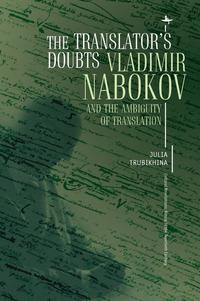
The Translator’s Doubts. Vladimir Nabokov and the Ambiguity of Translation
Покупка
Издательство:
Academic Studies Press
Автор:
Trubikhina Julia
Год издания: 2015
Кол-во страниц: 253
Дополнительно
Вид издания:
Монография
Уровень образования:
Дополнительное профессиональное образование
ISBN: 978-1-61811-261-3
Артикул: 694001.02.99
Доступ онлайн
1 800 ₽
В корзину
Using Vladimir Nabokov as its "case study,” this volume approaches translation as a crucial avenue into literary history and theory, philosophy and interpretation. The book attempts to bring together issues in translation and the shift in Nabokov studies from its earlier emphasis on the "metaliterary” to the more recent "metaphysical” approach. Addressing specific texts (both literary and cinematic), the book investigates Nabokov’s deeply ambivalent relationship to translation as a hermeneutic oscillation on his part between the relative stability of meaning, which expresses itself philosophically as a faith in the beyond, and deep metaphysical uncertainty. While Nabokov’s practice of translation changes profoundly over the course of his career, his adherence to the Romantic notion of a "true” but ultimately elusive metaphysical language remained paradoxically constant.
Тематика:
ББК:
УДК:
ОКСО:
- ВО - Бакалавриат
- 45.03.01: Филология
- ВО - Специалитет
- 45.05.01: Перевод и переводоведение
ГРНТИ:
Скопировать запись
Фрагмент текстового слоя документа размещен для индексирующих роботов
THE TRANSLATOR’S
DOUBTS VLADIMIR
NABOKOV
AND THE AMBIGUITY
OF TRANSLATION
Cultur al Re volutions: Russia in the 20th Century
Series Editor
Boris Wolfson—Amherst College
Editorial Board:
Anthony Anemone—The New School
Robert Bird—The University Of Chicago
Eliot Borenstein—New York University
Angela Brintlinger—The Ohio State University
Karen Evans-Romaine—Ohio University
Jochen Hellbeck—Rutgers University
Lilya Kaganovsky—University Of Illinois, Urbana-Champaign
Christina Kiaer—Northwestern University
Alaina Lemon—University Of Michigan
Simon Morrison—Princeton University
Eric Naiman—University Of California, Berkeley
Joan Neuberger—University Of Texas, Austin
Ludmila Parts—Mcgill University
Ethan Pollock—Brown University
Cathy Popkin—Columbia University
Stephanie Sandler—Harvard University
THE TRANSLATOR’S
DOUBTS VLADIMIR
NABOKOV
JULIA
TRUBIKHINA
AND THE AMBIGUITY
OF TRANSLATION
B O STO N
2 0 1 5
Library of Congress Cataloging-in-Publication Data:
A bibliographic record for this title is available from the Library
of Congress.
Copyright © 2015 Academic Studies Press
All rights reserved
ISBN 978-1-61811-260-6 (hardback)
ISBN 978-1-61811-261-3 (electronic)
Book design by Ivan Grave
Published by Academic Studies Press in 2015
28 Montfern Avenue
Brighton, MA 02135, USA
press@academicstudiespress.com
www.academicstudiespress.com
For my grandmother,


Valeria Kunina,
who—by her life worthy of a Soviet “Scarlett O’Hara” rather than
any scholarly word she actually wrote—taught me a thing or
two about what matters in art: perseverance, allegiance to ironic
rationality, intolerance to cruelty, and the higher sense of loyalty
that, if we are to believe Ezra Pound, “is hard to explain.”
 T a b l e  o f  C o n t e n t s
Acknowledgments
8
9
Chapter 1
38
Nabokov’s Beginnings: “Ania” in Wonderland or
“Does Asparagus Grow in a Pile of Manure?”
Chapter 2
86
The Novel on Translation and “über-Translation”:
Nabokov’s Pale Fire and Eugene Onegin
Chapter 3
141
“Cinemizing” as Translation:
Nabokov’s Screenplay of Lolita and Stanley Kubrick’s
and Adrian Lyne’s Cinematic Versions
Conclusion
206
Vladimir Nabokov within the Russian and Western
Traditions of Translation
Selected Bibliography
226
Index
240
 A c k n o w l e d g m e n t s
This book grew out of my doctoral dissertation. It would not
have been possible without my friend and dissertation adviser,
Richard Sieburth. Due to Richard and in the spirit of Walter
Benjamin’s understanding of the Translator’s task, I was able to
maintain this project with stoicism as a “chiasmus of hope and
catastrophe.”  He had a wonderful vision of the whole while the
project was in its disjointed parts. His enormous erudition and
insightful suggestions were invaluable to me.
I am grateful to my colleague and friend Elizabeth Beaujour,
who knew the project at its dissertation stage and at various
points read and commented on its different parts. I feel
enormous gratitude to the colleagues and friends who, along
with Elizabeth, long ago were part of my dissertation committee:
Eliot Borenstein and Mikhail Iampolski, thank you!
I am tremendously fortunate to work alongside terrific
colleagues in the Russian Division of Hunter College,
CUNY, and benefit every day from their knowledge, sense of
companionship, and our shared love for Russian literature and
culture.
I am grateful to my daughter Anya for being my anchor and
unrelenting judge in all matters extraliterary. I want to thank
my mother, Natalia Kunina, for enabling me to make my own
“translation” in space and culture, to come to graduate school at
New York University and, ultimately, to undertake this project.
In her usual quiet way, she gave me the most valuable thing one
can get from a parent—a strong sense of self.
Finally, everlasting thanks to my husband, Dennis Slavin, for
being—in translation terms—both loyal and faithful, and for his
selfless help and support throughout my work on this book.
On Translating Eugene Onegin
I.
What’s translation? On a platter
A poet’s pale and glaring head,
A parrot’s screech, a monkey’s chatter,
And profanation of the dead.
The parasites you were so hard on
Are pardoned if I have your pardon,
O, Pushkin, for my stratagem:
I traveled down your secret stem,
And reached the root, and fed upon it;
Then in a language newly learned,
I grew another stalk and turned
Your stanza, patterned on a sonnet,
Into my honest roadside prose—
All thorn, but cousin to your rose.
II.
Reflected words can only shiver
Like elongated lights that twist
In the black mirror of a river
Between the city and the mist.
Elusive Pushkin! Persevering,
I still pick up Tatiana’s earring,
Still travel with your sullen rake.
I find another man’s mistake,
I analyze alliterations
That grace your feats and haunt the great
Fourth stanza of your Canto Eight.
This is my task—a poet’s patience
And scholiastic passion blent:
Dove-droppings on your monument.
Vladimir Nabokov (1955)2
Похожие Показать весь список
Доступ онлайн
1 800 ₽
В корзину