
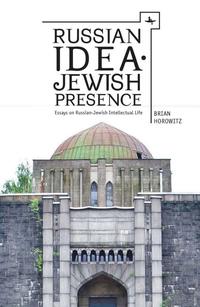
Russian Idea — Jewish Presence: Essays on Russian-Jewish Intellectual Life
Покупка
Тематика:
Обществознание
Издательство:
Academic Studies Press
Автор:
Горовиц Брайан
Год издания: 2013
Кол-во страниц: 311
Дополнительно
Вид издания:
Монография
Уровень образования:
Дополнительное профессиональное образование
ISBN: 978-1-61811-052-7
Артикул: 693899.02.99
Доступ онлайн
1 800 ₽
В корзину
In Russian Idea — Jewish Presence, Professor Brian Horowitz follows the career tracks of Jewish intellectuals who, having fallen in love with Russian culture, were unceremoniously repulsed. Horowitz relays the paradoxes of a synthetic Jewish and Russian self-consciousness in order to correct critics who have always considered Russians and Jews as polar opposites, enemies, and incompatible. In fact, the best Russian-Jewish intellectuals — Semyon Dubnov, Maxim Vinaver, Mikhail Gershenzon, and a number of Zionist writers and thinkers—were actually inspired by Russian culture and attempted to develop a sui generis Jewish creativity in three languages on Russian soil.
Скопировать запись
Фрагмент текстового слоя документа размещен для индексирующих роботов
Russian
Idea•
Jewish
Presence
Essays on Russian-Jewish Intellectual Life
BRIAN HOROWITZ
Boston  2013
Russian
idea•
Jewish
PResence
Library of Congress Cataloging-in-Publication Data:
A catalog reference for this title is available from the Library of Congress.
ISBN 978‐1‐936235‐61‐2 (hardback)
ISBN 978-1-618110-52-7 (electronic)
Copyright © 2013 Academic Studies Press
All rights reserved
Cover design by Ivan Grave
Book design by Adell Medovoy
On the cover:
Synagogue at Preobrazhenskoe Jewish Cemetery.
Photograph by William Brumfield.
Published by Academic Studies Press in 2013
28 Montfern Avenue
Brighton, MA 02135, USA
press@academicstudiespress.com
www.academicstudiespress.com
To Benjamin, Rebecca, and Sophia, whom I love.
Contents


Introduction                                                            13


I. Varieties of Russian-Jewish History: Liberals, Zionists, and Diaspora Nationalists                                 16

1.  The Russian Roots of Semyon Dubnov’s Life and Works                 18
2.  Maxim Vinaver and the First Russian State Duma                      37
3.  What is “Russian” in Russian Zionism?: Synthetic Zionism and the Fate of Avram Idel’son                                                  54
4.  An Innovative Agent of an Alternative Jewish Politics: The Odessa
    Branch of the Society for the Promotion of Enlightenment among the Jews of Russia                                                  72
5.  Politics and National Self-Projection: The Image of Jewish Masses in
    Russian-Jewish Historiography, 1860-1914                            87
6.  “Both Crisis and Continuity”: A Reinterpretation of Late-Tsarist Russian Jewry                                                           105
7.  Crystallizing Memory: Russian-Jewish Intelligentsia Abroad and Forms of Self-Projection                                                124


II. M. O. Gershenzon and the Intellectual Life of
    Russia’s Silver Age                                                 139

8.  M. O. Gershenzon — Metaphysical Historian of Russia’s Silver Age: Part 1                                                                  141
9.  M. O. Gershenzon — Metaphysical Historian of Russia’s Silver Age: Part 2                                                                  171
10.  “...Th Break Free of Centuries-Old Complications, of the Abominable
    Fetters of Social and Abstract Ideas”: M. O. Gershenzon’s Side in the
    Correspondence Across a Room                                        198
11.  Unity and Disunity in Landmarks (Vekhi): The Rivalry between Pyotr
    Struve and Mikhail Gershenzon                                       213
12.  M. O. Gershenzon and Georges Florovsky: Metaphysical Philosophers of Russian History                                         229
13.  From the Annals of the Literary Life of Russia’s Silver Age: The
    Tempestuous Relationship of S. A. Vengerov and M. O. Gershenzon 239
14.  M. O. Gershenzon, the Intellectual Circle, and the Perception of
    Leader in Russia’s Silver-Age Culture                                   258

Bibliography                                                                275

Appendix A:  Jewish Monuments in Russia at the Turn of the 20th Century     288

Appendix B:  Rare Photographs of Gershenzon and his Family                  294

Index                                                                       301


— 8 —
List of Illustrations
1. 	 St. Petersburg Choral Synagogue (Photograph by William Brumfield)
2. 	 The exhibit of the Society for the Promotion of Enlightenment at the
1893 Fair in Novgorod (reproduced courtesy of Michael Beizer)
3. 	 The lawyer and activist, Maxim Vinaver (reproduced courtesy of
the Jewish Studies Department of the European University in St.
Petersburg).
4. 	 Medal coin from the Society for the Promotion of Enlightenment
(reproduced courtesy of Michael Beizer)
5. 	 Jewish Arc in front of the St. Petersburg Choral Synagogue
(Photograph by William Brumfield)
6. 	 The historian and writer, Semyon Dubnov (reproduced courtesy of
the Jewish Studies Department of the European University in St.
Petersburg)
7. 	 The civic activist and writer, Mikhail (Menashe) Morgulis
(reproduced courtesy of the Jewish Studies Department of the
European University in St. Petersburg)
8. 	 Mikhail Osipovich Gershenzon (reproduced courtesy of Mikhail
Chegodaev)
9. 	 Mikhail Osipovich Gershenzon and family (reproduced courtesy of
Mikhail Chegodaev)
10. 	Mikhail Osipovich Gershenzon (reproduced courtesy of Mikhail
Chegodaev)
18
36
53
71
86
104
123
Acknowledgements
I would like to thank the following individuals who gave me advice to
improve the book: Shaul Stampfer, Jeffrey Veidlinger, Maxim Shrayer,
Hugh McLean, Ezra Mendelsohn, Edith Frankel, Antony Polonsky,
Samuel Ramer, Oleg Budnitsky, Shai Ginsburg, Vladimir Lukin, Scott
Ury, Dragan Kundzic, Shulamit Magnus, Kathryn Shield, Zvi Gitelman,
Deborah Dash-Moore, Marat Grinberg, Shaul Stampfer, Viktor Kel’ner,
Bettina Kaibach, Urs Heftrich, Vladimir Levin, Edward Kasinec, Robert
H. Davis, Taro Tsurumi, Heinz Dietrich-Loewe, Joachim von Puttkamer,
Włodzimierz Borodziej, Irina Paperno. I must also mention my friend
and colleague, Seth Appelbaum, who gave me much help with notes
and bibliography. I also need to acknowledge my mentor, colleague, and
friend, William Craft Brumfield. Needless to say, any mistakes in the
book are mine alone.
I would also like to acknowledge those institutions that have given
me direct aid. The Dean’s Office of Liberal Arts at Tulane University,
The Jean and Samuel Frankel Center for Advanced Judaic Studies at the
University of Michigan, The Imre Kértesz Kolleg at the University of
Jena, The Alexander Von Humboldt Foundation, Yad Hanadiv Foundation, the Posen Foundation USA.
Essay 1 appeared in Hebrew in Zion 3 (2012): 341–358.
Essay 2 appeared in German in Von Duma zu Duma. Hundert Jahre
Russischer Parlamentarismus. Ed. Dittmar Dahlmann and Pascal Trees
(Bonn: Bonn University Press, 2008), 115-131.
Essay 4 appeared in Place, Identity and Urban Culture: Odessa and New
Orleans, Occasional Papers of the Kennan Institute. Ed. Blair Ruble and
Samuel Ramer (Washington DC: Woodrow Wilson International Center
for Scholars, 2008), 9-18.
Essay 5 appeared in The Jews of Eastern Europe: Studies in Jewish
Civilization. Ed. L. Greenspoon, R.A. Simkins, and B. Horowitz (Omaha:
Creighton University Press, 2005): 168-189.
Essay 6 appeared in Russian in Vestnik Evreiskogo Universiteta 11, no.
29 (2006): 89-112.
Похожие Показать весь список
Доступ онлайн
1 800 ₽
В корзину