
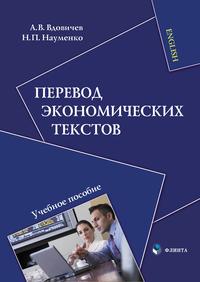
Перевод экономических текстов
Покупка
Тематика:
Английский язык
Издательство:
ФЛИНТА
Год издания: 2025
Кол-во страниц: 227
Дополнительно
Вид издания:
Учебное пособие
Уровень образования:
ВО - Специалитет
ISBN: 978-5-9765-1338-9
Артикул: 618174.03.99
Доступ онлайн
325 ₽
В корзину
Целью настоящего издания является формирование знаний, умений и навыков, необходимых для выполнения перевода текстов официально-деловой и экономической тематики с английского языка на русский и с русского языка на английский через усвоение терминологии и жанровых особенностей делового дискурса.
Для студентов, специализирующихся в сфере официально-делового перевода, также может использоваться как основное или дополнительное пособие по английскому языку для студентов экономических специальностей.
Скопировать запись
Фрагмент текстового слоя документа размещен для индексирующих роботов
ауме нко
ПереВод
экоНомических
текстоВ
Учебное пособие
4-е издание, стереотипное
Москва
Издательство «ФЛИНТА»
2025
УДК 811.111+33(075.8)
ББК 81.432.1+65я73
В25
Вдовичев А.В.
   Перевод экономических текстов : учеб. пособие /
А.В. Вдовичев, Н.П. Науменко. — 5-е изд., стер. — Москва :
ФЛИНТА, 2025. — 227 с. — ISBN 978-5-9765-1338-9. — Текст :
электронный.
Целью настоящего издания является формирование знаний,
умений и навыков, необходимых для выполнения перевода
текстов официально-деловой и экономической тематики с
английского языка на русский и с русского языка на английский
через усвоение терминологии и жанровых особенностей
делового дискурса.
Для студентов, специализирующихся в сфере официальноделового перевода, также может использоваться как основное
или дополнительное пособие по английскому языку для
студентов экономических специальностей.
УДК 811.111+33(075.8)
ББК 81.432.1+65я73
линта
В25  Науменко Н.П., Вдовичев А.В., 2017
©  Науменко Н.П., Вдовичев А.В., 2018
© Издательство «ФЛИНТА», 2018
Contents
Предисловие .................................................................................................4
Unit I. Economics and Its Concepts ...........................................................6
Unit II . Business and Its Forms of Organization .....................................26
Unit III. Banks and Banking System .......................................................46
Unit IV. Accounting and Reporting ..........................................................80
Unit V. Capital and Finance .................................................................... 111
Unit VI. Management. Marketing ..........................................................142
Unit VII. Economic Globalization .........................................................162
Appendix 1. Incoterms ...................................................................................186
Appendix 2. Major Job Titles in Business ......................................................190
Appendix 3. World’s Major Currencies ..........................................................193
Appendix 4. Major Abbreviations and Acronyms in Economics
and Finance .............................................................................................206
Literature ......................................................................................................226
ПРЕДИСЛОВИЕ
Учебное пособие состоит из семи разделов и четырех приложений, а каждый раздел  — из двух частей. Первая часть
предназначена для формирования навыков и умений перевода
официально-деловых текстов с английского языка на русский, а
вторая — с русского на английский. Тематически деловой контекст семи разделов представлен следующими основными предметными областями: экономика как научная дисциплина, коммерческая деятельность и юридические формы ее организации,
финансы и финансовые рынки, банки и банковское дело, бухгалтерский учет, менеджмент и маркетинг, экономическая глобализация.
В каждом разделе даются терминологические списки и три
текста по каждой из указанных тем для изучения контекста с
целью последующего перевода. Текстам предшествуют задания на предпереводческий анализ их структурной, лексической
и фразеологической систем. Актуализация терминологии осуществляется на базе подстановочных и трансформационных
упражнений.
Навыки реферативного перевода, перевода с листа и, в конечном итоге, полного письменного перевода формируются также
на базе поиска различных типов информации, анализа переводческих соответствий и трансформационных процедур, используемых переводчиком для преобразования исходного текста в текст
перевода с учетом требований адекватности перевода.
Тексты для перевода, отобранные из ведущих англоязычных
и русскоязычных изданий в области финансов, банковской и хозяйственной деятельности, маркетинга и менеджмента, являясь
логическим продолжением лекционного и семинарского курсов
основ экономических знаний, обеспечивают фоновые знания будущих переводчиков, специализирующихся в деловой коммуникации, стимулируют развитие у студентов умения пользоваться
специализированными словарями и справочниками.
Все тексты разной степени сложности и могут использоваться как для аудиторной работы под руководством преподавателя,
так и для самостоятельной.
Приложения включают перечни мировых валют, таможенных
терминов и сокращений, общепринятых в коммерческой деятельности.
Unit I
Economics and its Concepts
Part I. Translation from English into Russian
1. Give Russian equivalents of the following terms.
	1.	 aggregate demand
26.	labor
	2.	 aggregate supply
27.	land
	3.	 allocate
28.	macroeconomics
	4.	 alternative use
29.	means of production
	5.	 bias
30.	merge
	6.	 capital
31.	mesoeconomics
	7.	 consumer
32.	microeconomics
	8.	 consumer goods
33.	national economy
	9.	 consumption
34.	natural resources
	10.	demand
35.	normative economics
	11.	economic security
36.	opportunity cost
	12.	economics
37.	per capita
	13.	economy
38.	positive economics
	14.	entrepreneurship
39.	production
	15.	factors of production
40.	scarcity
	16.	free goods
41.	standard of living
	17.	GDP
42.	supermacroeconomics
	18.	gross exports
43.	supply
	19.	gross imports
44.	tangible goods
	20.	goods
45.	to bear losses
	21.	government spending
46.	to curtail
	22.	household
47.	to reap profits
	23.	human needs
48.	total production
	24.	inflation
49.	unemployment
	25.	intangible goods
50.	want (n.)
2. Read texts 1-4.
3. Study the following, paying attention to the terms and their contextual use:
a) what economics is;
b) what positive economics means;
c) what normative economics means;
d) how to define main concepts and components of economics as
a science.
4. Pick out the idiomatic expressions and give their Russian equivalents.
5. Pick out the abbreviations from the texts below and give their Russian equivalents.
Text 1
Economics as an Academic Discipline
Any science starts with a definition. We must take the definition
apart before it can be put together in a meaningful way. The definition
will be developed into a clear description of the science of economics.
Every time you come to a new text or exercise in this Part of Unit I,
look back to the definition to see where and why the new material fits
into the definition.
Economics is a social science that studies how society chooses to
allocate its scarce resources, which have alternative uses, to provide
goods and services for present and future consumption.
The definition starts “Economics is” and that is what is being defined. So the remaining words need to be understood to make sense of
the notion “economics”. Let us start with goods and services.
Goods and Services
What exactly are goods and services? Goods are anything that satisfies a want. That is the purpose of production — to provide goods
that satisfy wants. So goods are produced, and the consumption of
those goods satisfies wants. Goods can be tangible or intangible.
Tangible goods are physical items, such as bulldozers or pizzas.
Intangible goods, such as medical care or education are called
services. Both goods and services satisfy wants and therefore can
be called goods.
Resources
The satisfaction of wants can only be accomplished by using up
resources, the inputs, the so-called factors of production or means of
production. These resources can be classified as land, labor, capital,
and entrepreneurship.
Land is land itself and anything that grows on it or can be taken
from it are the “natural resources”. Imagine producing anything from
a pizza to a medical doctor without the use of land somewhere along
the productive process. Labor, another resource, is a human effort,
both physical and mental.
The resource capital is also known as capital goods. An economist's use of capital is not a reference to money but to a resource.
Capital is a man-made tool of production; it is goods that have been
produced for use in the production of other goods. Goods are produced for one of two purposes. Goods may be consumer goods used for
the satisfaction of wants, which is the ultimate purpose of production.
Or goods may be capital goods produced not for consumption but for
use in producing more goods, either consumer or capital. So capital
goods, such as a mechanic's wrench or a school building, are resources
that have been produced and that will combine with other resources,
such as land and labor, to produce more output.
Some goods may be consumer goods in one use and capital goods
in another use. For example, consider a personal computer. When the
computer is used to play solitaire, it is consumer goods. On the other
hand, when it is used as a word processor to write a textbook, it is
capital goods. To tell whether goods are consumer goods or capital
goods, ask yourself a question: are the goods going to be consumed
directly or will they be used to produce more goods? If they are to be
consumed directly and purchased by consumers, they are consumer
goods; if they are to be used to produce other goods and purchased by
business, they are a capital goods.
Entrepreneurship is again human effort. Entrepreneurs are the risk
takers. They are more than managers, although they use managerial
ability. Entrepreneurs reap the profits or bear the losses of their undertakings. Entrepreneurship is the organizational force that combines the other factors of production — land, labor, and capital — and
transforms them into the desired output. The output may be capital
or consumer goods, but ultimately consumer goods are produced to
satisfy wants.
Scarcity
Resources are scarce. Scarcity is a relationship between how much
there is of something and how much of it is wanted. Resources are
scarce compared to all of the uses we have for them. If we want to
use more than there is of an item, it is scarce. Note that this meaning
is different from the usual meaning of scarce, which is “rarely found
in nature.” How are they different? Consider this example. Is water
scarce? How could anyone argue that water is scarce in the usual
sense? Water covers nearly two-thirds of the earth's surface. Yet an
economist would say that water is scarce. Why? The reason is that
there are so many competing uses for water that more water is wanted
than is available. If you find this hard to believe, ask farmers and ranchers in the West, where water rights are jealously guarded. As soon
as someone is willing to pay for a goods, or a resources, it is scarce by
the economist's definition.
Consider scarcity from another point of view. What if scarcity
did not exist? Then all goods would be free goods. Free goods would
mean that you could have all you want of everything without having
to give up something else you also want. Can you think of goods that
are not scarce? There may be some. Take air, for example. Isn't it free?
What do you have to give up to get air? In some locations, it probably
is free. But in other locations it is not, especially if air means clean
air. You could make a fortune if you could find a way to provide clean
air on a smoggy day in Los Angeles. People pay to avoid smog: they
don't go out when the smog is bad, they car pool and so on. So even
air may not be free. In fact, it is hard to think of goods or resources
that are free.
The production of goods to satisfy a want will reduce the amount
of available resources. Resources are limited. There is only so much
land, labor, capital, and entrepreneurship in existence at any point
of time. Resources are therefore scarce because there is not enough
of them to go around to produce all the things that we would like to
produce to satisfy all our wants. Hence goods are scarce, too. Scarce
resources yield scarce goods.
On the one hand, resources are limited, but on the other hand, human wants are unlimited. Wants are unlimited or nearly so. How can
that be? Everyone has wants, and if the truth were known, each individual has nearly unlimited wants. Examine my wish list. It certainly includes more goods and services than I have right now. I would
like to live in some exciting places. Paris would be acceptable, but
not all the time. I would also like a home in Hawaii or on Monterey
peninsula. And of course a place in the Alps for skiing. And because
these places are far away from each other, and I do not want to depend
on commercial airlines, a private jet would be nice. And probably a
Rolls-Royce or a Mercedes for the family and a Ferrari or Porsche for
me. Also, I would not want to spend all my time cleaning house or
cooking, so each home would need a complete staff. The list is fairly
long already, and I haven't gotten to my special passion — hats! You
can easily see that if each member of society made up a wish list, the
wants of all people added up would be enormous. Nearly unlimited.
The point is that wants exceed what can be produced from our limited
resources.
Unlimited wants alone are not a problem, but certainly a problem
exists when unlimited wants are combined with limited means of
satisfying those wants. The production of any goods on our wish list
Похожие Показать весь список
Доступ онлайн
325 ₽
В корзину